
This monthly report is prepared for Sinocism by the excellent Sinification, an invaluable resource for understanding how domestic and international affairs are debated within the Chinese establishment. — Bill
As ever, the US constitutes the main focus of China’s foreign-policy discourse in June. Yet there is a growing sense that, at least in the short term, America may no longer be Beijing’s principal source of strategic anxiety.
Today’s US–China section is still processing Trump’s May comments on Taiwan, widely read as favourable to Beijing, but interpreted in different ways: for Huang Jing, they mark the most significant shift in Washington’s Taiwan position since 1979; for Da Wei, they are better understood as tactical language rather than a fundamental change in US policy.
The Middle East section is overwhelmingly focused on the US–Iran memorandum of understanding signed on 17 June. The agreement is treated with caution, but broadly read less as a US victory than as evidence of, in Chen Qinghong’s words, “an empire’s twilight—fierce of face, feeble within”.
Meanwhile, Europe emerges as the more immediate economic-strategic worry. Concern over trade tensions continues, with one analyst noting that Europe’s China debate increasingly resembles Washington’s of a decade ago and warning that a tipping point into strategic competition may be approaching. Huang Yiping’s piece is deeply concerned about a trade war and, unusually for a Chinese scholar, sympathetic to European fears of a “China Shock 2.0”.
The domestic economy, covered in more detail in Sinification’s upcoming economics digest, helps connect these external trade tensions to China’s internal imbalances. Shen Jianguang identifies weak domestic demand as the fault line beneath China’s “three strongs and three weaks”; Justin Lin Yifu attributes the slowdown less to domestic failings than to weak global demand; and Jiang Xiaojuan warns against an AI transition that destroys jobs faster than it creates them.
This digest also includes a new cluster, “Going Out”: four articles on China’s outbound investment, prompted by State Council Order 837, which takes effect on 1 July. This prosaic-sounding regulation is highly significant, as Liu Jia shows in an official but helpful exegesis: it elevates two decades of NDRC/MOFCOM departmental rules into law and adds teeth—under Articles 24–25, foreign entities that discriminate against Chinese investors can be blacklisted, cut off from China-related trade and investment, and denied entry, work or residence.
The more analytically engaging writing on the new wave of “Going Out” comes from Shi Zhan, Liu Xiaochun and Li Wei, who argue respectively that renminbi appreciation would accelerate the going-global wave, that state support should in special circumstances extend as far as military means, and that firms are now exporting entire capability systems rather than mere products.
Xi’s 8–9 June state visit to North Korea is the month’s other major foreign-policy event, though analysis beyond the boilerplate is thin on the ground. Two pieces engage with the nuclear silence noted by Western analysts: Lü Chao observes that Pyongyang’s constitutional enshrinement of nuclear-weapon status sits uneasily with Beijing’s position, while Niu Xiaoping argues that crisis management has become more urgent than immediate denuclearisation. Wu Xinbo’s Japan piece extends the same regional logic, describing US–China stabilisation as a “second Nixon shock” for Tokyo.
Following the Xi–Putin summit in May, Xiao Bin provides the more official reading, with one interesting admission: delimiting the relationship’s “essence and boundaries” was partly intended to send “a clear signal to the international strategic community”. Wang Jinguo and Xie Yushi offer the more heterodox account, arguing that the Ukraine war has turned Russia’s chronic demographic decline into a “demographic earthquake”, shrinking a full-spectrum great power into a narrower Eurasian one.
Turning to society and technology, writers focus on China’s domestic ills. Sun Liping argues a single pathology—over-competition—underlies everything from lying flat to industrial overcapacity. Zhang Guijin and Qian Chen show urbanisation reasserting the traditional gender order, while a pseudonymous author offers a fascinating field study of a hollowed-out central-western “small-population county”.
On AI, authors are more upbeat. Huang Ping argues the US–China G2 renders middle powers’ technological sovereignty illusory and that China should make its firms indispensable rather than dominant. Sun Haiyong, meanwhile, claims that the AI race now turns on energy: the front where US weakness meets Chinese strength.
Finally, two complementary articles on critical minerals in Southeast Asia and Central Asia are both surprisingly candid about Chinese vulnerability: Sun Zhi and Zheng Hua argue that China’s rare-earth dominance now coexists with real dependence on Southeast Asian supply, while Zhao Huirong argues that America’s de-Sinicisation push in Central Asia is unlikely to displace China but will raise costs and squeeze China’s position.
Taken together, June’s discourse is confident about relative American decline, but less complacent about the second-order problems of Chinese power: exposed firms, resistant partners, resource chokepoints, hollowed-out counties, weak domestic demand and a social model that cannot export its costs forever.
— Jacob Mardell

In Brief
Zhou Bo on Washington’s quiet downgrading of Taiwan.
Li Cheng on strategic patience over Taiwan.
Huang Jing on the biggest shift in US Taiwan policy since 1979.
Da Wei on the lack of a fundamental US policy shift on Taiwan.
Zhu Weidong on creating momentum for “de facto unification without formal unification”.
Zheng Yongnian on the US–Iran agreement as a time-out, not a settlement.
Senior CICIR experts on the US–Iran MOU as a fragile pause that favours Iran.
Liu Zhongmin on the end of unipolar US hegemony in the Middle East.
Niu Xinchun on another lost American regional war.
Yan Xuetong on how the Iran war has lowered America’s strategic standing and raised China’s.
Huang Yiping on “China Shock 2.0” as a systemic challenge to Europe’s high-welfare model.
Zhang Bin on Europe’s fragmented China debate and the over-politicisation of trade imbalances.
Sun Chenghao on Europe’s China debate approaching its own strategic-competition tipping point.
Lü Peng on Germany and China as opposite casualties of the same globalisation trap.
Shi Zhan on RMB appreciation as an accelerant of Chinese firms’ going global.
Liu Jia on China’s first outbound-investment regulation and its countermeasure “teeth”.
Liu Xiaochun on making support for going-global firms a national strategy.
Li Wei on the third phase of Chinese globalisation: exporting whole capability systems.
Lü Chao on Xi’s Pyongyang visit and a “new stage” in China–DPRK relations.
Niu Xiaoping on crisis management overtaking denuclearisation on the Korean peninsula.
Wu Xinbo on US–China stabilisation as a “second Nixon shock” for Japan.
Wang Jinguo & Xie Yushi on Russia’s “demographic earthquake” and great-power shrinkage.
Xiao Bin on the China–Russia joint statements as expectation management.
Shen Jianguang on three expanding divides in the Chinese economy.
Justin Lin Yifu on the flaws of three pessimistic takes on the Chinese economy.
Jiang Xiaojuan on AI’s unusually broad threat to educated employment.
Sun Liping on over-competition as the root of China’s social and economic pathologies.
Zhang Guijin & Qian Chen on Chinese urbanisation’s reproduction of the traditional gender order.
Bai Che on why capable county cadres become rule-breakers.
Huang Ping on an AI G2 and the illusion of middle-power technological sovereignty.
Sun Haiyong on America’s electricity bottleneck in the AI race.
Sun Zhi & Zheng Hua on China’s rare-earth dependence on Southeast Asia.
Zhao Huirong on Washington’s “de-Sinicised” Central Asian minerals push.
1. US-China & Taiwan
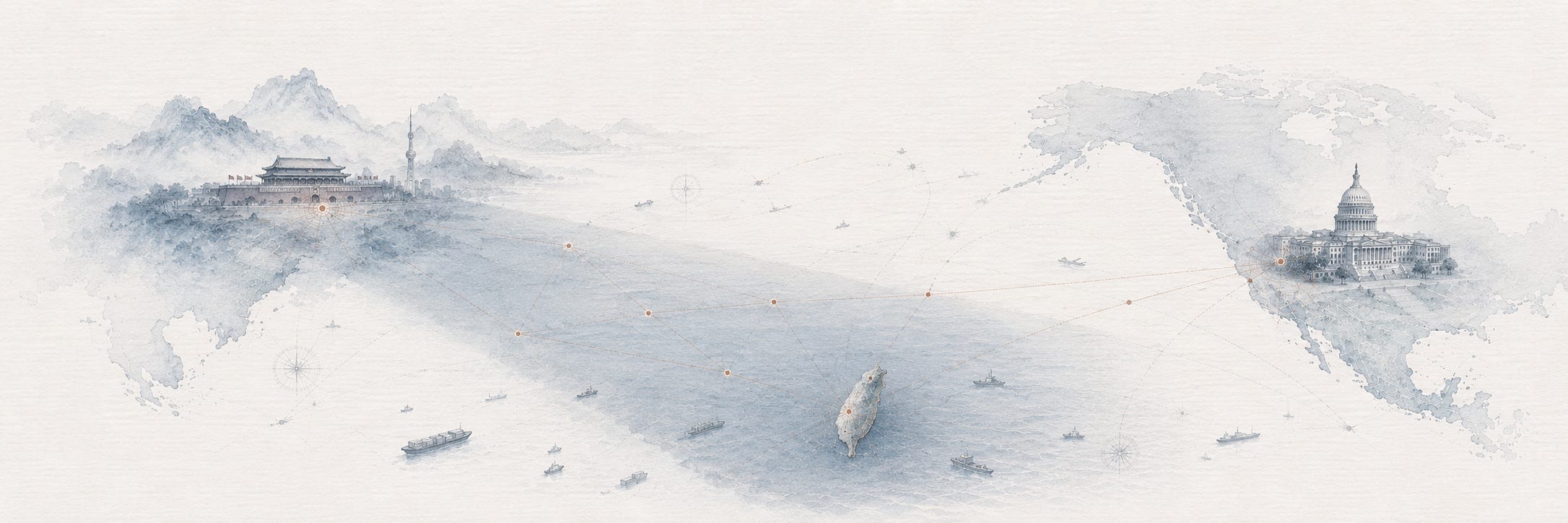
Zhou Bo (周波): The US Secretary of Defence’s omission of Taiwan at the Shangri-La Dialogue is of a piece with Trump’s deliberate playing-down of the issue during his Beijing visit—as Sino-American power converges, Beijing’s growing counter-leverage means each future arms sale to Taiwan will only come harder. More broadly, Trump’s Beijing visit, dismissed in the West as yielding little, was in fact historic: the “constructive strategically stable relationship” formula marks the first US acknowledgement of China as a power of equal, comparable standing, since strategic stability is by definition a relationship between equals. On the Strait of Hormuz, where the optimal resolution is a simultaneous, reciprocal reopening, one of the best roles China can play is to take custody of Iran’s enriched uranium—as Iran once entrusted its stock to Russia. — Senior Fellow, Centre for International Security and Strategy, Tsinghua University (观察者网, 1 June)
Li Cheng (李成): On Taiwan, time is on China’s side—Beijing should maintain strategic patience and is right not to rush into a so-called “fourth communiqué” with Washington, which would only mobilise anti-China forces. One leaders’ exchange does not change everything, but the US–China summit marked a dramatic reversal in strategic framing: from treating China as an enemy to presenting it as a friend. Trump’s thinking has been consistent since his first term—Taiwan is a pen-nib, China the desk it sits on—but America’s need for cooperation is now structural rather than merely personal to Trump. The United States faces severe domestic, financial and geopolitical difficulties; with the two powers now evenly matched [势均力敌], neither can prevail over the other and if war is avoided over the next decade, the relationship should settle into a durable pattern of competition and cooperation. — Professor and Founding Director, Centre on Contemporary China and the World, University of Hong Kong (广州粤港澳大湾区研究院, 15 June); Note: Shanghai-born, US-educated former Brookings scholar and US citizen
Huang Jing (黄靖): Trump’s statement that “Taiwan independence” means war marks the most fundamental shift in Washington’s Taiwan position since 1979, reversing the long-standing formula that a mainland “attack” on Taiwan would trigger war. The Beijing summit established US-China parity and replaced zero-sum rivalry with a “co-existing game”, underpinned by four Chinese red lines: Taiwan; “democracy and human rights”, with ideological attacks designated a forbidden zone for the first time since normalisation; China’s path and political system; and China’s right to development. Trump arrived in Beijing with no cards, yet Beijing declined to exploit his weakness. No trade agreement was signed in Beijing because Trump wants to bank the political capital at home when Xi visits the US ahead of the November midterms. — Distinguished Professor and Director, Institute of US and Pacific Studies, Shanghai International Studies University (上海全球治理与区域国别研究院, 8 June)
Da Wei (达巍): The stabilising framework established by the Trump-Xi summit has been reflected in Hegseth’s cooler tone at the Shangri-La Dialogue, especially his emphasis on military-to-military communication, but this does not signal any fundamental change in US strategy towards China or in its Taiwan policy. A few remarks by the US president do not mean policy immediately changes, and there remains a considerable distance between public comments about reconsidering arms sales and a substantive policy shift. Hegseth’s omission of Taiwan from the main speech, followed by his reiteration in the Q&A that the US position on the Taiwan Strait had not changed, reflected Trump’s lack of a final decision rather than a clear policy turn. — Director, Centre for International Security and Strategy, Tsinghua University (中评社, 1 June)
Zhu Weidong (朱衛東): The exceptional complexity and difficulty of the Taiwan issue mean that “the final resolution of the Taiwan issue will run through the entire process of national rejuvenation”, requiring Beijing to avoid both “impatience for unification” [统一急躁] and “passive waiting” [消极等待]. Reunification efforts must therefore resist both rash advance and delay, combining strategic confidence and patience with active efforts to shape the broader environment. The aim should be to create a momentum of “de facto unification without formal unification” [不统而统], recognising not only the risks and obstacles facing reunification, but also acknowledging the mainland’s growing advantages and the fact that time, momentum and legitimacy are on the mainland’s side. — Director, Institute of Taiwan Studies, Chinese Academy of Social Sciences (中评社, 10 June)
2. Middle East

Zheng Yongnian (郑永年): The US–Iran agreement is best understood as a time-out, not a settlement, and both sides needed an agreement: Washington was under international and domestic pressure, while Tehran could prolong the conflict through guerrilla tactics but had no fundamental prospect of victory. Both will claim victory because neither can afford to look defeated, but sustained implementation would make all sides better off. The Strait of Hormuz was never the prize, only leverage; the core issue remains Iran’s nuclear programme and the conflict was also a live test of AI-era warfare: Washington learnt both the uses and limits of AI-militarised force, while Tehran proved it could still resist a far stronger power. — X.Q. Deng Presidential Chair Professor and Dean, School of Public Policy, CUHK-Shenzhen (侠客岛, 22 June)
CICIR roundtable: Senior CICIR experts read the US–Iran MOU less as a US victory than as a fragile pause that largely favours Iran and leaves the next stage highly uncertain. Liao Baizhi (廖百智) says what the two sides give and receive is “almost wholly disproportionate”, as if America were “using an enormous carrot to coax Iran”. Qin Tian (秦天) says Iran led the tempo and outcome of the negotiations, and that the stabilisation of the Iranian camp marks the biggest reversal in Middle Eastern geopolitics in recent years. Chen Wenxin (陈文鑫) warns that every US concession is conditioned on Iranian “performance”, leaving Washington room to backtrack. Li Yanan (李亚男) adds that the hardest issues—the nuclear question, sanctions relief and Hormuz management—have simply been pushed into the next 60 days. Chen Qinghong (陈庆鸿) sees, on America’s 250th anniversary, “an empire’s twilight—fierce of face, feeble within” [色厉内荏]. — Directors and deputy directors, CICIR institutes of Middle East, US and World Politics studies (CICIR WeChat, 18 June)
Liu Zhongmin (刘中民): The “Islamabad Memorandum”, which for the first time recognises Iran’s regional influence through an international agreement, sends a clear signal that the era of unipolar American hegemony in the Middle East is drawing to a close. The war has left America’s Gulf alliance network in a severe crisis of trust, while Iran’s control of Hormuz marks the first substantive collapse of the postwar US maritime system in the Middle East. A new configuration composed of three centres of power—the Sunni Arab-Islamic states, the Shia camp and the Israel-led Abraham Accords states—is taking shape. The US-led Middle Eastern order is shifting from American dominance towards plural, regional autonomy, reflected in the Pakistan- and Qatar-mediated ceasefire and Iran’s proposal to coordinate management of the strait jointly with Oman. — Professor, Institute of Middle East Studies, Shanghai International Studies University (澎湃新闻, 24 June)
Niu Xinchun (牛新春): The US has lost another regional war—neither military superiority nor prolonged war can deliver final victory, and the only differences lie in the manner, timing and route of the war’s end. Iran’s blockade of Hormuz has proved an effective strategic threat against which America has no counter, leaving neither the region nor the US able to return to the pre-war status quo—Iranian primacy in the Gulf follows and the “freedom of navigation” principle upheld by the US since 1945 collapses. Trump saw “tariffs” and “war” as the two most effective and flexible instruments of foreign policy, but tariff increases have now been ruled “unconstitutional” by the US Supreme Court, while war has suffered a major reverse in Iran. The conflict may therefore prove the turning point of Trump’s tenure. — Academic Vice-President, Ningxia University; Executive Dean, China-Arab States Research Institute (世界知识, 17 June)
Yan Xuetong (阎学通): The Iran war has lowered America’s strategic standing and raised China’s: the old formula—China for the economy, America for security—is shifting, as countries begin to seek security cooperation with China too. Its aggregate impact may exceed that of the Russia–Ukraine war, intensifying the global arms race, placing greater pressure on the nuclear non-proliferation regime and raising the prospect of blockades of international waterways becoming a weapon of war. Regionally, the war is reshaping the security outlook of Middle Eastern states. It has deepened the US–Israel strategic rift and weakened regional trust in US security commitments and protective capacity, while more states explore more autonomous and diversified security paths, from Sunni military cooperation to Oman-style diplomatic balancing. Ultimately, the US and Iran have not reached a traditional armistice but an “agreement to negotiate” [同意谈判的协议], and Israel is the greatest obstacle to keeping the talks alive. — Honorary Dean, Institute of International Relations, Tsinghua University (凤凰新闻, 27 June)
3. Europe
Huang Yiping (黄益平): Europe’s fear of “China Shock 2.0” is not ordinary trade anxiety, but a systemic challenge bearing on the survival of its high-welfare model. If a broad and serious trade war or economic confrontation were to erupt between China and Europe, the shock to the global economy would be enormous. For China, the lesson is that a large economy cannot keep leaning on exports without testing its partners’ capacity to absorb them. Expanding domestic demand is therefore needed not only for China’s own rebalancing, but also to defuse external pressure. Concretely, there is still scope for China–EU cooperation: green transition, a clearer division of labour in high-end manufacturing, industrial AI and smart manufacturing, two-way opening in high-end services, and joint development of third-country markets in the Global South with individual EU states. — Boya Distinguished Professor and Dean, National School of Development, Peking University (爱思想, 13 June)
Zhang Bin (张斌): Europe’s anxiety about Chinese industrial competition is real, and not confined to a handful of protectionists, but Europe is far from monolithic. Business tends to be pragmatic, think-tank views are mixed, EU trade and investment officials are more confrontational, and Europe’s own problems—high energy costs, demography, weak investment and governance constraints—also matter. Trade imbalances have been over-politicised: structural factors such as import substitution play a role, but cyclical demand shifts may matter just as much. China should still do more to expand domestic demand, including through the exchange rate and other channels, but should frame its rise less as a “China shock” than a “China opportunity”. Its industrial ascent has lowered the manufactured-goods premium that long supported rich-country incomes, while forcing foreign firms to upgrade. — Deputy Director, Institute of World Economics and Politics, CASS (中国金融四十人论坛, 15 June)
Sun Chenghao (孙成昊): Europe’s China debate increasingly resembles Washington’s of a decade ago—the moment engagement tipped into strategic competition—but Europeans have not yet drawn America’s conclusion. Topics such as AI and digital infrastructure are increasingly treated as security questions rather than ordinary trade issues, while European anxiety has shifted from individual sectors to whole ecosystems. Greater European strategic autonomy may create more room for an independent China policy, but it will not necessarily make Europe more “pro-China”. The opening is that Europeans still talk about coexistence and practical cooperation, unlike the US debate after its own tipping point. China and Europe should therefore build working-level channels, crisis-management mechanisms and low-sensitivity cooperation in areas such as AI safety and food security. — Fellow and Head of the US–Europe Programme, Centre for International Security and Strategy (CISS), Tsinghua University (中美聚焦, 11 June)
Lü Peng (吕鹏): Germany and China sit on opposite sides of the same “Messina paradox” of globalisation: Germany is punished for being too costly—with €49-an-hour assembly labour and three-and-a-half-year approvals for a logistics centre—while China is punished for being too socially overstretched. China’s speed and cost advantage have rested on workers’ bodies and families absorbing costs that should have been socialised: long hours, weak welfare, high savings, high housing costs and little slack for consumption, fertility or innovation. The result is a cycle of razor-thin margins, weak demand and still fiercer involution. Yet although each side envies the other, neither should copy the other. China should instead enforce “time rights”—limits on working hours, paid leave and a crackdown on hidden overtime—while piloting tripartite “industry-welfare communities” in the Yangtze and Pearl River Delta clusters and rebuilding patient, relationship-based finance so industrial profits flow back into the “reproduction of people”. — Research Fellow, Institute of Sociology, CASS (FT中文网, 11 June)
4. Going Out
Shi Zhan (施展): RMB appreciation would help reduce China’s unsustainable US$1.2tn surplus and ease diplomatic friction, while lowering the cost of overseas investment and pushing Chinese firms abroad — much as yen appreciation after the Plaza Accord accelerated Japan’s outward investment. The process would carry Chinese industrial standards overseas, may seed a renminbi settlement zone, and could allow overseas RMB holders to help fund China’s social-security system through sovereign-bond purchases, creating an asset-rich “shadow China”. But the shift will mainly involve the “spillover” [溢出] of final-assembly “front-end” plants: China’s dense supply-chain “middle platform” [中台] is too embedded to relocate. Chinese firms therefore need Japanese sogo shosha-style “going-global partner” [出海合伙人] platforms that provide finance as well as logistics, and must move from taking rules abroad to helping shape them. — Professor, Institute for the Global History of Civilisations, Shanghai International Studies University (施展世界, 12 June 2026)
Liu Jia (刘佳): China’s first administrative regulation on outbound investment, in force from 1 July, writes the “holistic national security concept” into the governance of “going out” — and gives it teeth. Articles 24–25 create countermeasure mechanisms against foreign states, organisations or individuals that discriminate against Chinese investors or cut off normal transactions, including restrictions on China-related trade, investment, transactions and cooperation, and denial of entry, work, stay or residence. Article 13 closes a “human channel” of technology leakage, prohibiting transfer of export-controlled technology via seconded technicians, cross-border guidance or training. The regulation raises NDRC/MOFCOM/SAFE-led departmental rules onto a higher legal footing, keeps the filing-plus-approval framework, extends coverage in principle to Chinese resident individuals, and marks the 14th-to-15th Five-Year Plan shift from scale-and-opportunity to security-and-quality. — Research Fellow, Institute of Public Policy, South China University of Technology (IPP评论, 7 June)
Liu Xiaochun (刘晓春): Chinese firms have moved from passive respondents to active participants in global industrial restructuring—supporting their overseas expansion should now be treated as a national strategy. In certain countries and “special circumstances”, this may even require economic, financial and military means [军事等特殊手段] to protect Chinese enterprises and personnel. The current wave is historically unprecedented: thousands of firms of every size and sector are going global, across a far wider range of destinations, with entire industrial chains relocating in clusters. As these clusters expand, Chinese standards, rules and models are already spreading abroad spontaneously, though not yet in fully institutionalised form. Financial policy should adapt accordingly: unified management of cross-border RMB and foreign-exchange flows; building Shanghai into a service centre for going-global firms, covering financing, non-dollar FX trading, cross-border payments, SME treasury platforms and an “instant-response” decision-making mechanism for new demands. — Deputy Director, Shanghai Finance Institute; speech to a CF40 closed-door meeting, 12 June (CF40, 22 June)
Li Wei (李伟): Chinese firms are entering a third phase of globalisation: no longer just exporting products or building overseas channels, but exporting whole capability systems—design concepts, technical standards, supply-chain organisation, business models and long-term local operations. For firms targeting the US market, “connector countries” such as Vietnam, Indonesia, Malaysia, Thailand and Mexico are attractive first stops because they can help soften tariff and regulatory barriers. But this advantage depends on how the final market defines origin and eligibility, so firms need to turn short-term policy arbitrage into genuine local production and capability as rules-of-origin scrutiny tightens. Expansion now follows two complementary models: chain-style expansion [链式出海], in which anchor firms bring supplier ecosystems with them, and swarm-style expansion [蜂群式出海], in which SMEs use platforms, industrial belts and overseas warehouses to scale fast. — Professor of Economics and Associate Dean, Cheung Kong Graduate School of Business (FT中文网, 25 June)
5. East Asia

Lü Chao (吕超): Xi Jinping’s visit to Pyongyang marks a “new stage” in China-DPRK relations, resting not only on traditional friendship but also on shared strategic objectives: opposition to outside interference, support for multilateralism, and Pyongyang’s backing of Beijing on Taiwan, Tibet and Xinjiang. Future China-DPRK military cooperation could come to resemble China’s military cooperation with Pakistan, though closer military exchange is no alliance, is not third-party-directed, and does not breach China’s non-alignment principle. China’s denuclearisation stance remains unchanged and sanctions are a means rather than an end; yet North Korea’s constitutional enshrinement of nuclear-weapon-state status is at odds with China’s position. — Dean, Institute of American and East Asian Studies, Liaoning University; Research Fellow, Charhar Institute (察哈尔学会, from Kyunghyang Shinmun, 9 June 2026)
Niu Xiaoping (牛晓萍): On the Korean peninsula, crisis management is becoming more urgent than immediate denuclearisation. China’s formal position remains unchanged—denuclearisation through dialogue—but the practical difficulty of getting Pyongyang to give up its weapons has sharply increased. North Korea’s Ninth Party Congress made nuclear weapons the absolute core of national security and adopted a diplomacy of “interest-based pragmatism grounded in nuclear force”, seeking outside acceptance of its nuclear-state status, while South Korea’s debate over indigenous nuclear armament or nuclear sharing is also heating up. China now treats the DPRK as a key stabilising pivot on its periphery, whose strategic weight will keep rising. Pyongyang, embracing a multipolar world, is likely to pursue more active and diversified diplomacy. — Assistant Research Fellow, Institute for International Strategic and Security Studies and Centre for Northeast Asian Studies, SIIS (中评社, 10 June)
Wu Xinbo (武心波): US–China stabilisation is a “second Nixon shock” for Japan. Tokyo had bet on prolonged US–China confrontation as the route to its own military normalisation and strategic upgrading, but Washington’s move to manage rivalry instead leaves Japan strategically exposed. Full independence is blocked by three shackles — security dependence on the US, Japanese elite interests embedded in the alliance, and opposition from surrounding great powers — but full subservience is no longer viable either, because the shock has exposed the alliance’s hierarchy. Japan’s only rational course is limited autonomy within the US alliance: “security bound to America, diplomatic balancing, economic diversification”. A semi-dependent, semi-autonomous Japan cannot overturn the regional order, but it may become skilled at using—or quietly disrupting—US–China relations to regain leverage. — Professor, Shanghai International Studies University (上海国际战略问题研究会, 8 June)
6. Russia

Wang Jinguo (汪金国) & Xie Yushi (谢语诗): Russia’s war-driven demographic crisis is becoming a mechanism of great-power shrinkage. The Ukraine war has turned chronic population decline into a “demographic earthquake” [人口地震], leaving Russia “fewer, older and more unbalanced”. The strategic consequence is a Russia pushed from a full-spectrum great power towards a more selective and geographically narrower Eurasian power—still disruptive in security, energy, food and nuclear deterrence, but less able to sustain broad integration, European influence or global leadership. At home, population decline both exposes and accelerates weakening state capacity, producing “reverse modernisation” [逆现代化]: the modern tasks of identifying, managing, coordinating and redistributing across society are crowded out by coercion, extraction and ideological discipline, while social vitality, innovation and generational renewal ebb. Regionally, Russia’s Eurasian Economic Union-style dominance becomes harder to sustain as its demographic and economic pull fades, decaying from developmental integration into security-based control. — Wang: Professor, School of Politics and International Relations, Lanzhou University; Xie: PhD candidate, Lanzhou University (俄罗斯东欧中亚研究, via 时政国关分析, 18 June)
Xiao Bin (肖斌): The 2026 China–Russia joint statements are an exercise in calibrated expectation management: they delimit the partnership’s “essence and boundaries” [本质与边界]—non-alliance, non-confrontation and no third-party targeting—and send “a clear signal to the international strategic community” intended to reduce strategic misjudgement. With great-power uncertainty rising, “stable expectations” [稳定预期] have become one of the international system’s key public goods, which China–Russia ties are meant to help supply. The motives are asymmetric: for Moscow, the relationship answers immediate pressure and anchors national-system reshaping; for Beijing, deeper strategic alignment and “systemic integration” secure structural stability on its periphery. Investment co-operation remains “relatively narrow”, external risk costs are high, high-tech and SME co-operation is underdeveloped, and cross-border infrastructure cannot keep pace with trade. — Research Fellow, Institute of Russian, Eastern European and Central Asian Studies, CASS (世界知识, 20 June)
7. Economy

Shen Jianguang (沈建光): China’s economy is marked by three structural splits—strong supply but weak demand, strong external but weak domestic demand, and strong new-economy but weak old-economy sectors—reflected in the data of May’s month-on-month PMI fall, April’s near-stagnant retail sales and the sharp year-on-year contraction in fixed-asset investment. Domestic demand is the central weakness. Without stronger fiscal and monetary support, the gap may widen between successful export-oriented, high-tech manufacturing sectors and the lagging domestic economy. Even the stronger sectors are not immune: they remain exposed to external-demand shocks, depend on domestic demand to absorb capacity, and require the fiscal resources generated by a healthier broader economy. Higher transfer payments to rural residents could be especially effective, given their relatively high propensity to consume. — Vice-President and Chief Economist, JD Group (FT Chinese, 10 June)
Justin Lin Yifu (林毅夫): China’s slowdown should not be read through pessimistic claims of “state advance, private retreat” [国进民退], ageing or balance-sheet recession, since the deeper cause lies in weak global demand after 2008 rather than a domestic structural failure. Infrastructure stimulus after the financial crisis expanded the role of state firms, but also supported private producers through demand for materials, employment and consumption; ageing need not derail growth because effective labour can rise through education; and household caution reflects confidence rather than lack of savings. Policy should focus on restoring expectations and using China’s latecomer advantages, industrial upgrading space and new quality productive forces to take advantage of the fourth industrial revolution. — Dean, Institute of New Structural Economics, Peking University (观一线, 11 June).
Jiang Xiaojuan (江小涓): AI disruption differs from earlier technological shocks because it is shrinking the same categories of work across all industries at once rather than displacing workers into adjacent roles with similar skills, putting many educated young people at risk of being pushed out of regular employment. Since many displaced workers face the immediate reality of “if hands stop, mouths stop” [手停口停], social policy cannot wait for long-term adjustment: income relief, retraining and social security must be strengthened urgently. A better balance between capital expenditure and labour expenditure incentives should be established, rather than rewarding equipment purchases with tax rebates while offering no comparable incentive for hiring people. — Professor, University of Chinese Academy of Social Sciences; Chair, National Data Expert Advisory Committee (Caixin, 26 June)
8. Society & Local Governance
Sun Liping (孙立平): A single pathology—over-competition—underlies a startling range of China’s social and economic ills, from lying flat [躺平], involution [内卷] and non-marriage to industrial overcapacity. Having swung from the pre-reform absence of competition to the opposite extreme, China now treats competition as an end in itself, spread indiscriminately into domains that should resist it—public administration, basic education, healthcare, care for the elderly, public security—where doctors compete for patients and even fines become quota-contests, yielding systemic injustice and warped public services. Some managers even weaponise competition as a governance technique [治理术], cultivating a “wolf culture” of mutual trampling through ranking and last-place elimination. — Professor Emeritus, Department of Sociology, Tsinghua University (立平坐看云起, 6 June)
Zhang Guijin (张桂金) & Qian Chen (钱晨): In one Pearl River Delta city, women aged 27–40 outnumber men roughly two to one among principal hukou migrants—but this is less a story of female advancement than of the traditional gender order reasserting itself through urbanisation. The emerging pattern is “mothers migrate with the children” [母携子迁]: rural families deliberately split the household register [拆户], with mother and children taking urban hukou for school access while the father retains the rural registration, where male-skewed collective entitlements and patrilocal norms [从夫居] continue to define “home” as the husband’s village. State policy promotes gender-equal, people-centred urbanisation, but village self-governance can reassert the old order: women’s equal land rights exist in law, only to be voted away in practice. The remedy is to put women’s names on land, homestead and collective-share titles, and make marriage irrelevant to collective membership. — Zhang: Associate Research Fellow, Institute of Sociology and Population Studies, Guangdong Academy of Social Sciences; Qian: Teaching Assistant, United Front Theory Research Department, Guangdong Institute of Socialism (妇女研究论丛, Issue 2, 2026)
Bai Che (白车): In one central-western “small-population county”, capable cadres become rule-breakers because the system makes compliant action hard to square with superior-level demands. Showcase deadlines from above collide with project-compliance timelines, making irregular procedure routine, while grassroots cadres become convenient scapegoats when higher levels need a negative example. Quantified anti-corruption rankings also punish small counties for lacking the numbers to compete, and official “lying flat” spreads. Behind this is an economic hollowing: a third of residents have left since the pandemic; the county’s economy rests on 9,000 fiscally supported workers and retirees; retrenchment has choked consumption and project work, with tenders falling from over 100 last year to virtually none. E-commerce hollows out county retail, while the replacement digital-economy jobs stay in eastern industrial clusters. The unified national market accelerates this concentration, and debt-constrained local governments can no longer spend against it. — Pseudonymous field work (IPP评论, 12 June)
9. Tech & AI
Huang Ping (黄平): The AI race has settled into a US–China “G2”, leaving middle powers’ “technological sovereignty” in AI an illusion. Traditional US allies can only choose America; emerging partners are likely to do so too. Anything Chinese is treated as a potential “backdoor” [后门], and adopting it risks challenging Washington. China’s task is therefore not to make them choose China, but to stop them choosing sides: make Chinese firms indispensable across value-chain niches, not dominant. This should not be state-led or branded as an “AI globalisation initiative”. The method is market “inducement” [利诱]: high-value, localised enterprise-cluster solutions, with Beijing supplying the “certainty” [确定性] firms need abroad — policy consistency and backing, not subsidies. — Associate Professor and Assistant Dean, School of Public Policy, CUHK-Shenzhen (大湾区评论, 10 June)
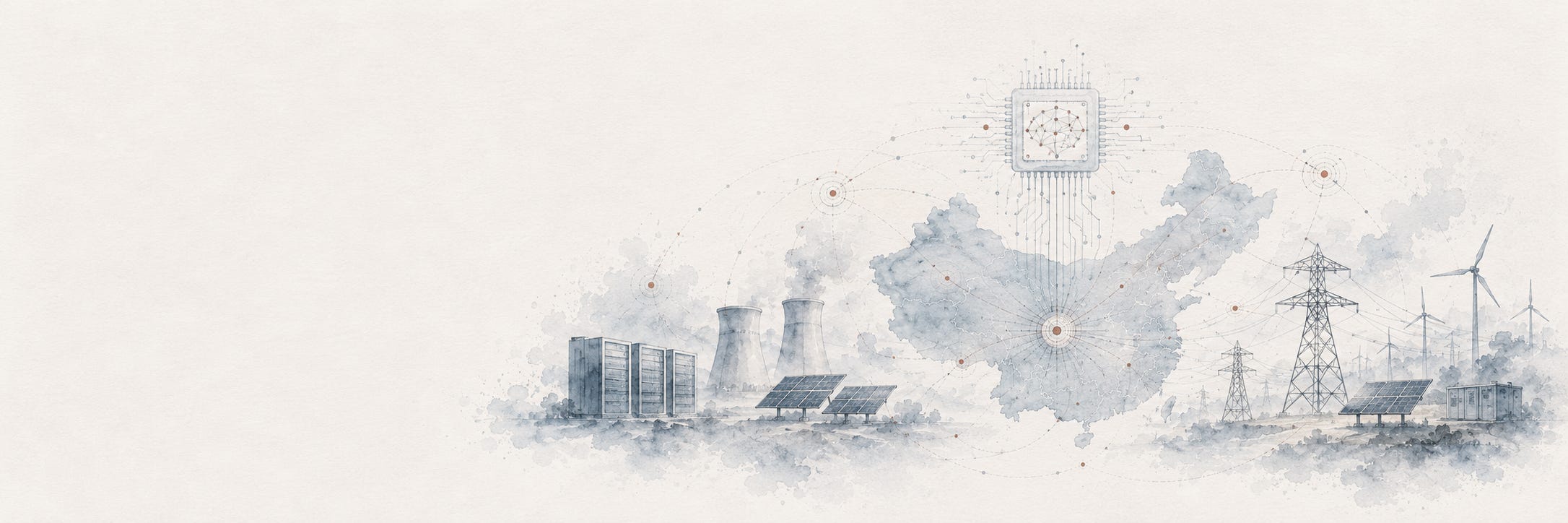
Sun Haiyong (孙海泳): American AI is running into a structural electricity bottleneck, shifting the US–China AI race from chips to energy efficiency and capacity—the arena where US weakness meets Chinese strength. US net generation rose only about 6.3% between 2005 and 2024, even as data-centre demand has surged. The Trump-era answer—more fossil fuels and nuclear power—is itself supply-chain constrained, with key components in short supply. China has roughly 60% of global transformer capacity, while the US imports about 80% of its own transformers, making tariffs on Chinese kit self-defeating. Suppressing cheap, fast-build solar and storage through FEOC rules only worsens the shortfall. As US tech firms are pushed into building “shadow grids” [影子电网], capital that might have gone into chips and R&D is diverted into energy infrastructure, while a power-starved, “circular” AI economy risks becoming a bubble. — Research Fellow, Institute for Public Policy and Innovation Studies, Shanghai Institutes for International Studies (爱思想, 24 June)
10. Critical Minerals
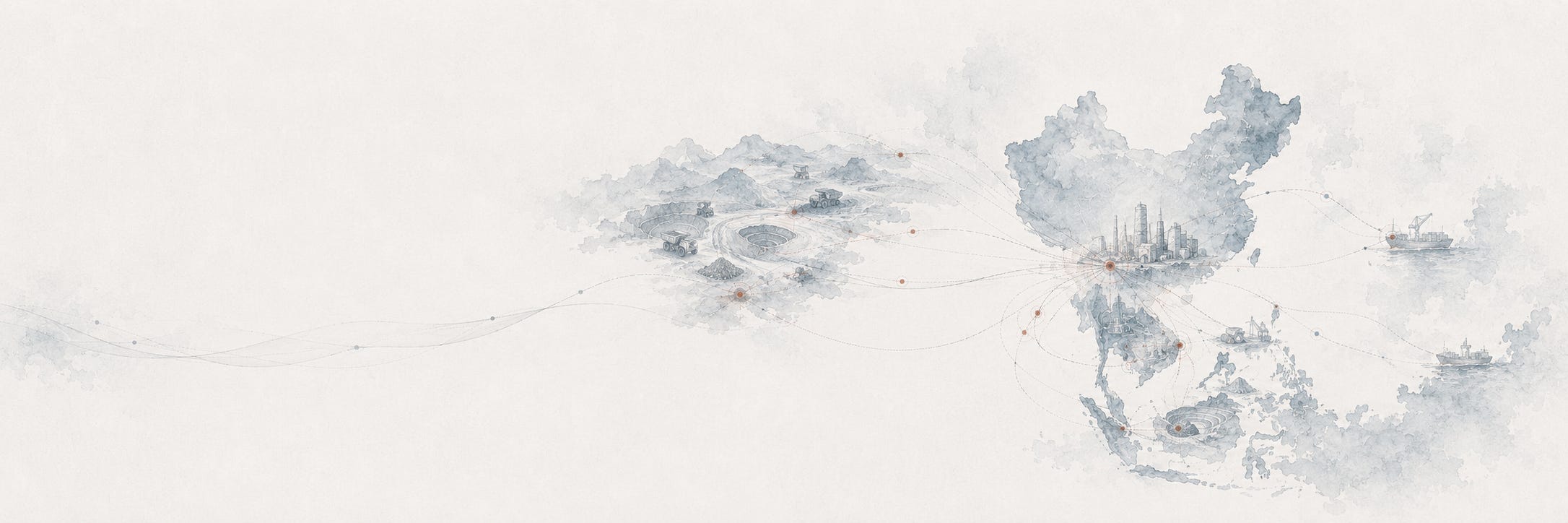
Sun Zhi (孙帜) & Zheng Hua (郑华): China’s rare-earth dominance now coexists with real dependence on Southeast Asia: Myanmar and Laos supply over 91% of China’s major rare-earth oxide imports, while China’s proven terbium reserves would struggle to meet projected global demand even if fully mined. Southeast Asian states are pursuing neither exclusionary resource nationalism nor short-term self-sufficiency, but “embedded autonomy” [嵌入式自主]: tightening resource sovereignty through raw-ore export bans and local-processing mandates while courting rival investors to climb the value chain. As “new intermediate-zone” [新中间地带] actors, they seek Chinese processing technology and Western market access at once—Malaysia agreed not to restrict rare-earth exports to the US while still seeking Chinese know-how. Beijing’s April and October 2025 export controls further raise the strategic value of the region’s heavy rare-earth supply. — Sun: Doctoral candidate, School of International and Public Affairs, Shanghai Jiao Tong University; Zheng: Professor, School of International Relations, Sun Yat-sen University (国际论坛, via 爱思想, 19 June)
Zhao Huirong (赵会荣): America’s drive to build a “de-Sinicised” (去中国化) Central Asian critical-minerals supply chain is unlikely to displace China, which imports 70% of the region’s critical minerals and holds 35% of proven resources, 68.5% of mining capacity and 80% of output—but the attempt still squeezes the PRC. Washington’s bilateral deals, C5+1 and MSP/PGII platforms target scarce minerals—sponge titanium, chromium and rhenium in trade, tungsten and lithium in investment—while pairing resource access with corridor control, including a Kyrgyz railway keyed to the China–Kyrgyzstan–Uzbekistan Makmal node. US-led ESG and technical standards raise Chinese compliance costs; the “resource control” (资源控制) narrative attacks China’s governance discourse; and C5+1 mechanisms dilute BRI convening power. — Research Fellow, Institute of Russian, Eastern European and Central Asian Studies, CASS (国际论坛 via 爱思想, 15 June)


Shao Yuqun on the Post-Summit Shift in Trump’s Taiwan Policy (24 June)
Shao Yuqun reads Trump’s post-Beijing comments on Taiwan as more than tactical ambiguity. For her, the new “constructive strategic stability” formula marks a shift in the balance of pressure: Washington still insists its Taiwan policy has not changed, but Beijing is increasingly able to tie US–China stabilisation to American restraint over Taiwan. The test is arms sales — and whether Trump’s language hardens into policy. Read here
Zheng Yongnian on Local Government Overreach and the Private Economy (22 June)
Zheng Yongnian offers a sharper-than-usual critique of how local governments distort China’s private economy. In sectors from electric vehicles to chips and AI, officials and favoured firms rush into fashionable industries, stretch limited capital and suffocate the social vitality needed for genuine entrepreneurial breakthroughs. The deeper question is whether China can retain a capable state without allowing it to smother the market and society beneath it. Read here
Huang Qifan on China’s Trade Surplus Problem (16 June)
Huang Qifan addresses China’s US$1.2 trillion goods surplus in unusually direct terms. His answer is not denial but adjustment: moderate renminbi appreciation, stronger domestic consumption and better use of imports. The piece is noteworthy because it treats the surplus not only as a foreign-relations problem, but as a symptom of China’s own growth model. Read here
The End of Easy Capital | Economic Digest: May 2026 (9 June)
May’s economics digest asks whether China’s future-industry push can escape the weaknesses of the old debt-led model. Economists worry that the “new three” industries — electric vehicles, batteries and solar — are already showing familiar signs of duplication, overcapacity and local-government overreach. Savings remain plentiful, but patient, risk-bearing capital is scarce; equity markets are still too shallow to replace bank lending, local platforms and state-backed finance. The result is a debate about whether China can build future industries without another round of misallocated capital and hidden public debt. Read here

Qin Hui on Why Condemning Trump Is Not Enough (8 June)
Qin Hui condemns Trump’s Iran strike as reckless and morally hollow, but argues condemnation is insufficient. Iran’s blockade harms Europe, Japan, Gulf states and China, so liberal and affected powers should defend freedom of navigation and public order rather than remain passive merely because Trump acted wrongly first. Read here
Strategic Stability, Structural Strain | Digest: May 2026 (2 June)
May’s digest follows Chinese analysts as they interpret Trump’s Beijing visit as the beginning of a more stable US–China phase — but not a less troubled one. Strategic parity may be replacing coercive escalation at the top, yet the pressures beneath it remain acute: Taiwan, Europe, the Middle East, domestic economic imbalance, research bottlenecks and AI competition. The new order, if there is one, is stable only in the narrow sense that neither side can easily force the other to bend. Read here
N.B. Sinification features a broad spectrum of voices, ranging from conservative hawks and state propagandists to more moderate and liberal thinkers. Readers are encouraged to bear this diversity in mind when engaging with the content.


