
The PRC has still not confirmed that Xi Jinping will travel to India for the BRICS Summit 2026 in New Delhi this weekend, but the expectation is that he will attend.
Wednesday, September 9th, is the 50th anniversary of the death of Mao.
In this issue:
August trade data
Capital boost for state financial firms
Preparations for Xi’s DC visit
AI on the Trump-Xi agenda
China and Rubio’s South America visit
The Feed: Business, Economy and Trade - Politics and Law - Foreign and Defense Affairs - Hong Kong - Taiwan - Tech and Media - Society, Arts, Sports, Culture and History - Energy, Environment, Science and Health - Rural and Agricultural Issues
Today’s top items:
1. August trade data - The PRC’s August exports rose 25% year on year to $401.44 billion, while imports increased 28.2% to $282.36 billion. The goods surplus was $119.09 billion, and has now been over $100 billion for four consecutive months. Export growth matched expectations, imports missed by 1.8 percentage points, and the surplus was almost exactly as forecast. Caixin on the numbers:
China’s exports grew a better-than-expected 25% year-on-year in August, driven by a price surge in AI-related products that masked volume declines.
Outbound shipments reached slightly over $400 billion, General Administration of Customs data showed Tuesday, with the growth beating a 23.3% average forecast in a Caixin survey. Imports rose 28.2% to $282 billion.
The trade surplus widened to $119 billion, pushing the January-August total to a record $806 billion.
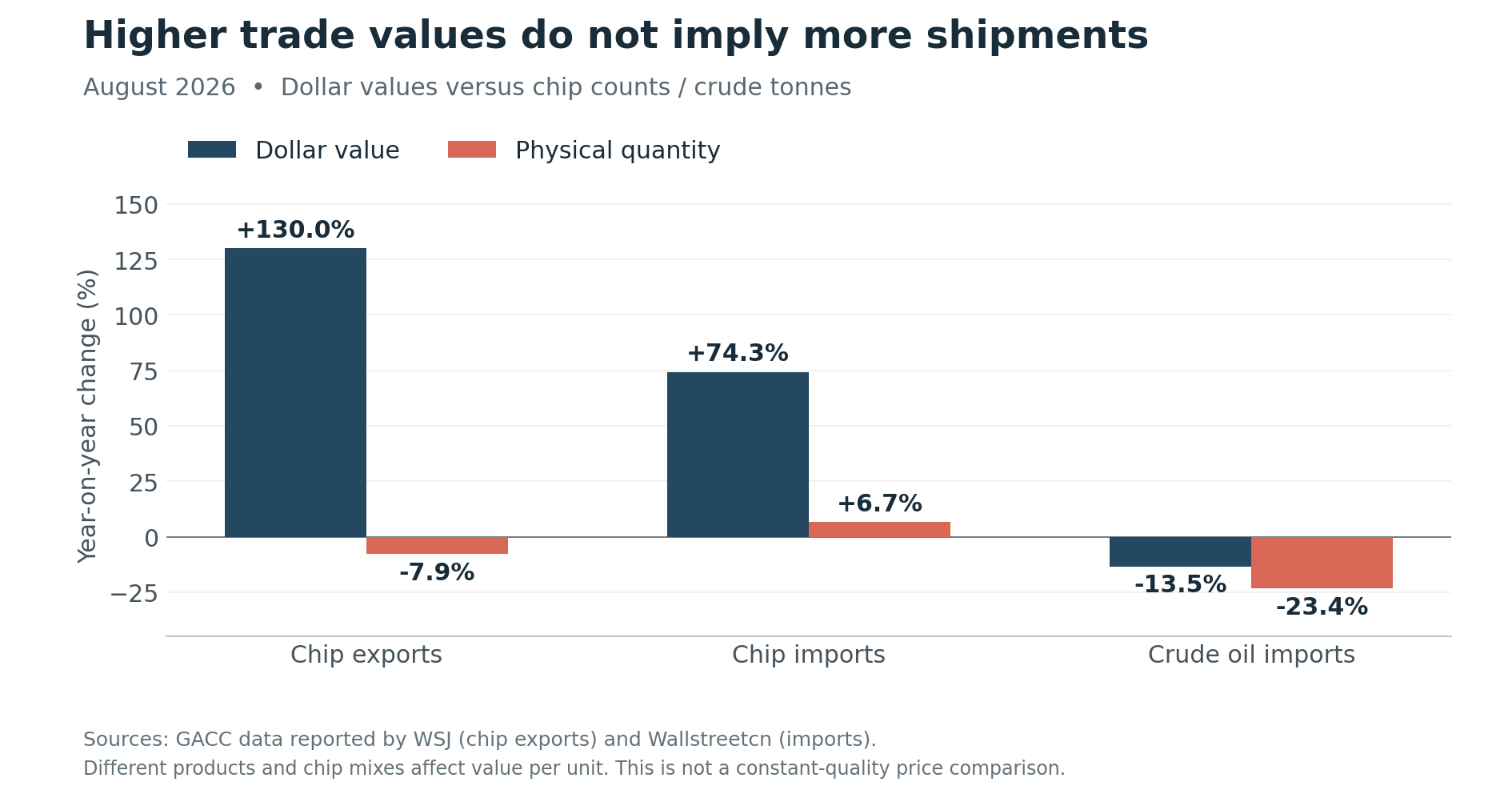
The January–August surplus was $805.51 billion and is tracking for over $1.2 trillion for 2026; that will not help tensions with major trading partners. Robust exports may give the leadership the (false?) confidence they can wait for existing domestic support measures to work.
2. Capital boost for state financial firms - The Ministry of Finance announced up to RMB360 billion in new capital for eight state banks and insurance firms on September 6. The MoF will issue 300 billion in special treasury bonds, and China National Tobacco Corp. and related companies will place 30 billion each into ICBC and ABC.
This is smaller than last year’s recapitalization, but covers a broader range of institutions. The March 2026 government work report explicitly proposed RMB300 billion in special treasury bonds for large state commercial banks, but the inclusion of insurance companies was a surprise. Commentary suggests the injections were precautionary, not because of any imminent problems, and that the money for the insurance firms may allow them to invest more into the stock market as “patient capital”.
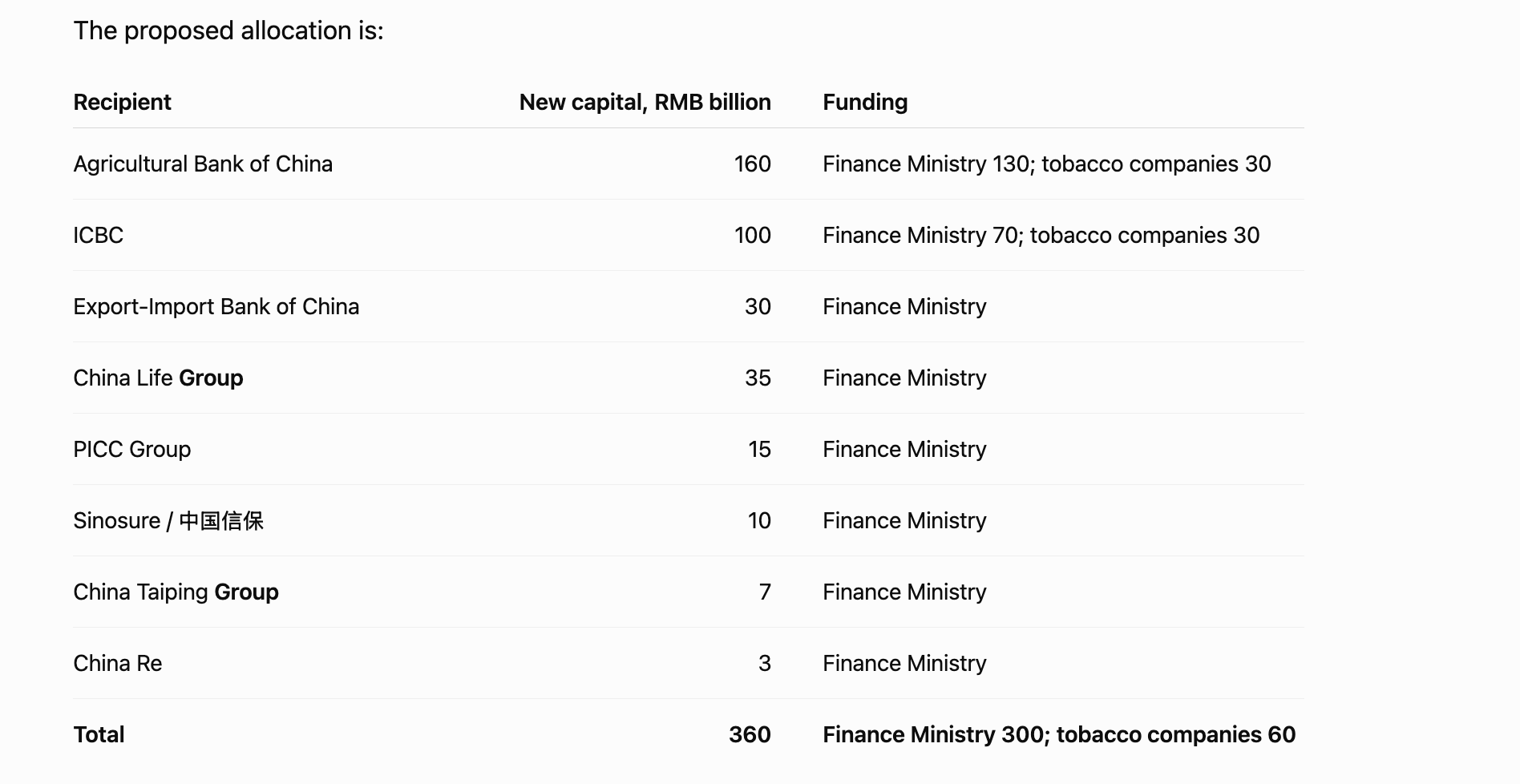
Caixin on the tier 1 capital boost:
Industry analysts told Caixin that the latest funding is largely precautionary. The banks and insurers receiving capital remain broadly well capitalized, they said, but the additional buffer could help them withstand market and external shocks, support government priorities and, in the case of insurers, expand long-term investment and potentially take a larger role in resolving problems at weaker financial institutions.
Why are China National Tobacco Corp. and related companies putting 30 billion RMB into each bank? Because they are incredibly flush with cash.
3. Preparations for Xi’s DC visit - Xi will arrive in DC in just over two weeks, and it sounds like there is a bit of a scramble to get the details worked out. Reuters reported a delegation of PRC CEOs will travel with him, but so far it is not clear what they will do here. I am hearing that the CEOs of Zhongji InnoLight and Eoptolink, makers of high-speed optical transceivers, will be in the group, perhaps as a way to forestall the rumored FCC actions to ban Chinese optical transceivers.
4. AI on the Trump-Xi agenda - Reuters reported on Friday that the US and China may hold an AI safety dialogue in mid-September. I am not sure that anything structured and authoritative in this area will happen before the Xi visit in about two weeks.
Earlier today Treasury Secretary Bessent told an event that:
“Beating China — there is no day after tomorrow if China wins at this. Like everything, a trillion-and-a-half-dollar defense budget, the Iron Dome. If they were to pull ahead of us on AI, then nothing else matters,” Bessent said.
“And the U.S. does have the lead. And when I look and I think about how we did it, it was just this incredible ecosystem, and it was organic, and it kept building on itself. It was the technology. It was the chips,” he continued.
This afternoon, the NSA, FBI and CISA released a report titled China-Based Artificial Intelligence Companies Conducting Industrial-Scale Distillation Campaigns Against U.S. AI Companies. From the executive summary:
China-based artificial intelligence (AI) companies are conducting systematic extraction of proprietary functionalities and capabilities of U.S. AI companies’ models through industrial-scale knowledge distillation campaigns that form the core—not merely a supplement—of their AI development strategy. While “distillation” is recognized as a legitimate and useful technique in AI research, China-based AI companies are engaging in aggressive, malicious, and targeted distillation activities at an industrial scale that extract restricted proprietary functionalities and capabilities of U.S. frontier AI models. The National Security Agency (NSA), Cybersecurity and Infrastructure Security Agency (CISA), and Federal Bureau of Investigation (FBI) (hereafter referred to as the authoring agencies) are releasing this joint Cybersecurity Advisory to alert organizations about these malicious activities and techniques and recommend mitigations to reduce their potential impact.
Likely with Chinese government awareness, DeepSeek, Moonshot AI, Alibaba, MiniMax, StepFun, and Z.AI extracted billions of tokens across millions of exchanges/requests from U.S. frontier AI models, including variants of Claude, GPT, Gemini, and Grok, since at least late 2024. DeepSeek has conducted organized campaigns since at least 2024 targeting reasoning capabilities, specialized optimizations, and domain-specific functions to train its R1 and V3 models. Alibaba leveraged industrial-scale distillation to improve the company’s Qwen family of AI models. Moonshot AI, MiniMax, Stepfun, and Z.AI also engaged in malicious knowledge distillation of U.S. AI companies’ models.
Between this report and Bessent’s comments earlier today, how does the Trump Administration not do more to target distillation as well as remote access to high-end AI chips?
5. China and Rubio’s South America visit - Ahead of his trip this week to Colombia, Ecuador, and Peru, US Secretary of State Marco Rubio discussed his goals on the State Department’s Substack, and he has China on his mind:
For too long, foreign state-backed extra-hemispheric actors—specifically from China—have entered our hemisphere with promises that mask their predatory practices. Their involvement too often comes in the form of opaque contracts, unsustainable debt burdens, worker exploitation, and environmental destruction. When critical national assets fall under another nation’s ownership or control, countries lose their sacred right to determine their own destiny and face grave threats to their national sovereignty, data privacy, and economic independence.
The United States offers a clear, transparent alternative. U.S. companies and business leaders invest directly in your national economy, develop your local workforce, and support the communities that surround them...
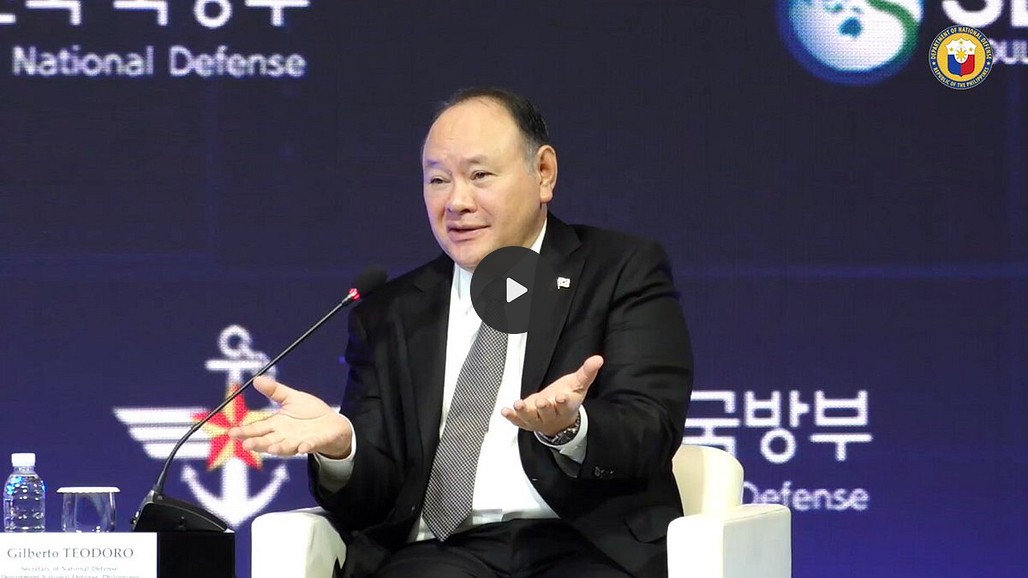
At the Seoul Defense Dialogue Tuesday, Philippine Defense Secretary Gilberto Teodoro took a question on gray-zone coercion and answered it by reading out a note the PRC side had given him, which called the 2016 South China Sea arbitral award "illegal, null and void." His rebuttal to the "null and void" line was two words: "Because you lost." He then said that delivering the note in the first place was "coercion, bullying and aggression”.
He also said:
I will keep this paper as a memento of how desperate China is, and how ineffective its position is in the face of a free audience. ... Thank you very much for the person who gave me this piece of paper. I hope you don't suffer in the gulag for it.

No wonder they have sanctioned him and his family.