
China’s Venezuela Calculations; Real Estate Market Expectations; December Politburo and Democratic Life Meetings; Museum Scandal; 2026 Propaganda Tasks
Happy New Year! I hope all of you who got some time off had a nice break. It has not been a quiet twelve days since the last newsletter, but sometimes you just have to unplug. Apologies for missing some things, and I hope to backfill on some topics throughout the week.
Today’s top items:
1. PRC and Venezuela - The first official statement from the Foreign Ministry after news of the US raid and rendition of Maduro said that:
China is deeply shocked [震惊] by and strongly condemns the U.S.’s blatant use of force against a sovereign state and action against its president. Such hegemonic acts of the U.S. seriously violate international law and Venezuela’s sovereignty, and threaten peace and security in Latin America and the Caribbean region. China firmly opposes it. We call on the U.S. to abide by international law and the purposes and principles of the UN Charter, and stop violating other countries’ sovereignty and security.
The Ministry of Foreign Affairs spokesperson reiterated that language Monday in response to a question.
I am not sure what this US action means for China, but here are some areas to think about:
This looks to have been a massive PRC intelligence and analytical failure. PRC special envoy Qiu Xiaoqi met with Maduro in Caracas just hours before the raid, and may have still been in country when it occurred. And as with Syria, the value of any sort of partnership with China does not extend to political security;
The PRC is not very reliant on Venezuelan oil as the country accounts for a low single digit percentage of PRC oil imports, and if the US rebuilds the oil industry and increases output China can still buy it if they want to;
As best as I can glean, outstanding PRC loans to Venezuela are in the $10-20B USD range; not nothing and the PRC will absolutely push Maduro’s successor to honor them, but not that material;
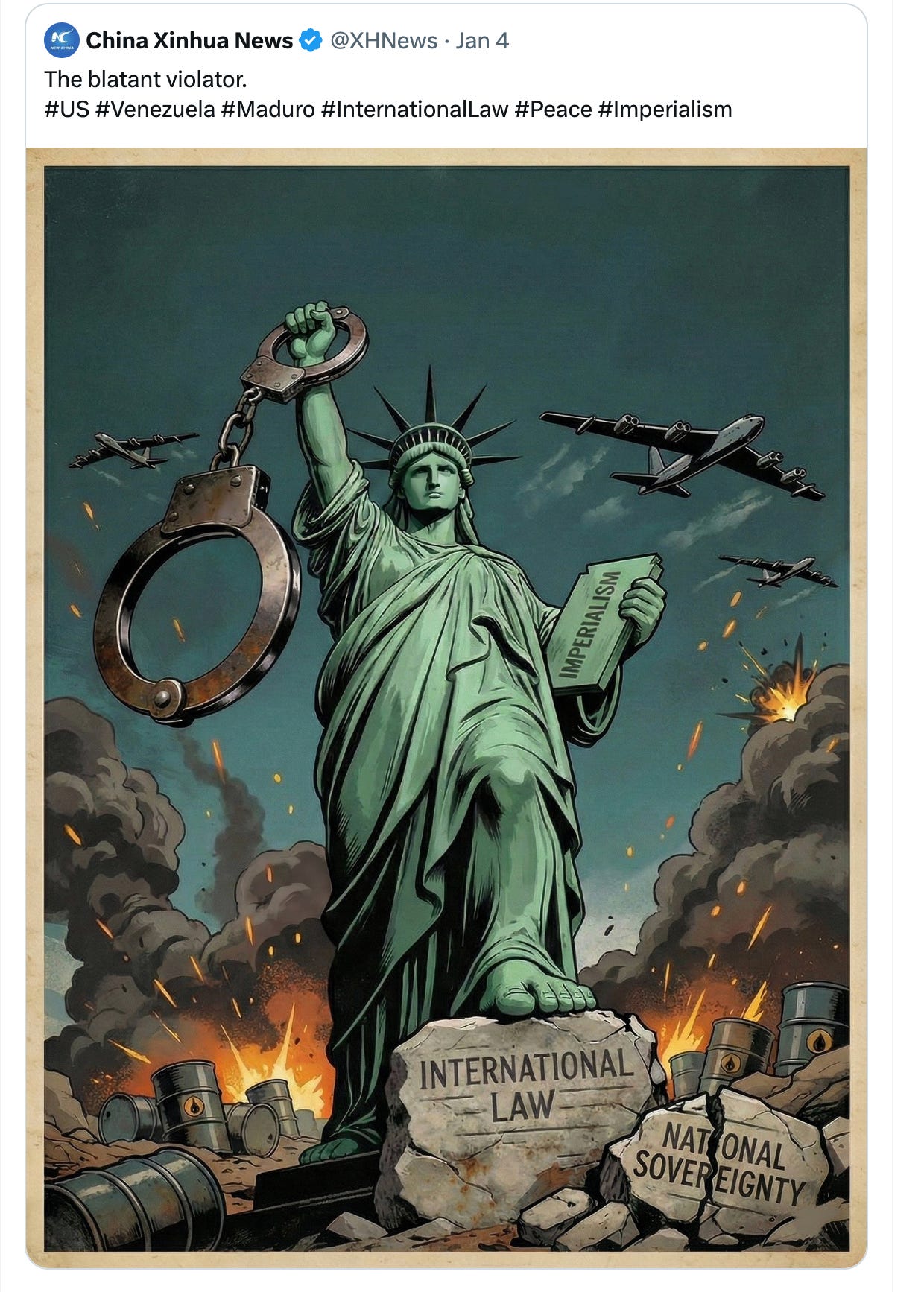
The propaganda value of the US flouting international law in such a high profile way against a Global South country may be priceless, and the action fits perfectly with how the PRC talks about the US as a hegemon, imperialist and destabilizing force in the world. This graphic from Xinhua is a good example, though strangely the PRC never issued anything like this when Russia invaded Ukraine:
The performance of the US military was impressive, but when it comes to a Taiwan contingency it is not clear how relevant Xi and PLA Generals may think this kind of operation would be in coming to Taiwan’s assistance;
The PRC sees Taiwan as an internal affair and has conditioned most countries to accept its definition of the “one China principle”. It has mounted an aggressive campaign to misrepresent what UN General Assembly Resolution 2758 says about Taiwan’s status, so most countries will likely have little to no substantive reaction if the PRC uses force to try to take Taiwan. The PRC calculations about Taiwan will not change due to this US action in Venezuela, though it may juice the propaganda efforts;
The PRC would probably be happy with this US adventure turning into a quagmire, as it would tie down so many US military assets in the Western Hemisphere, and away from Taiwan and the Indo-Pacific;
If Cuba comes under so much economic pressure as a result of this US action that the government starts to wobble, Beijing officials would not be happy;
Secretary of State Rubio’s comments Sunday may presage more pressure on Chinese interests and partners in the Western Hemisphere:
You can’t turn Venezuela into the operating hub for Iran, for Russia, for Hezbollah, for China, for the Cuban intelligence agents that control that country.”..
“What we’re not going to allow is for the oil industry in Venezuela to be controlled by adversaries of the United States. You have to understand, why does China need their oil? Why does Russia need their oil? Why does Iran need their oil? They’re not even in this continent,” Rubio said. “This is the Western Hemisphere. This is where we live, and we’re not going to allow the Western Hemisphere to be a base of operation for adversaries, competitors and rivals of the United States.
One issue that I expect will get more of Trump’s attention soon is the Panama Canal and the facilities at either end owned by CK Hutchison. Trump announced last year that there was a deal to sell them to a consortium outside of PRC control, but based on several recent reports Xi is blowing that up.
2. Real estate market expectations - The latest issue of Qiushi has an article by “special commentator” Zhou Tingjun, a researcher at the Ministry of Housing and Urban Development, titled “Improve and Stabilize Real Estate Market Expectations 改善和稳定房地产市场预期”. I have posted a full translation here. It reiterates much of what we heard from last month’s Central Economic Work Conference, but one section in particular may raise hopes of a more forceful response:
In recent years, major changes have taken place in the supply and demand relationship of China’s real estate market. Some projects and some cities have experienced local oversupply, leading to a relatively large decline in real estate sales and prices. This has had a significant impact on the demand side of the real economy, the asset side of balance sheets, and the liability side of financial institutions. Real estate carries significant financial asset attributes, has strong correlations, covers a wide range of areas, and attracts high social attention. Strengthening expectation management is of special importance for stabilizing the real estate market…
In terms of policy expectations, policy intensity must meet market expectations, and policies must be given sufficiently at one time [政策要一次性给足]. We cannot adopt “fuel-adding tactics” (incremental measures), which leads to a game state between the market and policies. In terms of policy coordination, strengthen policy consistency assessment.
The author also may be hinting at the likely forthcoming bankruptcy of Vanke with this language:
Currently, the debt of real estate enterprises remains relatively high, and the possibility of individual enterprises undergoing bankruptcy reorganization cannot be ruled out. We must plan ahead and effectively prepare for response.
目前房地产企业债务仍然较高,不排除个别企业仍有破产重组的可能,要未雨绸缪,有效做好应对。
To stabilize the market and expectations, the article outlines three strategic areas:
Maintain Policy Intensity: The government should implement decisive, “all-at-once” support measures rather than incremental “fuel-adding” tactics to prevent the market from betting against policy. Restrictions should be lifted to meet rigid and improvement demands, ensuring real estate policies align with broader macroeconomic goals.
Manage Supply: Authorities must strictly control new supply while revitalizing existing stock, specifically encouraging the acquisition of unsold commercial housing for use as affordable housing. The focus must shift to building “good houses” (green, smart, safe) and reforming the housing provident fund system.
Strengthen Expectation Management: Beyond housing prices, sensitive indicators like foreclosures and corporate debt must be monitored. The government should use mainstream media to interpret market trends objectively and strictly control false information and rumors to foster rational public expectations.