
In this issue:
Deflation over for now
MOFCOM responds to US distillation advisory
Previewing the Xi-Trump summit
DeepSeek IPO and new model
Regulators want to pop the Robot Bubble
New spy drama
The Feed: Business, Economy and Trade - Politics and Law - Foreign and Defense Affairs - Hong Kong - Taiwan - Tech and Media - Society, Arts, Sports, Culture and History - Energy, Environment, Science and Health - Rural and Agricultural Issues
Today’s top items:
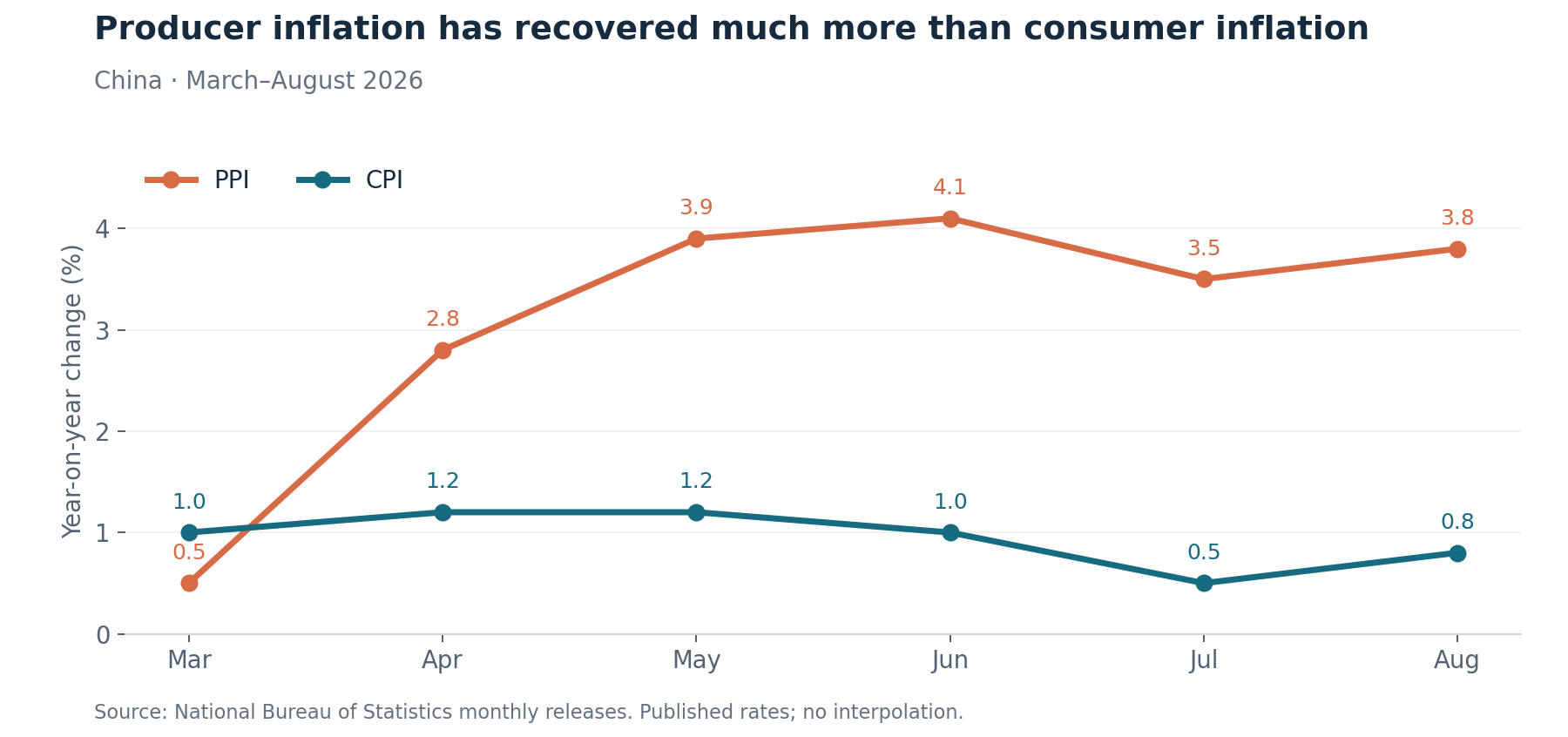
1. Deflation over for now - The NBS released August price data Wednesday. CPI rose 0.8% year on year, matching the Reuters consensus, while PPI increased 3.8%, slightly above its 3.6% consensus. Both rose 0.4% from July. Much of the improvement is due to commodity costs and particular supply conditions, rather than households spending more confidently or businesses regaining broad pricing power.
The consumer-price rebound was heavily influenced by fuel as petrol rose 7.2% month on month, contributing approximately 0.21 percentage points, or just over half of August’s total CPI increase. Internationally sensitive oil and metals industries contributed about 0.31 percentage points of the 0.4% monthly PPI increase, or approximately 78%.
So the mess in the Middle East has helped end China’s deflation in headline price measures, but today’s release does not establish a durable recovery in domestic pricing power.
2. MOFCOM responds to US distillation advisory - The Ministry of Commerce put out a spokesperson Q&A Wednesday on the September 8 joint advisory from NSA, CISA and the FBI accusing PRC AI companies of “industrial-scale” distillation of US frontier models.
The statement, translated here, says the charge has “neither a factual nor a legal basis,” calls distillation “a common practice through which AI models learn from one another,” and says US labs do plenty of it too, citing their own model reports as disclosing “extensive distillation of Chinese models.” Three consecutive paragraphs open with “the US approach is a textbook example of...美方做法是典型的...”, covering double standards, industry monopoly and technological hegemony in turn. It also goes after US labs’ terms of service, calling broad geographic restrictions “霸王条款 unfair terms” and suggesting the advisory is meant to endorse them:
The US approach is a textbook example of pursuing an industry monopoly under the pretext of cracking down on distillation. By having its security agencies issue the advisory, the US is tying the interests of certain companies and capital to national security, and using coercive state agencies to interfere in normal commercial activities. We have noted that certain US AI companies abuse their competitive advantages by imposing unfair terms in user agreements, such as broad geographic restrictions. The US allegations concerning distillation raise suspicions that they are intended to endorse these unfair terms.
美方做法是典型的以打击蒸馏为名,行产业垄断之实。美方由安全部门发布公告,是将个别企业和资本利益与国家安全相捆绑,动用国家强权机构干涉正常商业活动。我们注意到,美个别人工智能企业滥用竞争优势地位,在用户协议中设置宽泛的地域限制等霸王条款。美方相关蒸馏指控,有为这些霸王条款背书之嫌。
The response concludes:
The large-model industry is currently at a critical stage of technological iteration, recurring risks, and growth and development. As major countries, China and the US should address the challenges and risks facing AI with a positive and responsible attitude. The two heads of state have agreed to conduct an intergovernmental dialogue on AI. China is willing to engage in constructive and professional discussions with the US through dialogue, on the principles of equality, mutual benefit, and win-win cooperation. However, if the US takes action to contain and suppress Chinese AI companies under the pretext of cracking down on distillation, China will resolutely take countermeasures. We hope the US will work with China toward the same goal, manage risks through dialogue and communication, and help the AI industry benefit the world.
当前,大模型产业正处于技术迭代、风险迭发、成长发展的关键时期。中美作为大国,应以积极负责态度处理人工智能领域面临的挑战和风险。两国元首已同意开展人工智能政府间对话,中方愿意以平等互利、合作共赢原则,通过对话与美方开展建设性和专业的讨论。但如果美方以打击蒸馏为名,实施遏压中国人工智能企业的行动,中方必将坚决采取措施予以反制。希望美方与中方相向而行,通过对话和沟通管控风险,推动人工智能产业惠及全球。
Expectations should be low for US-China AI discussions around Xi’s upcoming visit, not only because of this advisory and the response but also because the US side is far from having any sort of coherent approach to regulation, or even empowered staff to figure out what to do. Politico just reported that Sam Corcos, CIO at the Treasury Department and Secretary Bessent’s top AI advisor, has been “reassigned…away from AI policy after the adviser relayed private misgivings over White House policy to AI companies.”
Dialogue is needed, especially after the tweet today by a former Anthropic researcher saying “the people building AI earnestly believe that it could kill us all by the end of the decade”. Perhaps the best thing we can hope for out of any Trump-Xi discussion of AI is that the two sides assign competent and relevant people to join the dialogue. One person who absolutely should be on the PRC side is Huang Ru at the NDRC.
US incoherence around AI regulation certainly helps the PRC make the case to the rest of the world that they are taking a more responsible approach to AI development.
3. Previewing the Xi-Trump summit - Former Obama Administration official Ryan Hass, now at Brookings, has a good article on what to expect for Xi’s visit:
China’s leaders continue to behave as though strategic competition remains undiminished...
Chinese commentators now describe America and China as being on an equal footing and entering a period of “strategic stalemate.” Like any good negotiator, Chinese leaders do not want to pay more than is necessary to sustain a period of bilateral stability. For China’s leaders, the goal is to buy time and space to strengthen self-reliance, not necessarily to improve relations with the United States.
Former Biden official Julian Gewirtz wrote on his Substack that the US and China have a “K-Shaped U.S.-China Relationship”:
It’s more accurate, and more revealing, to think of this relationship as two vectors—both conciliation and competition, both stability and strife. Diplomacy and competition have long coexisted in U.S.-China relations; what’s new is the widening distance between unusually intensive stabilization at the top and intense rivalry below. The U.S.-China relationship is not simply a paused “truce” or a static “détente.” It is accelerating in two directions at once.
Da Wei, Director of the Center for International Security and Strategy and Professor in the Department of International Relations at Tsinghua University and the former Director of the Institute of American Studies at the China Institutes of Contemporary International Relations (CICIR), a Ministry of State Security-affiliated think tank, wrote this week in Foreign Affairs about what may be the most desired outcome of the upcoming meeting, related to Taiwan:
As long as Beijing believes that cross-strait integration remains achievable, it has no reason to resort to military force. The United States could shift its declared policy to align more closely with Beijing by recognizing Chinese sovereignty over Taiwan or by explicitly opposing Taiwan’s independence, which would reassure Beijing that the prospect of “peaceful reunification” remains viable. This would allow China and the United States to reach a consensus that realizes the U.S. objective of a peaceful resolution to the dispute yet also maintains the ability of the people in Taiwan to preserve their political and social systems. By keeping the prospect of peaceful reunification alive, the core concerns of all three parties can be accommodated as much as possible.
Washington’s decision to pause $14 billion in arms sales to Taiwan, reached during Trump’s May summit with Xi, defused a rapidly escalating flash point in U.S.-Chinese relations. But it presents a new challenge to the nascent framework of strategic stability. Although Beijing certainly welcomed the delay, the pause has also raised expectations for future U.S. policy regarding Taiwan. Should the Trump administration eventually resume arms transfers—an outcome deemed likely by most Washington observers—Beijing will fiercely oppose the move, potentially jeopardizing the strategic stability framework. This scenario represents a concrete and salient threat that both countries must manage in the period ahead.