
The first day of President Trump’s visit to Beijing had impressive optics and lots of warm, positive energy, at least in the public reporting. Specific, concrete deliverables are so far few, but we may learn more after Trump’s visit concludes after lunch Friday. President Trump did say that Boeing would get orders for 200 planes, significantly below expectations, with no further details or confirmation from the Chinese side. At the dinner banquet, he invited Xi and Peng Liyuan for a state visit in September.
So far the most important news from the Thursday meeting, from what we can see publicly, is that the US and China have agreed to “build a constructive China-US relationship of strategic stability as the new positioning for China-U.S. relations…[that] will provide strategic guidance for China-U.S. relations over the next three years and beyond”, at least according to Xi’s opening statement at the meeting with Trump:
Xi stressed that China is committed to the stable, healthy, and sustainable development of China-U.S. relations. President Trump and I agreed to build a constructive China-US relationship of strategic stability as the new positioning for China-U.S. relations. This will provide strategic guidance for China-U.S. relations over the next three years and beyond, and will, I believe, be welcomed by the two peoples and the international community. “Constructive strategic stability” should be positive stability with cooperation as the mainstay, a sound stability with moderate competition, a constant stability with manageable differences, and an enduring stability with promises of peace. A “constructive China-US relationship of strategic stability” is not a slogan but should be reflected in actions that move in the same direction.
习近平强调,中方致力于中美关系稳定、健康、可持续发展。我同特朗普总统赞同将构建”中美建设性战略稳定关系”作为中美关系新定位,将为未来3年乃至更长时间的中美关系提供战略指引,相信会受到两国人民和国际社会的欢迎。”建设性战略稳定”应该是合作为主的积极稳定,应该是竞争有度的良性稳定,应该是分歧可控的常态稳定,应该是和平可期的持久稳定。”中美建设性战略稳定关系”不是一句口号,而应该是相向而行的行动。
Xi defined the four pillars of this new positioning, translation of the four areas via Xinhua:
positive stability with cooperation as the mainstay 合作为主的积极稳定指引
sound stability with moderate competition 竞争有度的良性稳定
constant stability with manageable differences 分歧可控的常态稳定
enduring stability with promises of peace 和平可期的持久稳定。
The PRC leadership wants a period of strategic detente and this concept could realize that on terms favorable to them for the rest of Trump’s second term. Any future U.S. moves to address PRC industrial overcapacity, tighten technology controls, etc. could then be cast by Beijing as violations of the new “constructive China-US relationship of strategic stability” to which the two leaders personally agreed.
The formulation (tifa 提法) accepts that the US-China relationship is competitive — as Xi did in 2023 with the Biden administration — but it now insists that competition be kept “moderate” (有度) and that differences be “manageable” (可控). This may allow China to get to define what counts as acceptable competition. It also makes Xi and his team look like they have successfully stood their ground against the Trump Administration and are now negotiating from a position of equal strength.
This is a useful point from Li Yaqi’s Substack:
A relationship you have stabilized is a relationship you can compete inside for a long time without it breaking. Stability is not the opposite of rivalry here. It is the container that makes a long rivalry survivable. “Fighting step by step” is, structurally, what managed long-term competition looks like from the inside…
It is disciplined struggle from the position of strength…
The phrase matters because it captures the cadre requirement behind this new diplomatic language. China’s diplomats are not only expected to take a proactive and assertive stance on matters of principle. They are also expected to struggle with skill: to use experience, judgment, timing, and tactical discipline to advance strategic objectives. In that sense, new tifa should not be mistaken for a post-competitive mood. It is closer to an operating doctrine for competition that has become more mature, more sensitive, and more bureaucratically tooled.
Did the US side agree to this new formulation for US-China relations? It is not mentioned in the much shorter White House readout from the same meeting, posted to X:
President Trump had a good meeting with President Xi of China. The two sides discussed ways to enhance economic cooperation between our two countries, including expanding market access for American businesses into China and increasing Chinese investment into our industries. Leaders from many of the United States’ largest companies joined a portion of the meeting. The Presidents also highlighted the need to build on progress in ending the flow of fentanyl precursors into the United States, as well as increasing Chinese purchases of American agricultural products. The two sides agreed that the Strait of Hormuz must remain open to support the free flow of energy. President Xi also made clear China’s opposition to the militarization of the Strait and any effort to charge a toll for its use, and he expressed interest in purchasing more American oil to reduce China’s dependence on the Strait in the future. Both countries agreed that Iran can never have a nuclear weapon.
Xi also raised Taiwan, in stark language but nothing particularly new:
Xi stressed that the Taiwan question is the most important issue in China-U.S. relations. Handled well, the overall stability of the bilateral relationship can be maintained. Handled poorly, the two countries will collide or even come into conflict, pushing the entire China-U.S. relationship into a very dangerous situation. “Taiwan independence” and peace across the Taiwan Strait are mutually exclusive, like fire and water. Maintaining peace and stability across the Taiwan Strait is the greatest common ground between China and the United States, and the U.S. side must handle the Taiwan question with the utmost prudence.
习近平强调,台湾问题是中美关系中最重要的问题。处理好了,两国关系就能保持总体稳定。处理不好,两国就会碰撞甚至冲突,将整个中美关系推向十分危险的境地。”台独”与台海和平水火不容,维护台海和平稳定是中美双方最大公约数,美方务必慎之又慎处理台湾问题。
Treasury Secretary Bessent told CNBC in an interview that President Trump would have more to say about Taiwan:
KERNEN: So many times I’ve, and this will be the final question. I know you got to run, Mr. Secretary. But you have so many different hats. I’m going to ask you, it’s kind of a Treasury, kind of a secretary of war question, I guess. Will Taiwan come up? Do you know whether President Xi is going to ask President Trump to change the long-standing strategic ambiguity? Or will there be any requests from President Xi to limit arms sales to Taiwan at this point? Do you know? Can you comment on that at all?
BESSENT: Sure, sure, Joe. It wouldn’t be a U.S.-China summit without the Taiwan issue coming up. And I’m confident that President Trump, the, understands the issues around that and the, is very resolute the, in his answers. And I’m sure we’ll be hearing more from him in the coming days on that.
Perhaps we will hear more on Taiwan from Trump in a few hours when he talks with Sean Hannity of Fox News.
Today’s People’s Daily page one is one for history:
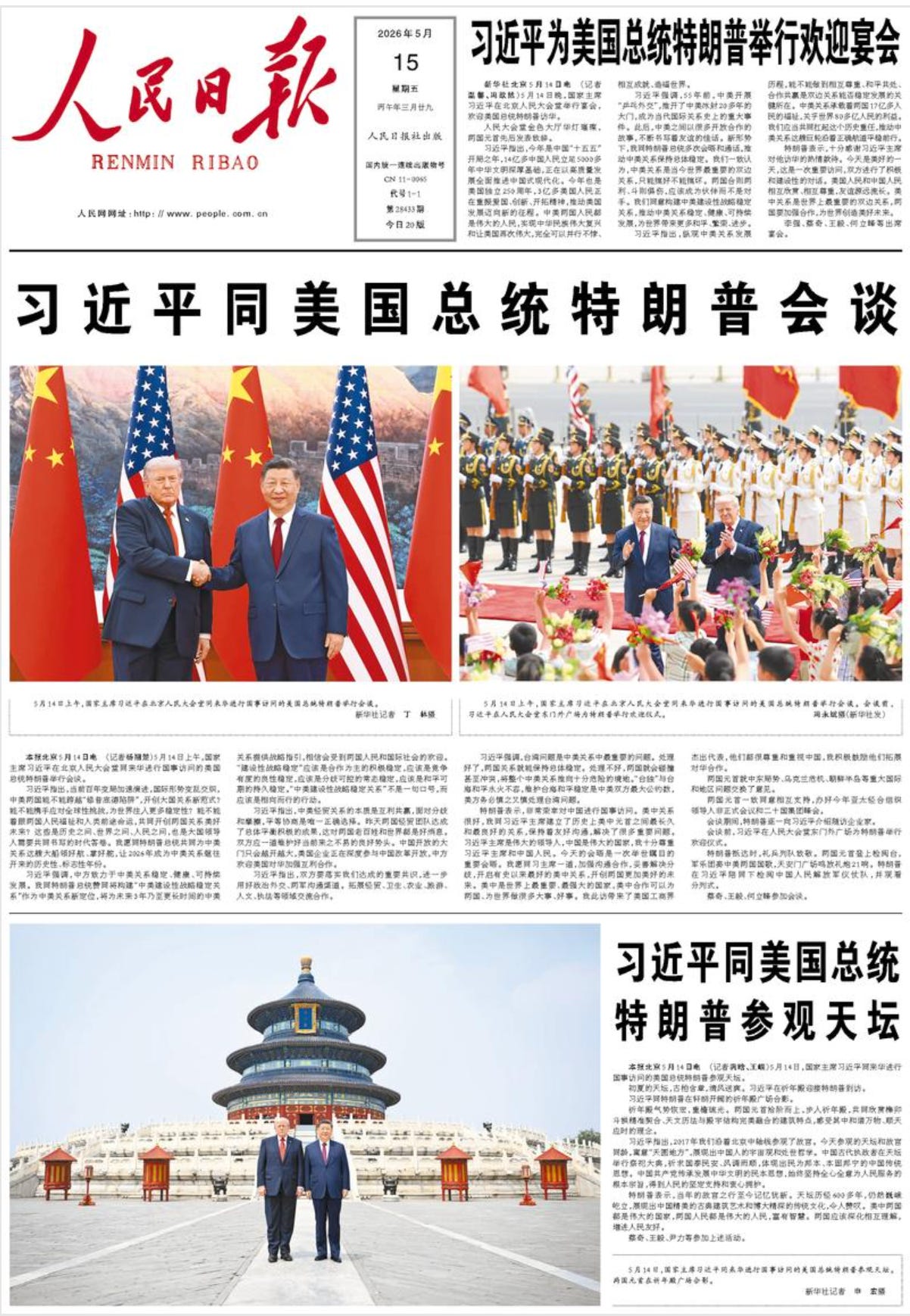
Today’s top items:
1. Key US-China meetings - This section includes a full translation of the readout of the Xi-Trump meeting
2. Rubio and Bessent on the talks - Secretary of State Rubio told NBC News that Taiwan “did not feature prominently” in the talks with Xi, while Secretary Bessent told CNBC that they are “going to talk about forming a board of trade for the bilateral trade between the U.S. and China. And we’re going to talk about a board of investment that will be responsible for investment in non-sensitive areas.” Bessent also said in the interview that the US and China will “set up a protocol in terms of how do we go forward with best practices for AI to make sure nonstate actors don’t get a hold of these models”. From Bessent’s comments, it kind of sounds like lots of things are not yet locked down.
3. Anthropic on competition on AI between the US and China - Anthropic has been consistent that it wants the US and its allies to lead in AI, not the Communist Party of China. Today they released a new paper on the topic titled 2028: Two scenarios for global AI leadership:
In this post, we present two scenarios for what the world might look like in 2028, when we expect transformative AI systems to have arrived.
In the first scenario, America has successfully defended its compute advantage. Policymakers have acted to tighten export controls further, disrupt China’s distillation attacks, and further accelerate democracies’ adoption of AI. In this world, democracies set the rules and norms around AI. It’s also in this scenario that we’re most likely to successfully engage with China on safety, which we’re supportive of to the extent this is possible.
In the second scenario, America has chosen not to act. Policymakers have not tightened loopholes on the CCP’s access to compute, and AI firms in China have quickly taken advantage—catching up to the frontier and even overtaking America. In this world, AI norms and rules are shaped by authoritarian regimes, and the best models enable automated repression at scale. It will be no solace that this authoritarian triumph has happened on the back of American compute.