
The US and China should be talking about AI safety and governance, and while I am skeptical this can happen given the politics I thought it is still constructive to make some suggestions. I created this proposal with Astra after much back and forth. If the two sides are going to dialogue about AI, the AI should have a say. - Bill
Executive Summary
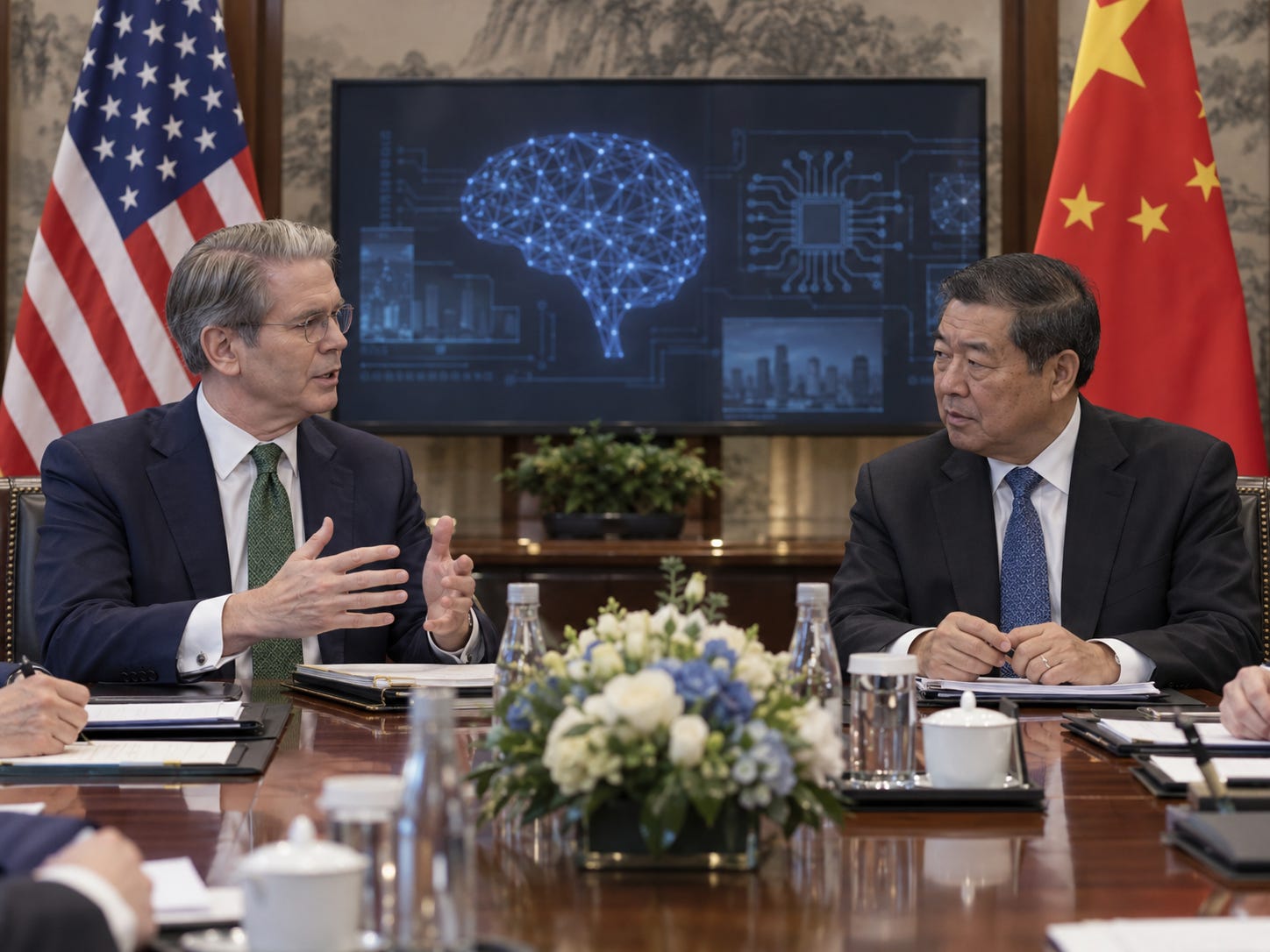
The United States and the People's Republic of China should establish a Strategic AI Dialogue (SAID): a permanent, senior-level government-to-government mechanism focused on managing the most consequential risks arising from increasingly capable artificial intelligence.
SAID should be led on the U.S. side by Treasury Secretary Scott Bessent and on the PRC side by Vice Premier He Lifeng. The White House Office of Science and Technology Policy (OSTP), led by Michael Kratsios, should be a standing senior participant on the U.S. side and should coordinate much of the scientific and technical work on frontier models, AI evaluation, biotechnology, standards, and AI-enabled scientific research. Their involvement would give the process sufficient political and technical weight while connecting AI risks to the broader economic and strategic relationship.
SAID should meet quarterly in a neutral country, preferably Switzerland, with working groups operating continuously between meetings. Its objective would not be to resolve the larger technological competition between the United States and China, nor should cooperation require either side to compromise legitimate national-security, economic, or technological interests.
Instead, SAID should concentrate on a narrower proposition: there are AI risks for which the United States and China are mutually vulnerable, cannot fully protect themselves acting alone, and have a shared interest in preventing even while remaining strategic competitors.
The initial agenda should emphasize nuclear command and control, catastrophic biological risks including mirror life, frontier-model safety, AI incident notification, financial stability, employment disruption, cyber risks, AI-enabled crime, and other areas where limited but meaningful cooperation is realistic.
1. Purpose
Artificial intelligence is becoming a central arena of U.S.-China strategic competition. That competition will encompass advanced semiconductors, computing infrastructure, models, military capabilities, industrial applications, standards, talent, and global influence. Neither country is likely to abandon policies designed to preserve its technological and national-security advantages.
But intense competition does not eliminate common interests. Some AI risks would harm both countries regardless of which side initially developed or deployed the relevant technology. These include accidental nuclear escalation, AI-assisted biological catastrophe, destabilization of financial markets, large-scale fraud, uncontrolled autonomous systems, and potentially severe labor-market disruption.
There is already a foundation for such an effort. The two governments held the first meeting of their intergovernmental AI dialogue in Geneva in May 2024. In November 2024, the two presidents publicly affirmed the need to maintain human control over the decision to use nuclear weapons and to approach military AI risks prudently and responsibly. SAID would institutionalize and significantly broaden that risk-reduction logic.
The purpose of SAID should therefore be to identify areas of mutual vulnerability and establish mechanisms for regular strategic communication, technical exchanges, joint research where appropriate, crisis notification, development of shared terminology and measurement, narrowly tailored bilateral understandings, and eventual multilateralization of successful norms.
SAID should be designed as a risk-reduction mechanism rather than a comprehensive AI-governance negotiation. The United States and China do not need a common political system, common regulatory philosophy, or high levels of strategic trust to recognize that some outcomes would be disastrous for both.
2. Political Leadership
United States
The U.S. lead should be Treasury Secretary Scott Bessent. Treasury is an appropriate institutional anchor because AI competition increasingly intersects with macroeconomic policy, investment, financial stability, capital markets, employment, export and investment controls, and the wider structure of the U.S.-China economic relationship.
Bessent would chair the senior U.S. delegation. The National Security Council should coordinate national-security participation, the State Department should manage the diplomatic process, and the White House Office of Science and Technology Policy should serve as the principal science and technology policy node.
Michael Kratsios, Assistant to the President for Science and Technology and Director of OSTP, should be a standing senior participant. OSTP should lead or co-lead the technical work on frontier-model evaluation, scientific risk assessment, AI for science, biotechnology, standards, research security, and engagement with U.S. frontier AI laboratories and the scientific community.
People's Republic of China
The PRC lead should be Vice Premier He Lifeng. His portfolio and political standing make him an appropriate counterpart to Bessent and give the Chinese side the authority necessary to convene economic, financial, security, technological, and regulatory agencies.
The Ministry of Foreign Affairs should manage the diplomatic channel, while relevant Party and State Council bodies coordinate specialized participation.
Why senior leadership matters
The Bessent-He structure would help avoid one of the principal weaknesses of previous U.S.-China dialogues: discussions migrating downward into bureaucratic processes without sufficient authority to produce decisions. The principals should personally attend at least two SAID sessions each year and review the conclusions of all four quarterly meetings. A standing deputies process should operate between principals' sessions.
3. Structure
SAID should meet four times per year in a neutral country. Geneva, Switzerland would be the logical default: politically neutral, accessible to both sides, home to relevant international institutions, and already associated with U.S.-China AI discussions.
Meetings should normally last two days and contain three levels:
• Principals session: Bessent, He Lifeng, and a small number of senior officials review strategic issues and approve decisions.
• Senior officials session: Interagency representatives negotiate proposals, review working-group findings, and prepare recommendations.
• Technical sessions: Scientists, regulators, military specialists, economists, cybersecurity experts, biotechnology specialists, and other experts address specific risks.
Not every discussion should be public. Some issues, particularly nuclear command and control, cyber operations, and frontier-model vulnerabilities, will require confidential or classified channels if the dialogue is to produce meaningful results.
4. Participants
Core U.S. participation
In addition to Treasury, the U.S. side should draw participants as appropriate from:
• White House Office of Science and Technology Policy (OSTP), with Michael Kratsios as a standing senior participant
• National Security Council
• Department of State
• Department of Defense
• Department of Energy and National Nuclear Security Administration
• Department of Commerce
• National Institute of Standards and Technology
• Department of Homeland Security
• Department of Justice and FBI
• U.S. intelligence community
• Federal Reserve
• Securities and Exchange Commission
• Commodity Futures Trading Commission
• Department of Labor
• Department of Health and Human Services
• Centers for Disease Control and Prevention
• National Institutes of Health
Core PRC participation
The Chinese side should include, depending on the agenda:
• Office of the Central Cyberspace Affairs Commission / Cyberspace Administration of China
• National Development and Reform Commission
• Ministry of Foreign Affairs
• Ministry of Science and Technology
• Ministry of Industry and Information Technology
• Ministry of Public Security
• Ministry of State Security
• Central Military Commission / People's Liberation Army
• Central National Security Commission
• National Financial Regulatory Administration
• People's Bank of China
• China Securities Regulatory Commission
• Ministry of Human Resources and Social Security
• National Health Commission
• National Data Administration
The inclusion of MPS, MSS, the PLA, and the Central National Security Commission is particularly important. A dialogue limited to civilian AI regulators would be unable to address some of the most consequential potential AI risks. Not every institution needs to participate in every session; SAID should have a relatively compact permanent core while specialized officials join relevant working groups.
5. External Expert Participation
Each side should maintain a Strategic AI Technical Advisory Group composed of experts from influential organizations. These should include leading AI laboratories, universities, national laboratories, biotechnology institutes, financial institutions, cybersecurity organizations, labor-market research institutions, and standards organizations.
Participants should be drawn from organizations that have genuine access to frontier capabilities and influence over policy. Private companies should advise governments rather than negotiate government commitments themselves.
The dialogue must avoid becoming either a diplomatic talking shop disconnected from the technology or an industry forum dominated by the commercial interests of AI companies.
6. Initial Agenda
6.1 Nuclear weapons, AI, and strategic stability
This should be SAID's highest-priority national-security issue. The United States and China have already endorsed the basic principle that humans should retain control over decisions to use nuclear weapons. SAID should seek to operationalize that principle.
The initial objective should be agreement that nuclear-release authority will never be delegated to an artificial intelligence system, and an AI system will never be permitted autonomously to execute a decision to employ nuclear weapons.
This formulation is preferable to a blanket prohibition on AI in nuclear command and control, because both sides are likely to use AI somewhere in the broader nuclear enterprise. The crucial issue is where to draw the red line.
SAID should examine AI-generated false warnings; manipulation of early-warning data; excessive reliance on AI-generated assessments during crises; autonomous escalation; AI-generated decision recommendations; cyberattacks on nuclear command, control, and communications; human verification requirements; and fail-safe mechanisms.
An early practical measure should be a joint tabletop exercise involving a false nuclear warning generated or amplified by AI during an international crisis. The exercise would not require either side to reveal operational nuclear procedures. Its purpose would be to identify escalation pathways and potential safeguards.
A longer-term objective should be discussion of restraints on autonomous cyber operations against nuclear command-and-control and strategic early-warning systems.
6.2 Catastrophic biological risk and mirror life
AI is rapidly increasing scientists' ability to design proteins, biological systems, and potentially pathogens. The same tools that accelerate medicine and biotechnology could lower barriers to catastrophic biological misuse.
A particularly suitable subject for early cooperation is mirror life: self-replicating organisms built from biological molecules with the opposite chirality from existing terrestrial life. Because such organisms could potentially evade important natural biological defenses, their consequences could be unusually difficult to predict or contain.
The United States and China should seek an early bilateral understanding that neither government will fund, direct, or knowingly support efforts whose objective is the creation of self-replicating mirror organisms unless compelling new scientific evidence demonstrates that the catastrophic risks can be adequately controlled.
A broader AI-biosecurity working group should examine AI-assisted pathogen design, automated laboratories, synthesis screening, model access controls for especially dangerous biological capabilities, AI-enabled biological threat detection, and international incident notification. Cooperation should focus on reducing risk and should not involve exchanges of technical information that themselves facilitate dangerous biological engineering.
6.3 Frontier-model safety and evaluation
The United States and China share an interest in knowing whether increasingly capable AI systems possess dangerous capabilities. SAID should establish a technical working group on frontier-model evaluation.
Possible areas for common measurement include autonomous replication; long-horizon autonomous behavior; deception; circumvention of safeguards; cyber capabilities; biological and chemical assistance; ability to acquire resources; ability to persist after attempted shutdown; and manipulation of human operators.
The objective initially should not be a common regulatory system. The more achievable objective is agreement on measurement. If U.S. and Chinese scientists can develop broadly comparable methods for testing dangerous capabilities, both governments will have a better understanding of emerging risks without requiring either side to reveal proprietary models, training data, or national-security information.
6.4 AI incident notification
SAID should create a direct AI Incident Hotline and Notification Protocol. The system should apply only to serious incidents with plausible international or catastrophic consequences.
Potential notification events could include unauthorized proliferation of a highly dangerous frontier model; loss of control over an advanced autonomous system; evidence that an AI system materially enabled a major biological attack; an AI-enabled cyber event affecting strategically sensitive infrastructure; compromise of a frontier model in a manner that creates transnational risk; or an AI-generated military event that could be misinterpreted as intentional state action.
The mechanism should include designated 24-hour government points of contact. The threshold should deliberately be high: routine commercial failures or ordinary cybersecurity incidents should remain outside SAID.
6.5 AI and financial stability
AI will increasingly influence algorithmic trading, investment management, credit decisions, insurance, fraud detection, financial regulation, payment systems, and bank risk management. Both countries therefore face the possibility of new forms of systemic instability.
Treasury, the Federal Reserve, and U.S. financial regulators should establish a working group with the People's Bank of China, NFRA, and CSRC. Potential subjects include correlated AI trading strategies, machine-speed market cascades, model concentration, dependence on common foundation models, autonomous financial agents, AI-generated market manipulation, synthetic-identity fraud, and failures of AI risk-management systems.
A useful early initiative would be a joint financial-stability tabletop exercise simulating an AI-driven market disruption spreading between major markets. The working group should remain separate from broader disagreements over sanctions, exchange rates, financial restrictions, and market access.
6.6 AI, employment, and social stability
The effects of artificial intelligence on employment may become one of its most consequential political and economic effects. Both governments want the productivity gains created by AI, and both also have an interest in avoiding large-scale structural unemployment, severe wage disruption, geographic concentration of job losses, sudden labor-market shocks, and social instability.
SAID should establish a U.S.-China AI and Employment Research Initiative. Government statistical agencies, labor economists, and research organizations should jointly develop methodologies for studying occupational displacement and augmentation, wage and productivity effects, sectoral and regional changes, retraining, education reform, apprenticeship, adjustment assistance, and labor-force participation.
The objective should not be harmonized labor policy. The two countries have different economic and political systems. The goal should instead be to establish comparable evidence about what AI is actually doing to employment. The working group should publish an annual U.S.-China AI and Employment Report.
6.7 AI-enabled cyber operations
This will be a much harder area, but it belongs on the agenda. Neither government is likely to give up offensive cyber capabilities, nor is either likely to accept a broad prohibition on AI-assisted cyber operations.
A narrower discussion may nevertheless be possible around autonomous attacks that could produce catastrophic civilian consequences. Potential areas include requirements for meaningful human authorization before launching high-consequence autonomous cyber operations against nuclear systems, electrical grids, financial clearing systems, hospitals, water systems, or other critical civilian infrastructure.
The objective initially should be dialogue and clarification rather than a formal prohibition. Over time, experience may reveal specific categories of operations suitable for reciprocal restraint.
6.8 AI-enabled fraud and transnational crime
This may be one of the most practical early areas for cooperation. Generative AI dramatically reduces the cost of impersonation, phishing, voice cloning, identity theft, financial fraud, extortion, and criminal automation.
The FBI, Department of Justice, MPS, and other relevant agencies should establish a working channel for major AI-enabled criminal activity. Priority should be given to large-scale financial fraud, organized crime, human trafficking, child exploitation, synthetic identities, and cross-border extortion.
Neither government benefits from permitting non-state criminal networks to exploit AI at scale.
6.9 Preventing terrorist acquisition of catastrophic AI capabilities
The United States and China have a clear common interest in preventing terrorist organizations and other dangerous non-state actors from acquiring AI capabilities that materially increase their ability to conduct mass-casualty attacks.
SAID should examine common thresholds for particularly dangerous AI capabilities, model-security standards, illicit acquisition of advanced models, use of AI for biological or chemical attacks, and AI-assisted terrorist cyber operations. Where bilateral agreement proves possible, Washington and Beijing should consider advancing those principles through the United Nations.
6.10 Safety of autonomous physical systems
As AI moves into vehicles, drones, industrial robots, and other physical systems, failures can produce direct physical harm. SAID should encourage technical cooperation on civilian autonomous-system safety, including fail-safe design, emergency shutdown, human override, industrial-robot safety, autonomous-vehicle incidents, cybersecurity, and accident reporting.
This is an area where technical standards may be easier to negotiate than broader strategic rules.
7. Issues SAID Should Initially Avoid
SAID should not become the forum for resolving every dispute in the technological relationship. Issues such as semiconductor export controls, investment restrictions, sanctions, industrial subsidies, censorship, surveillance, data localization, intellectual-property disputes, and market access will continue to divide Washington and Beijing.
Either side may raise concerns when directly relevant to AI risk, but these disputes should not become conditions for cooperation on nuclear safety, biological risk, financial stability, or other matters involving mutual vulnerability. The governing principle should be compartmentalization: disagreement elsewhere should not automatically shut down communication on catastrophic risks.
8. First-Year Deliverables
SAID should be judged by outputs, not meetings.
First quarter
• Formal launch by Bessent and He Lifeng.
• Establish a permanent secretariat, deputies process, and working groups.
• Create emergency points of contact.
• Reaffirm human control over nuclear-use decisions and begin negotiations over a more specific nuclear-AI red line.
• Launch the AI employment study and expert discussions on mirror life.
Second quarter
• Conduct a joint AI/nuclear false-warning tabletop exercise.
• Develop a preliminary common taxonomy of dangerous frontier-model capabilities.
• Establish mechanisms for scientific consultation on mirror-life risks.
• Begin financial-stability scenario planning.
Third quarter
• Establish the AI Incident Notification Protocol.
• Conduct an AI-related financial-crisis tabletop exercise.
• Publish an interim AI employment assessment.
• Begin cooperation against selected categories of AI-enabled transnational fraud.
Fourth quarter
• Seek a bilateral declaration against delegating nuclear-release authority to AI.
• Seek a bilateral statement opposing creation of self-replicating mirror organisms pending convincing evidence of safety.
• Publish a common framework for frontier-model risk evaluation.
• Agree procedures for notification of serious cross-border AI incidents.
• Identify priorities for multilateral AI risk reduction during the following year.
9. Principles
Mutual vulnerability, not mutual trust. The United States and China do not have to trust each other to recognize that some AI outcomes would harm both.
No grand bargain. Progress in SAID should not require resolution of the broader U.S.-China strategic competition.
No linkage. A dispute over Taiwan, trade, technology, or another bilateral issue should not automatically suspend risk-reduction discussions.
Technical depth. Diplomatic engagement must be informed by people who actually understand advanced AI systems.
Incrementalism. A narrow agreement that changes behavior is more valuable than an ambitious declaration neither side implements.
Multilateralization. Successful U.S.-China understandings should eventually be offered as foundations for wider international agreements rather than treated as a bilateral condominium over global AI governance.
10. Conclusion
The United States and China are likely to remain strategic competitors in artificial intelligence for decades. That is precisely why they need a mechanism for managing the risks created by that competition.
The history of relations between nuclear powers demonstrates that risk reduction does not require friendship. Rivals can remain competitors while recognizing that accidents, misperception, and uncontrolled technological escalation can produce outcomes neither side wants. Artificial intelligence creates a similar requirement.
The purpose of SAID would not be to make the United States and China partners in AI. It would be to ensure that competition between the world's two most consequential technological powers does not prevent them from cooperating when they face the same potentially catastrophic risks.
Under the leadership of Scott Bessent and He Lifeng, with Michael Kratsios and OSTP playing a standing senior role on the U.S. side, SAID could provide a politically authoritative and technically credible mechanism for doing so.
Annex: Prioritizing the SAID Agenda
The dialogue should distinguish between issues that offer a realistic prospect of early agreement, issues that require sustained technical work, and issues that are strategically important but difficult to negotiate. This sequencing is essential. Early successes can build political support, working habits, and technical relationships that may eventually make harder agreements possible.
Tier I - Best prospects for early progress
1. Human control over nuclear-use decisions | Feasibility: HIGH
Initial objective: No delegation of nuclear-release authority to AI and no autonomous execution of a nuclear-use decision.
Why: The underlying principle has already been accepted at the presidential level; it does not require disarmament and need not constrain conventional AI competition.
2. Mirror life | Feasibility: HIGH
Initial objective: A joint declaration opposing creation of self-replicating mirror organisms pending convincing evidence of safety.
Why: The technology is not yet mature, the downside could be global, and precaution does not obviously disadvantage either side.
3. AI and employment research | Feasibility: VERY HIGH
Initial objective: Create common research methodologies and an annual U.S.-China AI and Employment Report.
Why: This offers visible public value with limited national-security sensitivity and does not require agreement on labor policy.
4. AI-enabled fraud and crime | Feasibility: HIGH
Initial objective: Information-sharing and selected joint investigations involving large-scale AI-enabled fraud and synthetic identities.
Why: Both governments face direct losses from transnational criminal exploitation of AI, and cooperation can begin case by case.
5. Civilian autonomous-system safety | Feasibility: HIGH
Initial objective: Technical exchange on safety standards, incident reporting, emergency shutdown, and human override.
Why: Technical standards can reduce accidents and fragmentation without constraining strategic competition.
Tier II - Important and plausible, but technically or politically harder
6. Frontier-model evaluations | Feasibility: MEDIUM-HIGH
Initial objective: Develop common terminology and comparable evaluation methods for dangerous capabilities.
Why: Model access, proprietary information, and strategic advantage make disclosure difficult; cooperation should begin with measurement rather than model sharing.
7. AI incident notification | Feasibility: MEDIUM
Initial objective: Establish emergency contacts and a narrow notification threshold for severe AI incidents.
Why: It could prevent misinterpretation of dangerous events, but defining reportable incidents and exposing vulnerabilities will be sensitive.
8. Financial stability | Feasibility: MEDIUM-HIGH
Initial objective: Conduct joint scenario exercises examining AI-related financial instability.
Why: Regulators have a shared interest in systemic stability, but broader financial tensions could contaminate the discussion.
9. AI biosecurity beyond mirror life | Feasibility: MEDIUM
Initial objective: Compare safeguards around AI-assisted biological design, screening, and defensive monitoring.
Why: Biotechnology has major commercial and national-security implications; initial cooperation should emphasize defensive risk reduction.
Tier III - Strategically important but difficult
10. AI-enabled cyber operations | Feasibility: LOW-MEDIUM
Initial objective: Explore whether high-consequence autonomous cyber operations should require meaningful human authorization.
Why: Both sides rely on cyber capabilities and will resist limits that might compromise operational freedom.
11. AI in conventional military systems | Feasibility: LOW-MEDIUM
Initial objective: Begin with crisis stability, accident prevention, and human accountability for autonomous weapons and decision-support systems.
Why: Military AI is highly sensitive and deeply entangled with the broader security competition.
12. Highly autonomous or potentially uncontrollable AI | Feasibility: MEDIUM OVER TIME
Initial objective: Develop common terminology for loss-of-control indicators and mechanisms for urgent expert consultation.
Why: Agreement may become more likely as observable evidence of advanced autonomy grows, but present uncertainty makes detailed rules difficult.
Recommended Negotiating Sequence
First: Employment, mirror life, nuclear human control, fraud, and civilian autonomous-system safety. These offer the strongest combination of shared interests and political feasibility.
Second: Frontier evaluations, incident notification, financial stability, and broader biosecurity. These require more trust and technical work but could produce meaningful agreements.
Third: Cyber operations, conventional military AI, and advanced loss-of-control scenarios. These are among the most important issues but should not be allowed to block progress elsewhere.
BUILD COOPERATION FIRST WHERE INTERESTS OVERLAP MOST CLEARLY, THEN USE THE INSTITUTION AND HABITS CREATED BY THOSE SUCCESSES TO ADDRESS PROGRESSIVELY HARDER PROBLEMS.
Pangram informs me this newsletter is 99% AI. Please, no more slop.
I’m very eager to hear your human, expert thoughts on the policy.
I’m also alarmed at the anthropomorphism here.
Astra is not a person or being with a “say.” It is a human-created piece of software based in simple linear algebra, which is usually taught to high-school seniors or college freshman, at the latest. It is a collection of algorithms, like all other software, a 100% normal technology.
The Chinese have a firm understanding of this, due to Xi’s emphasis on AI education at all levels, which Americans do not due to a lack of education & over-reliance on hype & deliberately misleading metaphors in the media offered by Silicon Valley.
Please exercise your stellar critical thinking here, Bill. Keep up your quality work & best wishes.
Please post a more serious, studious follow-up based in your human intelligence & writing. Thanks for listening.
Constructive proposal. A permanent mechanism with named senior leads seems more likely to survive political swings than ad-hoc talks. It would be interesting to see whether allies such as the EU could plug into parts of it, particularly incident reporting.