
In this issue:
Xi at the SCO
China’s global strategy
Li Qiang meets US business delegation
Tax changes for foreigners
Auto industry overseas conduct guidelines
Latest issue of Qiushi
The Feed: Business, Economy and Trade - Politics and Law - Foreign and Defense Affairs - Hong Kong - Taiwan - Tech and Media - Energy, Environment, Science and Health - Education - Rural and Agricultural Issues
Today’s top items:
1. Xi at the SCO - Xi gave two speeches in Bishkek Monday for the SCO’s 25th anniversary: one to the Council of Heads of State in the morning, one to the “SCO Plus” session in the afternoon. I have posted translations here and here.
The morning speech is the deliverables speech. Under four headings (development, security, people, governance) Xi announced an international AI application cooperation center for SCO countries, more “10-gigawatt” solar and wind projects, 100 science and technology projects over three years, a port economy cooperation center in Tianjin, a basic education cooperation center, and support for standing up the SCO’s “four security centers.” Every one of the four global initiatives gets a mention, with the SCO cast as the “important platform” or “priority region” for each. The security section calls for strictly guarding against “external forces interfering in countries’ internal affairs, endangering political security” (外部势力干涉各国内政、危害政治安全).
The afternoon speech was titled “Jointly Advocate an Equal and Orderly Multipolar World” (平等有序的世界多极化), and Xi calls the trend toward multipolarity “irreversible.” Xi has been consistent with this theme:
The domination of international affairs by a small number of countries is a historical injustice; hegemony by one country, joint rule by a few, or bloc politics is not true multilateralism.
少数国家主导国际事务是历史不公,一国独霸、几方共治、集团政治不是真正的多边主义。
He also lists what must be rejected, “double standards, exceptionalism, interference and bullying, and the law of the jungle,” and says major countries “in particular should take the lead in following the rules.” The US is not named, but it does not need to be.
A Xinhua commentary, translated here, had this to say about the SCO:
Twenty-five years on, the once-in-a-century changes in the world are accelerating; dialogue and confrontation, win-win and zero-sum, multilateralism and unilateralism are locked in fierce contest, and the dark clouds of war have not receded. The SCO should bravely shoulder its historical responsibility and take the initiative to steer the course of history. Looking to the future, President Xi put forward four propositions: adhere to development as the priority and open up prospects for common prosperity; adhere to security as the essential and create an environment of universal security; adhere to a people-centered approach and deepen the foundation of friendship across generations; adhere to dialogue and consultation and improve fair and orderly governance. The "Four Adheres" respond to the concerns of all parties, emphasize an action orientation, and draw a blueprint for the SCO to achieve higher-quality development.
25年后的今天,世界百年变局加速演进,对话和对抗、共赢和零和、多边和单边激烈博弈,战争阴霾并未远去,上海合作组织应该勇担历史责任,主动引领历史航向。面向未来,习近平主席提出4点主张:坚持发展优先,开创共同繁荣的前景;坚持安全为要,营造普遍安全的环境;坚持以人为本,厚植世代友好的根基;坚持对话协商,完善公平有序的治理。"四个坚持"回应各方关切,注重行动导向,为上海合作组织实现更高质量发展擘画了蓝图。
There were no readouts of meetings with India’s Prime Minister Modi or Iran’s President Pezeshkian, so they probably did not happen.
Iran’s Mehr News Agency said Xi and Pezeshkian met on the sidelines of the summit, but from the photo it published it looks more like a brief, standing interaction than an actual meeting.
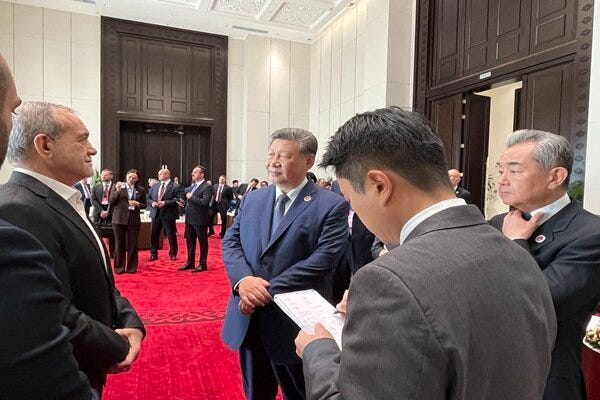
Xi is expected to be in New Delhi, India, on September 12–13, 2026, to attend the BRICS Summit, so if he does go he can meet Modi there.
Xi has now arrived in Egypt.
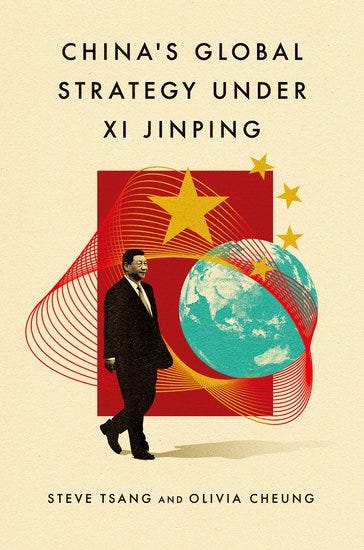
2. China’s global strategy - I am looking forward to reading Steve Tsang and Olivia Cheung’s new book “China’s Global Strategy under Xi Jinping”. The latest issue of China Leadership Monitor has an interview with the authors. The themes in Xi’s speeches at the SCO make even more sense:
What are the underlying assumptions and core components of China’s global strategy? How do these components complement each other?
China’s global strategy has a dual pivot. Its primary pivot is to engage the Global South, which constitutes a clear majority of the world’s countries and population, to secure support for China to steadily reshape the existing international order by re-centering the UN in global politics, so that, with China taking the lead, international affairs, from security crises to global governance, are more responsive to them than they are to the minority democratic West. This is the basis for Xi’s idea of the “democratization of international relations.” With the support of the Global South, Xi seeks to forge a common destiny of humankind, implying transforming what remains of the “liberal international order” into a Sino-centric order, which is based on his understanding of the traditional Chinese concept of tianxia…Putting tianxia in place implies “restoring” Chinese global pre-eminence. Xi has no desire for China to replace the U.S. as the global hegemon, not least because American hegemony after 1945 also included delivering costly public services, such as policing, to the global community. Nor does he want China to assume such obligations. Being embraced as the pre-eminent power suffices for him, as it will already ensure that China’s Communist Party system cannot be challenged.
This is a much better scholarly explanation of “what China wants” than anything i have read so far.
3. Li Qiang meets US business delegation - On Tuesday Li Qiang made nice with the members of the board of the US-China Business Council in Beijing, ahead of the Trump-Xi meeting later this month. According to the readout, translated here:
Li Qiang pointed out that surveying the development of international economic and trade cooperation today, some important lessons can be drawn: it can be said that win-win cooperation is the prevailing trend, respect and understanding are the foundation, and moving toward each other is the key. The essence of China-US economic and trade relations is mutual benefit and win-win, and strengthening cooperation is both an intrinsic need of both sides and the right choice. Looking around the world, China may be the only market with rich potential that combines the two characteristics of being “big” and “new”; in particular, high-quality, upgraded consumption such as smart consumption and green consumption is growing rapidly, and US companies are welcome to actively seize the opportunities and step up their efforts to open up and cultivate the Chinese market. China-US economic and trade cooperation is large in scale, and it is normal for some contradictions and frictions to arise. As long as there is mutual respect and mutual understanding, and communication and consultation are strengthened, solutions can always be found. China is ready to actively promote the resolution of the reasonable concerns of US companies in China and to safeguard a market environment of fair competition in accordance with the law; it also hopes the US side will move in the same direction, take concrete actions to address China’s concerns, and jointly implement the outcomes of the two countries’ economic and trade consultations. It is hoped that the US-China Business Council will continue to exercise its influence, guide all sectors in the United States to view China’s development rationally and objectively, and promote the stable, healthy, and sustainable development of China-US relations.
李强指出,综观当今国际经贸合作的发展,能够得出一些重要的启示,可以说合作共赢是大势,尊重理解是基础,相向而行是关键。中美经贸关系的本质是互利共赢,加强合作是双方的内在需求,也是正确选择。放眼世界,中国可能是唯一兼具“大”和“新”两个特点的富有潜力市场,特别是智能消费、绿色消费等高品质、升级类消费快速增长,欢迎美国企业积极抢抓机遇,加力开拓、深耕中国市场。中美经贸合作体量大,出现一些矛盾摩擦是正常的。只要相互尊重、相互理解,加强沟通协商,总能找到解决办法。中方愿积极推动解决美国来华企业的合理诉求,依法维护公平竞争的市场环境,也希望美方相向而行,以切实行动解决中方关切,共同落实好两国经贸磋商成果。希望美中贸委会继续发挥自身影响,引导美国各界理性客观看待中国发展,促进中美关系稳定健康可持续发展。
4. Tax changes for foreigners - The Ministry of Finance and the State Taxation Administration issued an announcement on September 1 making clear that, effective September 1, dividend and bonus income obtained by foreign individuals from foreign-invested enterprises shall be subject to individual income tax at a rate of 20 percent. This tax exemption has been in place since 1994, and now it is ended, effective today. Xinhua quotes Liu Yi, director of the China Center for Fiscal and Tax Research at Peking University, saying "After the exemption is removed, the individual income tax a foreign individual pays in China can be credited against tax owed to their country of residence, so the actual tax burden will not increase." But now the PRC government gets the revenue. Did anyone have advance notice of this?
Yicai in its coverage of the change cites tax avoidance by PRC citizens as a driver: