
Today has been a whirlwind of news about calls to pace AI development, triggered by Anthropic CEO’s “We Must Pace the Frontier” essay over the weekend. The reaction from the Trump Administration, and President Trump himself, make it clear the US government has no interest in slowing AI development, so the low expectations for any progress at the mooted US-China AI dialogue should now be even lower.
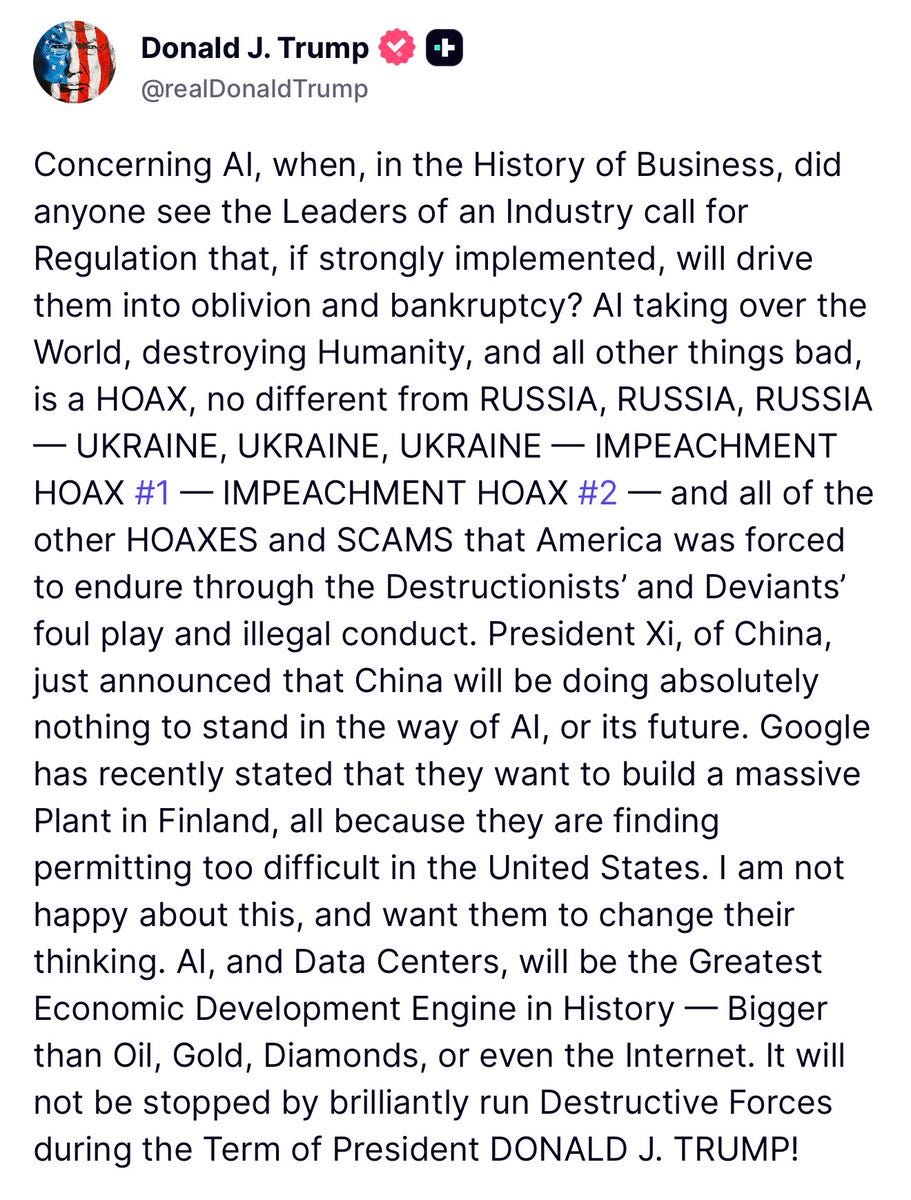
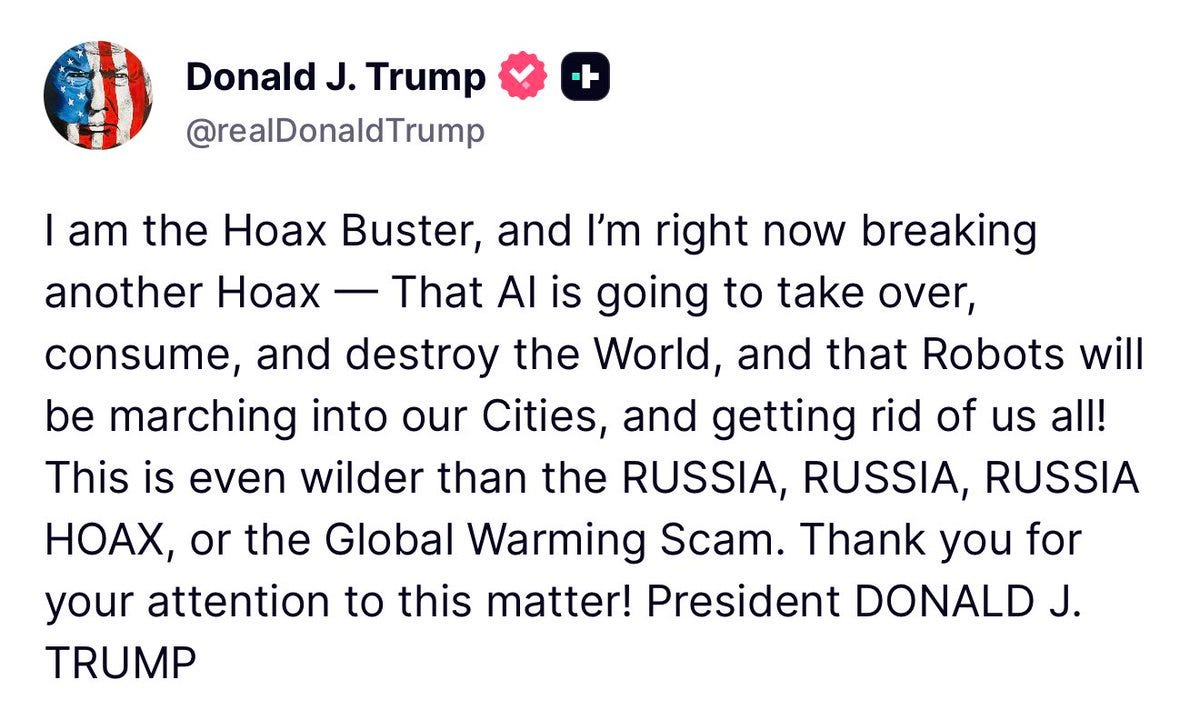
I hope the US and China do start an AI dialogue, but the two systems are in what political leaders on both sides increasingly see as an existential struggle, not so much for humanity but for their own countries. I do not see how they bridge that gap, even if they wanted to.
In this issue:
1. BRICS Summit
2. Xi-Modi meeting
3. Speculation about Xi’s visit to DC
4. AI risks and challenges
5. State Council Executive Meeting
6. Weak August credit data
7. “Dynamic zero 动态清零” for Central SOE payment arrears
8. 15th Five-Year Plan for the NEV industry
The Feed: Business, Economy and Trade - Politics and Law - Foreign and Defense Affairs - Hong Kong and Macau - Taiwan - Tech and Media - Society, Arts, Sports, Culture and History - Energy, Environment, Science and Health
Today’s top items:
1. BRICS Summit - Xi was in India for just about twenty-four hours, the summit did not seem to have many concrete deliverables, and his only official bilateral meeting was with Indian Prime Minister Modi. In his speech, Xi proposed five cooperation initiatives:
Open Source AI for All Initiative will establish an open-source zone and promote inclusive sharing of technology;
Trade and Investment Facilitation Initiative will create a partnership among special economic zones and tap new growth drivers for trade and the economy through a services-trade forum;
Digital Industry Cooperation Initiative will build a cloud platform and bridge the digital divide;
Intelligent Manufacturing Cooperation Initiative will help countries build smart factories and advance manufacturing transformation and upgrading;
Sci-Tech Talent Development Initiative will establish an alliance for training engineers, implement a youth sci-tech innovation exchange program, and reinforce the talent foundation.
On the war in the Middle East he had little new to say:
China is ready to work with fellow BRICS members to play its due role in achieving peace and tranquility in the Middle East and the Gulf
2. Xi-Modi meeting - So far the best read on the meeting comes from Manoj Kewalramani in Analysis of Modi-Xi Meeting in Delhi & BRICS Declaration:
My nutshell take on the meeting between Modi and Xi is that the meeting largely kept to expectations. No major breakthroughs were expected and none have been announced. Frankly, the fact that Xi Jinping was going to spend less than 24 hours in Delhi was indicative that one should not be expecting major outcomes.
From the Chinese readout, it’s clear that Beijing continues to have deep suspicions of Indian policy. Among the four points that Xi has articulated about the future of the relationship, the first is about strategic cognition, which basically means that India should adjust its approach to China. He wants Delhi to grasp the dynamics of the relationship as cooperative and not competitive, arguing that this judgement has been arrived at “on the basis of the stage of development the two countries are at and the international environment.” Of course, when such frameworks are mentioned around strategic cognition, these are about what the other side needs to grasp rather than what the Chinese system needs to imbibe.
The third point is essentially about the overhang of the US on the bilateral relationship.
3. Speculation about Xi’s visit to DC - Xi will arrive in DC in nine days and we still do not know much about what will be on the agenda. The usual meeting ahead of leader-level talks between the top diplomats and/or the top trade negotiators has not yet happened. The South China Morning Post has a new story suggesting that there will be a He Lifeng-Bessent/Greer meeting before Xi arrives, and that it may include discussion about launching an AI dialogue.
Given the heated rhetoric about AI, especially over the last few days, a dialogue that could agree on participants and perhaps the shape of the table would be a win. But expectations should be very low, as US policy towards AI regulation is incoherently inchoate.
4. AI risks and challenges - The latest issue of China Cyberspace (《中国网信》) magazine carries a signed article by Chen Yixin, Party Secretary and Minister of State Security, translated here. Chen’s essay is an important articulation of official views towards AI governance and risks, but there is not much new in it, beyond updated concerns about cybersecurity in the wake of Mythos. Chen leads with framing that echoes Xi’s comments at the April 2025 Politburo Study Session:
At present, artificial intelligence is leading the new round of scientific and technological revolution and industrial transformation deeper forward. The field of artificial intelligence has become the main battlefield of global scientific and technological competition and a new arena for strategic rivalry among major powers. The Party Central Committee attaches great importance to the development of artificial intelligence. General Secretary Xi Jinping has issued a series of important instructions, stressing the need to “comprehensively advance artificial intelligence technological innovation, industrial development and application empowerment, improve artificial intelligence regulatory systems and mechanisms, and firmly grasp the initiative in artificial intelligence development and governance.” We must thoroughly study and understand the spirit of General Secretary Xi Jinping’s important instructions, unswervingly implement the holistic approach to national security, accelerate the construction of a system for preventing and controlling artificial intelligence security risks, and use high-level security and highly effective governance to promote the healthy and orderly development of artificial intelligence in our country.
当前,人工智能引领新一轮科技革命和产业变革纵深推进,人工智能领域已成为全球科技竞争的主战场、大国战略博弈的新赛道。党中央高度重视人工智能发展,习近平总书记作出系列重要指示,强调要“全面推进人工智能科技创新、产业发展和赋能应用,完善人工智能监管体制机制,牢牢掌握人工智能发展和治理主动权”。我们要深入学习领会习近平总书记重要指示精神,坚定不移贯彻总体国家安全观,加快构建人工智能安全风险防治体系,以高水平安全、高效能治理推动我国人工智能健康有序发展。
He then takes an 8-6-7 approach:
Eight guidances / 八个方面 (Xi’s “fundamental guidance” for AI governance)
The strategic positioning of AI — 人工智能的战略定位
The development policy for AI — 人工智能的发展方针
The value orientation of AI — 人工智能的价值取向
The governance philosophy for AI — 人工智能的治理理念
The key tasks for AI — 人工智能的重点任务
Practical empowerment by AI — 人工智能的实践赋能
Supporting guarantees for AI — 人工智能的支撑保障
International cooperation on AI — 人工智能的国际合作
Six risks and challenges / 六大风险挑战
Systemically affects the political security environment — 系统性影响政治安全环境
Disruptively reshapes the cyber offense-defense landscape — 颠覆性升级网络攻防态势
Amplifies espionage and leakage risks at scale — 规模性放大窃密泄密风险
Monopolistic practices exacerbate imbalances in technological development — 垄断性加剧科技发展失衡
Structurally shocks the social governance system — 结构性冲击社会治理体系
Fundamentally transforms the form of military struggle — 根本性变革军事斗争形态
Seven key measures / 重点举措
Uphold the Party’s overall leadership — 坚持党的全面领导
Improve system-wide coordination and joint effectiveness — 提升体系作战合力
Strengthen risk sensing and early warning — 强化风险感知预警
Intensify scientific and technological innovation — 加大科技创新力度
Improve the legal safeguards system — 完善法治保障体系
Innovate forms of publicity and mobilization — 创新宣传动员形式
Deepen the effectiveness of international cooperation — 深化国际合作成效
Unsurprisingly, AI’s potential impact on political security is the number one risk. The second risk is cyber:
Second, it disruptively reshapes the cyber offense-defense landscape. Marked by the “Mythos” (Claude Mythos) and “Cyber” (GPT-5.5-Cyber) large models recently introduced by U.S. technology companies, artificial intelligence technology is significantly increasing the efficiency of cyber-vulnerability discovery and malware development, as well as their weaponization. Cyber offense and defense are entering a new stage characterized by industrialized vulnerability discovery, fully automated offense and defense, and AI-versus-AI confrontation. Some countries and organizations now have the ability to rapidly discover vulnerabilities in batches, automatically chain together attack paths and complete complex hacking tasks. This substantially lowers the technical threshold and cost of conducting cyberattacks and creates serious risks and hidden dangers for our country’s critical information infrastructure.
He concludes with the vision the PRC has been consistently advocating for global AI governance, a vision that conflicts with the Trump Administration’s:
Seventh, deepen the effectiveness of international cooperation. Uphold the global security governance vision of extensive consultation, joint contribution and shared benefits, deepen international cooperation in scientific and technological innovation, resolutely resist hegemonism, technological barriers and closed exclusion, establish a fair and open international artificial intelligence rules system, promote technological exchange and the open sharing of achievements, advance inclusive and balanced development, bridge the digital and intelligent divide, and guide artificial intelligence to better benefit the people and the world.
七是深化国际合作成效。秉持共商共建共享的全球安全治理观,深化国际科技创新合作,坚决抵制霸权主义、技术壁垒、封闭排他,建立公平开放的国际人工智能规则体系,推动技术交流和成果开放共享,推进普惠均衡发展,弥合数智鸿沟,引导人工智能更好造福人民、造福世界。
With a Trump–Xi meeting expected this month and the Fifth Plenum in October, there will be plenty of China headlines. Understanding what actually changes, and why it matters, takes more work.
The end of summer offer of 33% off your first year of Sinocism ends September 15.
Don’t delay - click here to get smarter about China.