
This is likely the last newsletter of 2025. Thank you for all your support throughout the year, and I wish you and your loved ones Happy Holidays and Happy New Year!
Summary of today’s top items:
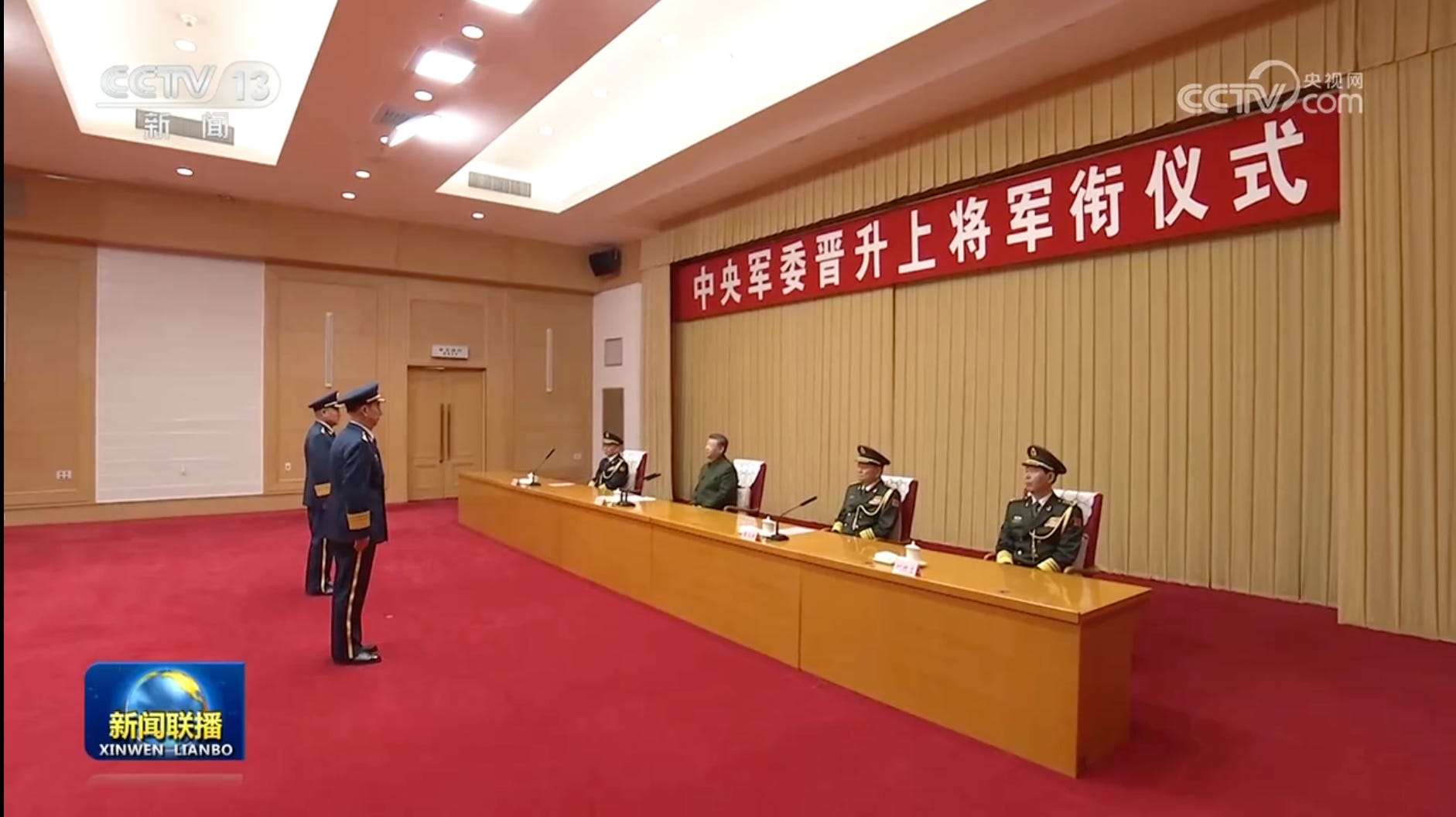
1. Xi promotes two generals - Yang Zhibin, Commander of the Eastern Theater Command, and Han Shengyan, Commander of the Central Theater Command. Both come from the PLA Air Force (PLAAF), and Han was the commander of the September 3 military parade. This promotion ceremony comes very late in the year, perhaps it took Xi and CMC vice chair Zhang Shengmin even longer than usual to vet the candidates, given the ongoing PLA purges, and the call last week for tips about procurement issues in the PLAAF?
2. Japan-PRC tensions - Things are not improving between Japan and China. Over the last few days several LDP lawmakers have visited Taiwan, and LDP Executive Acting Secretary-General Koichi Hagiuda met with Taiwan President Lai on Monday. PRC officials will of course express outrage about these visits, but what may have them more upset are recent reports of supposed comments by a Japanese official in Prime Minister Takaichi’s office “I think we should possess nuclear weapons.” The Defense Minister, when asked if the three Non-Nuclear Principles (No Possession, No Production, No Acceptance) should remain as Japan’s official policy, said, “In order to protect peaceful lives, it is only natural to proceed with discussions without ruling out any options”.
3. US-China - On Friday US Secretary of State and National Security Adviser Marco Rubio commented on the Japan-China tensions and the US-China relationship. He said:
The Japanese are a very close ally of the United States. I think these tensions are pre-existing. We understand that’s one of the dynamics that has to be balanced in that region. And I believe that we feel very strongly that we can continue with our strong, firm partnership and alliance with Japan and do so in a way that continues to allow us to find productive ways to work together with Chinese – the Chinese Communist Party and the Chinese Government…
We have to have relations with them. We have to deal with them. We have to find the things we are able to work together on. And I think both sides are mature enough to recognize that there will be points of tension now and for the foreseeable future. Our job as we’re part – as part of responsible statecraft is to find opportunities to work together. Because I think if there’s a global challenge that China and the U.S. can work together on, I mean, it’s – I think we can solve it.
The PRC side, in its ongoing efforts to highlight US-China drug cooperation, publicized a case against money launderers triggered by a US tip. The tip came in April 2024 and arrests were made in May 2025, during the Biden Administration.
From Xi’s perspective at least I think US-China relations are ending 2025 in about as good a place as he could have hoped for at the start of the year.
4. Warning to Mexico - CCTV’s Yuyuan Tantian account warns Mexico about its plan to impose tariffs of up to 50% on roughly 1,400 Chinese product lines, saying it is the result of U.S. coercion linked to the upcoming 2026 USMCA review. The article says Mexico is sacrificing third-party interests to appease Washington and warns that this protectionism will backfire by raising Mexican manufacturing costs and deterring Chinese investment in critical sectors like EVs. The article asserts that Mexico’s actions violate international trade rules and ignore previous diplomatic consultations.
Yuyuan Tantian says that China has a “systematic toolkit” ready for retaliation. While currently framing its actions as “response measures” to allow room for de-escalation, Beijing threatens to upgrade to full “countermeasures” if the tariffs are implemented. Specific threats include:
Targeted Retaliation: Utilizing the findings of its ongoing “trade and investment barrier investigation” (the first self-initiated by China) to impose countermeasures specifically on Mexico’s “most advantageous and sensitive industrial sectors.”
Legal Action: Filing lawsuits under the WTO framework.
Expanded Toolkit: Deploying newer instruments like anti-discrimination investigations, industrial competitiveness investigations, or the “Unreliable Entity List.”
The article says Mexico can either withdraw the proposal to preserve cooperation or face a determined Chinese response that will inflict pain on its key economic interests.
5. Nvidia chip smuggling investigation - Bloomberg reports that the US and Singapore governments are investigating Singapore-based Megaspeed both for its ownership structure and whether it has facilitated smuggling of export controlled chips to China. In October, The New York Times also raised questions about Megaspeed and its large purchases of Nvidia chips in A Mystery C.E.O. and Billions in Sales: Is China Buying Banned Nvidia Chips?. Maybe Nvidia can work its DC lobbying magic and get the US government to back off, but they will probably have a harder time influencing the Singapore investigation.
If you are like me you may still be scrambling for holiday gift ideas.
For anyone in your life who wants to get smarter about China, I am biased but I can think of no better gift than a subscription to Sinocism.
They will thank you every day if you send them a subscription to Sinocism. And it is easy to do - just click the button below.
Thanks, and Happy Holidays!
