
We revisit history to draw wisdom and strength for forging ahead. Looking back again today, 90 years later, on that period of suffering and glory, we recognize even more profoundly that victory in the Long March was inevitable and that it contained the path to victory by which the Party and the people’s army marched forward with resounding steps.
我们重温历史,是为了汲取奋进的智慧和力量。90年后的今天,再次回望那段苦难辉煌,我们更加深刻认识到,长征胜利是必然的,其中蕴含着党和人民军队铿锵前进的制胜之道。 - Xi Jinping Thursday
In this issue:
1. Long March 90th anniversary event
2. Li Qiang meets Putin
3. Wang Yi meets his Djibouti counterpart
4. New long march for A-share investors
The Feed: Business, Economy and Trade - Politics and Law - Foreign and Defense Affairs - Taiwan - Tech and Media - Society, Arts, Sports, Culture and History - Energy, Environment, Science and Health - Education
Today’s top items:
1. Long March 90th anniversary event - Xi Jinping spoke Thursday morning at the Great Hall of the People to mark the 90th anniversary of the Long March’s victory. Zhao Leji presided; Li Qiang, Wang Huning, Cai Qi, Ding Xuexiang, Li Xi and Han Zheng attended, along with about 3,000 others. I have posted a translation of Xi’s speech here.
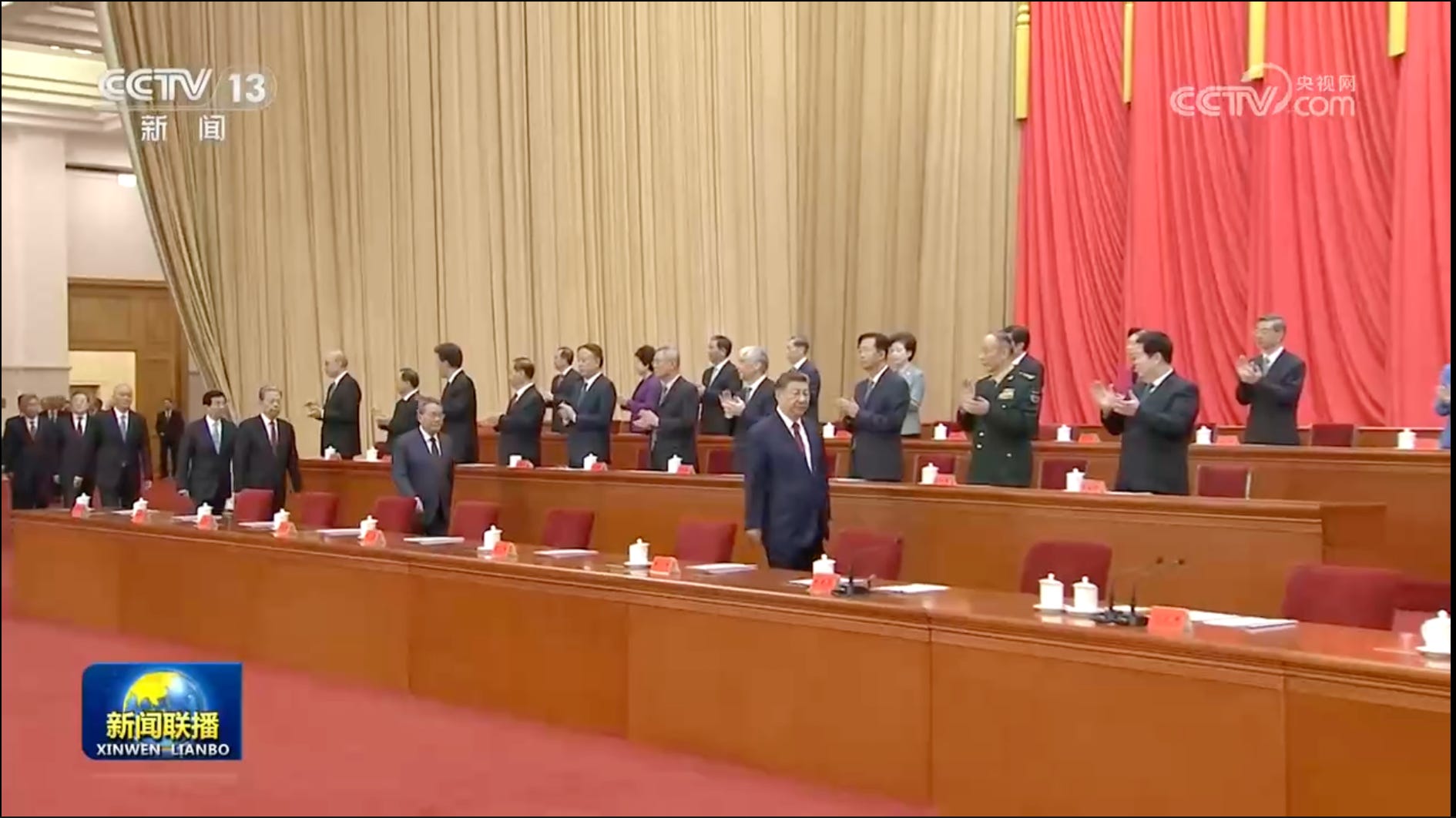
The speech is about a third the length of the one for the 80th anniversary commemoration in 2016, which Li Keqiang presided over three days before the Sixth Plenum gave Xi the “core” title.
The 2016 speech explained the Long March through four “great expeditions,” ideals and faith first. Today’s replaces them with four “roads to victory,” and the first and longest is the Party’s correct leadership and the significance of having a core:
— The great road to victory of the Red Army’s Long March was forged by relying on the Party’s correct leadership. At the beginning of the Long March, errors of the “Left” line caused immense losses to the Party and the Red Army. In January 1935, the Political Bureau of the CCP Central Committee held the Zunyi Meeting. In fact, it established Comrade Mao Zedong’s leading position in the CCP Central Committee and the Red Army, began to establish the leading position in the CCP Central Committee of the correct Marxist line represented principally by Comrade Mao Zedong, began to form the first generation of central collective leadership with Comrade Mao Zedong at its core, and opened a new stage in which the Party independently resolved practical problems of the Chinese revolution. At the most critical moment, it saved the Party, the Red Army, and the Chinese revolution. After the Zunyi Meeting, the Party and Red Army gained new life, broke through pass after pass, defeated Zhang Guotao’s separatism, and ultimately won the Long March. History proves eloquently that the Party’s correct leadership and the establishment of Comrade Mao Zedong’s core position were decisive for victory in the Long March.
——红军长征的伟大胜利之路,是依靠党的正确领导走出来的。长征初期,“左”倾路线的错误给党和红军造成极大损失。1935年1月,中央政治局举行遵义会议,事实上确立了毛泽东同志在党中央和红军的领导地位,开始确立以毛泽东同志为主要代表的马克思主义正确路线在党中央的领导地位,开始形成以毛泽东同志为核心的党的第一代中央领导集体,开启了党独立自主解决中国革命实际问题新阶段,在最危急关头挽救了党、挽救了红军、挽救了中国革命。遵义会议后,党和红军获得新的生命,一路闯关夺隘并战胜张国焘的分裂主义,最终取得长征胜利。历史雄辩地证明,党的正确领导和毛泽东同志核心地位的确立,对于红军长征胜利具有决定性意义。
That sentence had no equivalent in the 2016 speech, nor did the line that the Red Army “defeated Zhang Guotao’s separatism” (战胜张国焘的分裂主义), though that language did appear in the 2021 third historical resolution.
Of the five “musts” for the new Long March, the third one, on struggle, is new as a standalone section:
We must dare to struggle and be good at struggling...better coordinate development and security, and be ready at any time to withstand major tests of high winds and rough waves, even raging storms.
我们要敢于斗争、善于斗争...更好统筹发展和安全,随时准备经受风高浪急甚至惊涛骇浪的重大考验。
Here are the “five musts”:
To carry forward the great Long March spirit and travel the new Long March well, we must uphold the Party’s ideals, convictions, and purpose. 弘扬伟大长征精神、走好新的长征路,必须坚守党的理想信念宗旨。
To carry forward the great Long March spirit and travel the new Long March well, we must unwaveringly promote high-quality development and continually meet the people’s growing needs for a better life. 弘扬伟大长征精神、走好新的长征路,必须坚定不移推动高质量发展、不断满足人民日益增长的美好生活需要。
To carry forward the great Long March spirit and travel the new Long March well, we must be courageous in waging great struggles with many new historical features. 弘扬伟大长征精神、走好新的长征路,必须勇于进行具有许多新的历史特点的伟大斗争。
To carry forward the great Long March spirit and travel the new Long March well, we must accelerate the transformation of the people’s military into a world-class military. 弘扬伟大长征精神、走好新的长征路,必须加快把人民军队建成世界一流军队。
To carry forward the great Long March spirit and travel the new Long March well, we must uphold Party leadership and strengthen Party building. 弘扬伟大长征精神、走好新的长征路,必须坚持党的领导、加强党的建设。
According to the CCTV report on the ceremony, Zhao Leji had this to say:
Presiding over the gathering, Zhao Leji said that General Secretary Xi Jinping’s important speech reviewed the great course of the Party’s leadership of the Red Army in carrying out the Long March, summarized the great significance of the Long March victory, revealed the keys to victory that enabled the Party and the people’s army to advance with firm and resounding steps, expounded the historical value of the Great Long March Spirit, and set out five clear imperatives for carrying forward the Great Long March Spirit and traveling well the new Long March. The speech was highly political, ideological and instructive, and must be earnestly studied and understood and fully implemented. The entire Party, the entire military and the Chinese people of all ethnic groups must unite more closely around the CPC Central Committee with Comrade Xi Jinping at its core; follow the guidance of Xi Jinping Thought on Socialism with Chinese Characteristics for a New Era; profoundly understand the decisive significance of the Two Establishes; strengthen the Four Consciousnesses, reinforce the Four Confidences and uphold the Two Upholds; carry forward the Great Long March Spirit; travel well the new Long March; and work tirelessly to comprehensively advance the building of a strong country and the great cause of national rejuvenation through Chinese modernization.
赵乐际在主持大会时指出,习近平总书记的重要讲话回顾我们党领导红军进行长征的伟大历程,总结长征胜利的伟大意义,揭示长征胜利蕴含的党和人民军队铿锵前进的制胜之道,阐发伟大长征精神的历史价值,就弘扬伟大长征精神、走好新的长征路提出“五个必须”的明确要求。讲话具有很强的政治性、思想性和指导性,要认真学习领会,抓好贯彻落实。全党全军全国各族人民要更加紧密地团结在以习近平同志为核心的党中央周围,坚持以习近平新时代中国特色社会主义思想为指导,深刻领悟“两个确立”的决定性意义,增强“四个意识”、坚定“四个自信”、做到“两个维护”,弘扬伟大长征精神,走好新的长征路,为以中国式现代化全面推进强国建设、民族复兴伟业而不懈奋斗。
On to the Fifth Plenum that starts Monday…
2. Li Qiang meets Putin - Before flying back to Beijing to make the Long March event, Premier Li met with Putin. The readout, translated here, is thin, but he will meet Xi soon at APEC:
Putin asked Li to convey his sincere greetings to President Xi Jinping and wished the Fifth Plenary Session of the 20th CPC Central Committee every success. Putin said China had been, remained, and would continue to be Russia’s closest and most reliable partner. Russia is willing to deepen practical cooperation with China in all fields and supports China in hosting this year’s APEC Economic Leaders’ Meeting.
普京请李强转达对习近平主席的诚挚问候,预祝中国共产党二十届五中全会成功举行。普京表示,中国过去、现在和将来都是俄方最亲密、最可靠的伙伴。俄方愿同中方深化各领域务实合作,支持中方主办今年亚太经合组织领导人非正式会议。
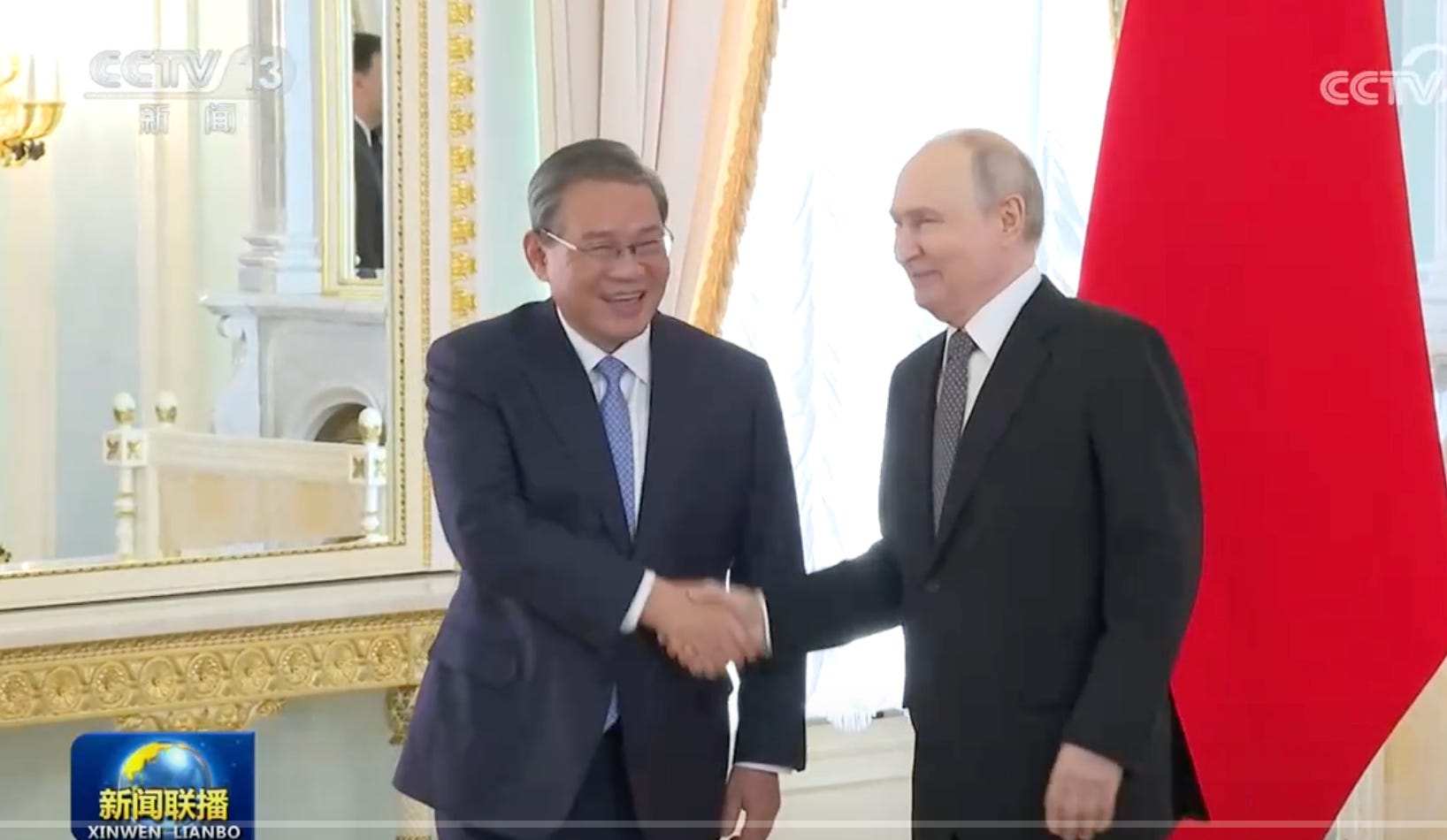
I have posted a translation of the Joint Communiqué of the 31st Regular Meeting Between the Chinese and Russian Heads of Government here.
3. Wang Yi meets his Djibouti counterpart - After their meeting, the two sides issued the “Joint Press Communiqué of the Foreign Ministers of the People’s Republic of China and the Republic of Djibouti on Safeguarding Peace and Stability in the Horn of Africa and the Security of Shipping Lanes in the Red Sea and Gulf of Aden”, which I have translated here. From the statement:
6. The two sides emphasized the importance of safeguarding freedom of navigation in the Red Sea and the Bab el-Mandeb Strait and stressed that the navigation rights exercised by merchant vessels of all countries in accordance with international law should be respected. They believe that the sovereignty, territorial integrity, and wishes of Red Sea coastal states must be genuinely respected in matters of Red Sea governance and security, and that increases in the region’s overall security risks should be avoided. China supports Red Sea coastal states in constructively safeguarding the unobstructed and secure operation of international shipping lanes and protecting the region’s common interests.
六、双方强调维护红海、曼德海峡航行自由的重要性,强调各国商船根据国际法行使航行权利应得到尊重。双方认为,在红海治理和安全问题上,应切实尊重红海沿岸国家主权、领土完整和意愿,避免推高地区整体安全风险。中方支持红海沿岸国家以建设性方式维护国际航道畅通安全、维护地区共同利益。
But they offered no details about how they might safeguard things.
4. New long march for A-share investors - PRC stock indexes keep going down, with the Shanghai Composite now below 3700, the CSI technically in a bear market, and the key tech indexes down over 40% from their 2026 highs:
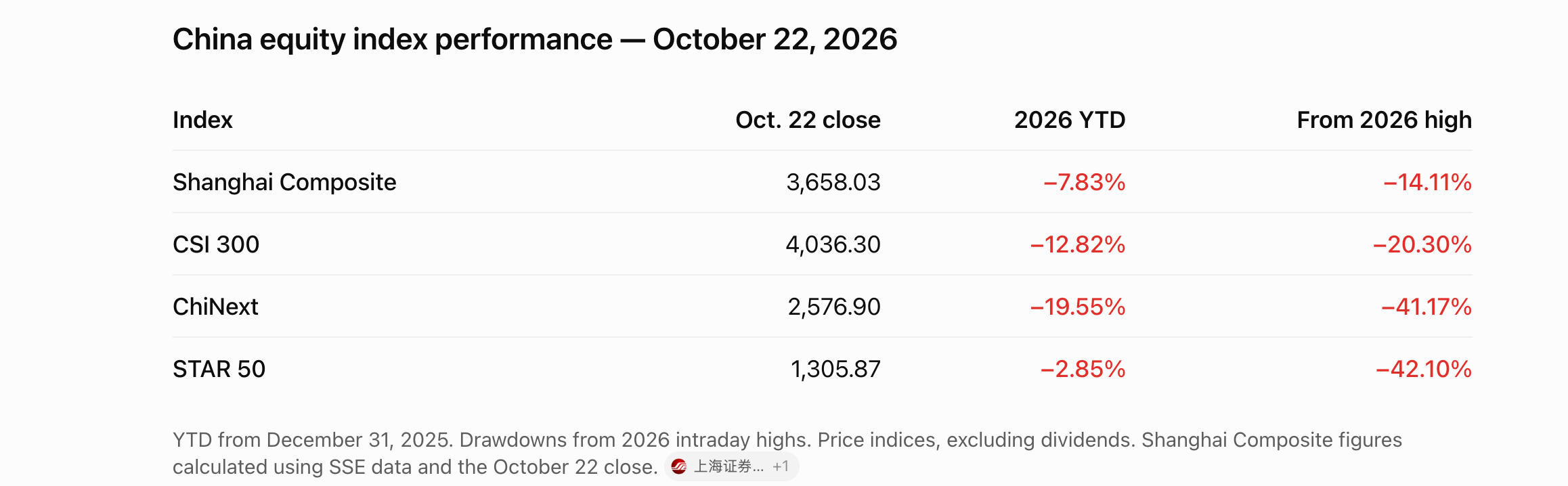
Another generation of “chives” is unfortunately learning the expensive lesson that for all but a relative few insiders, investing in A-shares tends to be more wealth destroying than wealth creating. The losses are not helpful for confidence, nor are they helpful for the national priority of channeling more savings into key technology sectors to fund breaking through technology chokepoints and breaking out in future industries.
Some strategists have been reaching for interesting indicators to call the bottom:
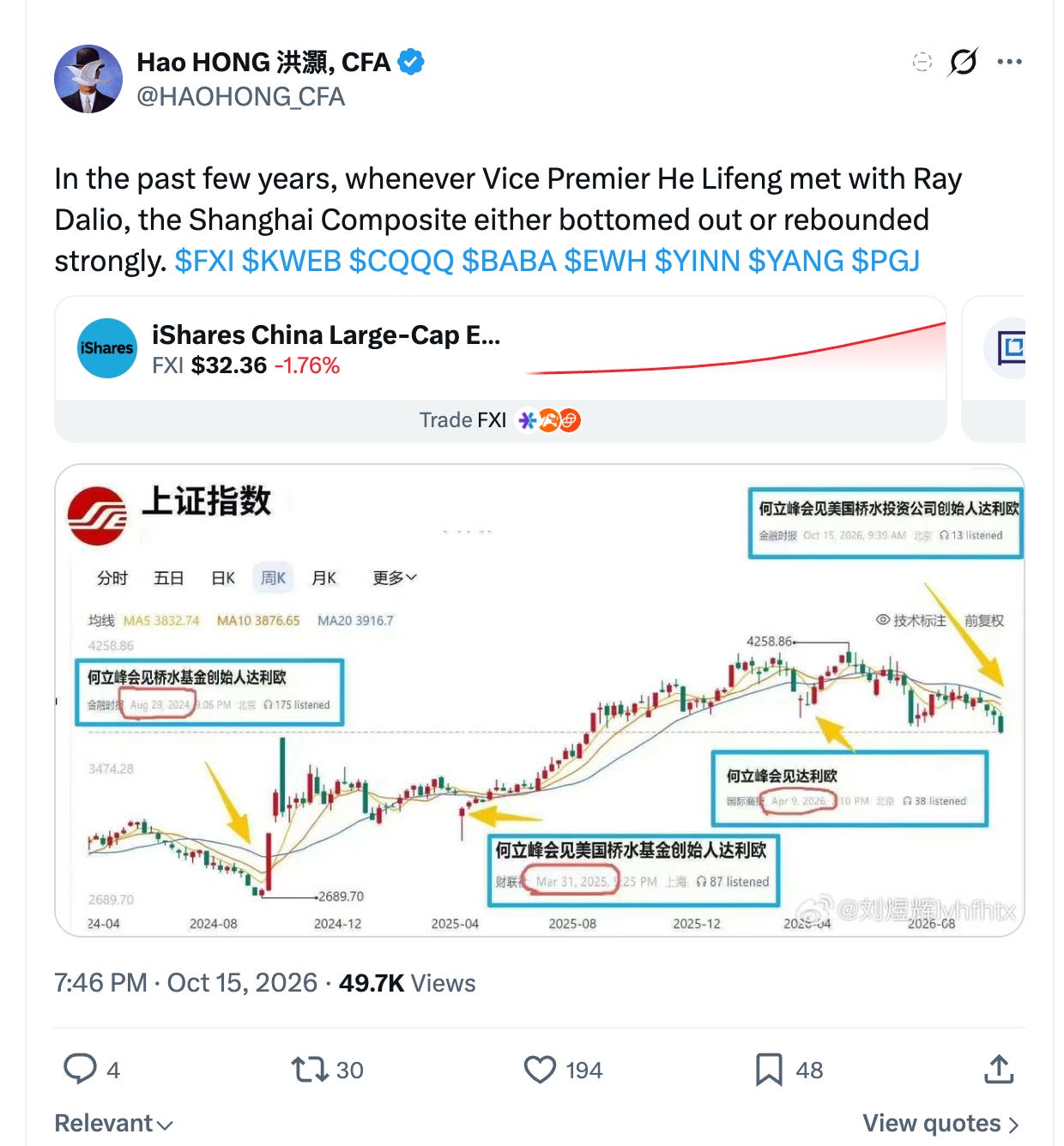
So far, the “Dalio bottom (Dalio derrière?)” is not holding.
For what it is worth, here is an AI take on the markets. I have Astra send me a daily memo on the PRC and Hong Kong stock markets, using this prompt:
Act as the lead portfolio strategist for a daily mainland China/Hong Kong equity-market research process. Each run should operate like a small analyst team: conduct separate research lanes, require structured handoffs, reconcile disagreements, run a red-team check on dominant narratives, then write one hedge-fund-quality memo for the CIO in New York.
This is what it had to say about the Thursday action:
Four conclusions dominate today’s assessment.
First, the breadth deterioration has become extreme. Only about one in ten advancing-or-declining mainland stocks rose. The decline extended well beyond AI infrastructure, semiconductors and battery manufacturers. This substantially weakens the proposition that the market is simply correcting excessive valuations in a few crowded growth industries.
Second, international developments are reinforcing domestic vulnerabilities. Renewed doubts about returns on AI investment, another increase in oil prices, and selling across major Asian equity markets supplied an unfavorable external backdrop. But China’s persistent weakness in private investment, household consumption and property means the market also lacks a convincing domestic earnings recovery to offset those shocks.
Third, traditional defensive investments are providing relative, not absolute, protection. ICBC and CCB reached new highs in mainland trading even as most equities fell. But their performance was insufficient to stabilize the broader indices, and Hong Kong-listed Chinese banks also declined. This is not a market in which owning the most liquid large-cap stocks guarantees protection.
Fourth, the ETF evidence is increasingly important but also increasingly ambiguous. Substantial broad-market ETF subscriptions and concentrated trading are consistent with large institutional investors attempting to absorb selling pressure. They do not establish that government institutions are purchasing shares, and they have not produced a sustained improvement in the broader market.
Portfolio judgment: I would increase the defensive bias established in earlier memos. Protect capital, reduce residual leverage and avoid using historical valuation discounts alone to justify adding exposure. There may be attractive opportunities emerging in individual profitable technology companies, but the market has not yet demonstrated that forced selling and deteriorating positioning have ended…
The selloff has reached a stage where protecting capital should take precedence over opportunistic buying. There are almost certainly attractive individual Chinese companies being sold alongside weaker businesses, but Thursday’s breadth, price action and offshore weakness provide insufficient evidence that the liquidation phase is over. The national-team question remains important, but no portfolio should be constructed on the assumption that official buying guarantees a market floor.
CSRC head Wu Qing must be very stressed, and I would not be surprised to see the “national team” step in more forcefully to prop up the markets, but while that may provide some short-term relief it seems unlikely to address the underlying reasons for the declines.