
Earlier today I published this week’s episode of Sharp China, in which we discussed the EU-China trade talks, Xi’s health and succession, and the possibility that the Trump Administration has hit “peak dove” on China. You can listen to it here.
In this issue:
1. National Health and Wellness Conference
2. Xi meets with leaders from Botswana and Togo
3. Cold water on the EU-China trade outcomes?
4. Visa finally gets approval for a bank card clearing institution
5. Huang Qifan under investigation
The Feed: Business, Economy and Trade - Politics and Law - Foreign and Defense Affairs - Hong Kong and Macao - Taiwan - Tech and Media - Society, Arts, Sports, Culture and History - Energy, Environment, Science and Health - Education - Rural and Agricultural Issues
Today’s top items:
1. National Health and Wellness Conference - The National Conference on Health and Wellness convened from October 12 to 13 in a major political mobilization for delivering the health commitments in the 15th Five-Year Plan. The previous one was held in 2016. The entire Standing Committee attended and Xi of course gave an “important speech” in which he:
stressed that the 15th Five-Year Plan period is a critical period for achieving the goal of building a Healthy China by 2035. China must unswervingly follow the distinctively Chinese path for health and wellness development, implement the guidelines for health and wellness work in the new era, leverage strengths, consolidate foundations, shore up shortcomings and reinforce weak links, promote the high-quality development of health and wellness undertakings, continuously improve the people’s health, and ensure decisive progress in building a Healthy China.
Among the key points from his speech:
Health must influence government decisions so planning, policy design, project appraisal and construction should prioritize their effects on health;
Prevention comes first so there should be more focus on healthier lifestyles, food safety and disease-control capacity, including preventing large-scale epidemics;
Strengthen care close to home so they need to improve and expand county and community institutions, tiered diagnosis and treatment, chronic-disease management and better integrate Chinese and Western medicine;
Coordinate healthcare, insurance and pharmaceuticals so there needs to be deeper reform of public hospitals around their public-service purpose; reasonable patient costs and optimization of procurement and insurance payments while preserving fund security;
Build capacity in medical research, innovation, health industries and personnel.
He also talked about China’s global role:
Xi stressed that health for all is a common aspiration of humanity. China should actively promote the building of a global community of health for all, join hands in responding to major challenges in health and wellness, and continuously improve the health and well-being of people in all countries. Health and wellness cooperation under the Belt and Road Initiative should be deepened, and China’s foreign health assistance should be strengthened and innovated. China should tell its Healthy China story well and further build international consensus.
The PRC has made incredible strides in health care in the last decade. There is still much to be improved, but this is one area where policymakers deserve a lot of credit.
2. Xi meets with leaders from Botswana and Togo - According to the readout of his meeting with the Botswana President, translated here, mining was on Xi’s agenda:
Xi put forward four proposals for advancing China-Botswana and China-Africa mining cooperation. First, uphold the premise of cooperation that Africa’s resources belong to Africa. China is willing to share its experience and help African countries formulate mining development plans suited to their national conditions. Second, uphold the philosophy of cooperation that balances principles and interests and pursues mutual benefit. China will continue to encourage Chinese companies to improve their operational capabilities, transfer green technologies suited to Africa’s realities, and promote South-South cooperation in mining development. Third, uphold high-quality development as the direction of cooperation. China will continue to promote the transformation of China-Africa mining cooperation toward industrial value addition, explore affordable and sustainable innovative financing models, and support Africa’s modernization through high-standard cooperation. Fourth, uphold a fair and open environment for cooperation. Africa’s resources should not become tools of geopolitical struggle. China welcomes genuine efforts by all parties to support Africa’s development and is willing to work with African countries to create more favorable conditions for corporate investment and operations...
习近平就推动中博、中非矿业合作提出4点主张:一是坚持非洲资源属于非洲的合作前提。中国愿分享自身经验,帮助非洲国家制定符合国情的矿业发展规划。二是坚持义利相兼、互利互惠的合作理念。中方将继续鼓励中国企业提升运营能力,转移符合非洲实际的绿色技术,推进矿业发展南南合作。三是坚持高质量发展的合作方向。中方将继续推动中非矿业合作向产业增值转型,探讨可负担、可持续的创新融资模式,以高水平合作助力非洲现代化进程。四是坚持公平开放的合作环境。非洲的资源不应成为地缘政治斗争工具,中方乐见各方真心助力非洲发展,愿同非方一道,为企业投资经营创造更适宜条件。
The two countries issued the “Joint Statement between the People’s Republic of China and the Republic of Botswana on the Establishment of a Comprehensive Strategic Cooperative Partnership”, translated here.
3. Cold water on the EU-China trade outcomes? - A Tuesday post from Yuyuan Tantian, translated here, may have thrown a bit of cold water on the claim that hybrid vehicle exports to the EU will be cut in half. Perhaps they are trying to signal strength to a domestic audience, but it makes it sound like there are some potential misunderstandings:
Tanzhu has learned that the baseline used in the negotiations was the number of hybrid vehicles the EU imported from China in 2025: 302,000.
谭主了解到,双方谈判时的基准,是2025年欧盟自中国进口混动汽车的数量:30.2万辆。
The claim that exports would “fall by more than half” came from the EU and serves the EU’s own narrative.
“减少一半以上”的说法来自欧方,服务的是欧方自己的叙事。
The EU subsequently extrapolated the expected volume of exports over the next four years using the growth rate of China’s hybrid-vehicle exports to Europe in recent years. It then compared that figure with the arrangement reached through the consultations and arrived at the claim that exports would “fall by more than half.”
欧方后来按过去几年中国混动汽车对欧出口的增速,推演出未来四年的预期出口量,再与磋商后的安排比较,得出“减少一半以上”的说法。
This extrapolated export volume was not the basis for the two sides’ actual consultations.
这个推演的出口量并不是双方实际磋商的依据。
Forecast data are inherently uncertain. Export performance in recent years was affected by many short-term market factors.
预测数据本身有不确定性。过去几年的出口情况包含了很多市场短期因素的影响。
It is inappropriate to use performance during a period of temporary fluctuations to make a linear projection for the next four years…
拿阶段性波动时期的表现去线性推演未来四年的情况,并不合适。Therefore, in assessing these negotiations, it is important to distinguish between the story the EU tells publicly and what the two sides actually agreed.
所以看这次谈判,要把欧方对外讲的故事和双方实际谈妥的内容分开看。
And this from South China Morning Post’s Finbarr Bermingham adds to the confusion:
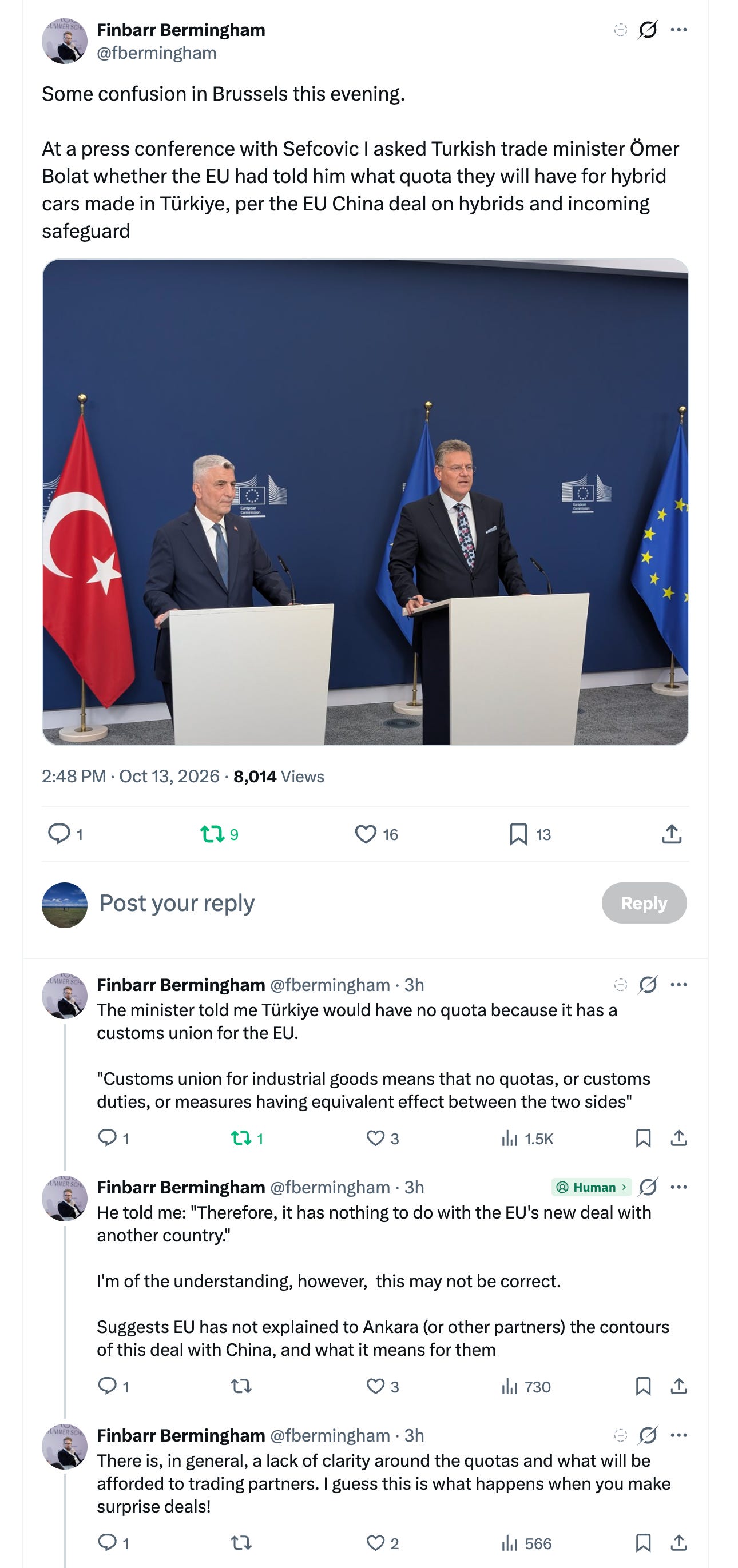
4. Visa finally gets approval for a bank card clearing institution - Almost two decades after Visa should have been allowed to set up a bank card clearing institution in China, the regulators granted approval to start the process. This long overdue approval is not a “deliverable” from Xi-Trump talks, nor is it a gesture of goodwill to the US given how long the PRC has dragged out this process, and how mature and competitive the payments space now is. But the Visa CEO, currently also the chair of the US-China Business Council, will now have even more incentive to act as a damper on US-China relations.
5. Huang Qifan under investigation - Sometimes the rumors are correct, and we got confirmation today that former Chongqing mayor Huang Qifan, 74, is in trouble. Huang’s political career effectively ended in 2016 after he left his post as mayor of Chongqing, where he served with Bo Xilai and then Sun Zhengcai, both of whom are now in prison. He clearly had some sort of political protection, but whatever that was is no longer operative.
After he was sidelined in 2016 he became politically irrelevant but remained a popular commentator on economic policies. We do not know why Huang’s luck ran out, but Caixin has some suggestions:
Since the 20th Party Congress, eight senior Chongqing officials have fallen: Zheng Hong, Xiong Xue, Lu Kehua, Duan Chenggang, Jiang Duntao, Hu Henghua, Luo Lin and Huang Qifan. In addition, Li Yuefeng and Wu Cunrong also previously served in Chongqing...
中共二十大以来,重庆已有郑洪、熊雪、陆克华、段成刚、江敦涛、胡衡华、罗蔺、黄奇帆等八名高官落马。此外,李钺锋、吴存荣也曾任职于重庆。
In addition, within the space of a month, two senior executives of important financial platforms that Huang built during his tenure have fallen, drawing attention. On September 12, Xie Wenhui, former Party secretary and chairman of Chongqing Yufu Holding Group Co., Ltd., was placed under investigation; he had long worked in the Chongqing Rural Commercial Bank system. On September 30, Wu Jian, former Party secretary and chairman of Southwest Securities Co., Ltd., was placed under investigation; he had served as a Party committee member and deputy general manager of Chongqing Yufu Assets Management Group Co., Ltd. Caixin also understands that Huang’s downfall is said to be related to problems in the mixed-ownership reform of some of the city’s state-owned enterprises during his time as mayor of Chongqing. And during his tenure as mayor, he lived through the downfall of two municipal Party secretaries, Bo Xilai and Sun Zhengcai.
此外,一个月内,黄奇帆任内打造的重要金融平台有两名高管落马,引发关注。9月12日,重庆渝富控股集团有限公司原党委书记、董事长谢文辉被查,他长期在重庆农商行系统工作;9月30日,西南证券股份有限公司原党委书记、董事长吴坚被查,他曾担任重庆渝富资产经营管理集团有限公司党委委员、副总经理。另据财新了解,黄奇帆落马据称与其担任重庆市长期间该市部分国企混改存在的问题有关。而他在重庆市长任上,经历了薄熙来和孙政才两任市委书记的落马。
Chongqing is a cursed posting for politicians. Former Chongqing Party Secretary Chen Min’er is in his second term on the Politburo and now in Tianjin, but any talk of him for a bigger promotion seems to have died out. Yuan Jiajun, with a background in the aerospace sector, is the current Party Secretary there.