
Looking back over the trials and hardships of the road traveled, the lens of time reveals change as well as steadfastness. The transformation in the way China and the United States interact demonstrates the new atmosphere and reshaping of the world brought by the Eastern power China as it advances step by step toward great rejuvenation. What has not changed is China’s historical initiative in bravely shouldering the responsibilities of a major country...
回望一路走来的风雨兼程,岁月的镜头里,看得见变化,也读得出坚守。中美相处方式之变,彰显中国这个东方大国一步步迈向伟大复兴给世界带来的新气象、新塑造。而不变的,是她勇担大国责任的历史主动。- September 28 People’s Daily account of Xi’s visit to the US
In this issue:
1. Outcomes from the Xi-Trump meetings
2. Propaganda on Xi’s visit
3. State Council executive meeting signals Q4 support for the economy
4. PRC-Philippine tensions
5. More Nvidia chips for China?
6. Special tax squads
The Feed: Business, Economy and Trade - Politics and Law - Foreign and Defense Affairs - Tech and Media - Society, Arts, Sports, Culture and History - Energy, Environment, Science and Health
I have had a hard time parsing the substance from the pomp of Xi Jinping’s visit to DC last week. I have some initial thoughts and hope to have more later this week.
But before we get to a discussion of the Trump-Xi bonhomie, it is worth highlighting the signals from the Monday State Council Executive Meeting. Based on the readout, translated here, the leadership is now worried about economic performance for the rest of the year and may be looking at a Q4 supplementary stimulus. From the readout:
“in response to problems in current economic performance, macro policy should increase countercyclical adjustment to keep the economy developing toward new and better growth and strive to meet annual development targets…Practical additional policies should be introduced: improve fiscal spending, use remaining local-government debt quotas, use and adjust monetary tools as appropriate, increase re-lending quotas for innovation, technological upgrading, agriculture, and small firms, and study policies to stabilize the property market and promote employment and income.”
Xi’s visit last week is not likely to do much for China’s Q4 economic performance, but it was another step towards stabilizing the strategic stalemate between the two countries.
The most important outcome from the meetings was not the agreement on the Board of Trade and the $30B of covered goods on each side, it was the convergence of the description of the relationship to “a constructive China–U.S. relationship of strategic stability based on respect, fairness, and reciprocity”. After Beijing the Chinese side had used “a constructive China–U.S. relationship of strategic stability” and the US side added “on the basis of fairness and reciprocity”.
In his remarks after the visit, Wang Yi had this to say about the new description:
An important political outcome of this visit was that President Xi and President Trump further expanded the substance of this new positioning of China–U.S. relations. They affirmed the importance of respect, fairness, and reciprocity, and agreed to build “a constructive China–U.S. relationship of strategic stability based on respect, fairness, and reciprocity,” providing clearer strategic guidance for China and the United States as they explore how major countries should get along. Respect means respecting each other’s sovereignty and territorial integrity, the social systems and development paths each has chosen, and each other’s core interests and major concerns. Fairness means pursuing mutually beneficial cooperation, addressing differences through consultation, refraining from zero-sum games in which one side wins at the other’s expense, and not seeking unilateral absolute advantage. Reciprocity means that the two countries are equal in sovereignty, with neither above nor below the other; that neither should act in a domineering or bullying manner; that each side’s concerns should be addressed on a reciprocal basis; and that cooperation in all fields should develop in a balanced way. President Xi pointed out that China and the United States, as two major countries, bear a historic responsibility to advance human development and progress. They should act with the responsibility befitting major countries, respond to the expectations of their peoples and the broad trends of the times, and explore a new path for major countries to get along properly. Achieving the great rejuvenation of the Chinese nation and making America great again can proceed in parallel without conflict, enable each other’s success, and benefit the world.
此访重要的政治成果是习近平主席同特朗普总统进一步拓展了中美关系新定位的内涵,明确尊重、公平、对等的重要性,同意构建“基于尊重、公平、对等的中美建设性战略稳定关系”,为中美探索大国相处之道提供了更明确的战略指引。尊重就是尊重彼此主权和领土完整,尊重各自选择的社会制度和发展道路,尊重对方核心利益和重大关切。公平意味着开展互利合作,协商处理分歧,不搞你输我赢的零和博弈,不追求单方面的绝对优势。对等意味着两国主权平等,没有高低之分,不搞霸道霸凌,对等解决各自关切,平衡发展各领域合作。习近平主席指出,中美两个大国肩负着促进人类发展进步的历史重任,应当展现大国担当,顺应人民期盼和时代大势,探索一条大国正确相处的新路。实现中华民族伟大复兴和让美国再次伟大,完全可以并行不悖、相互成就、造福世界。
I have translated Wang Yi’s full remarks here.
Another important outcome was that the two sides could only agree on a two-month extension of the tariff and non-tariff measures that expire November 10. In an explainer of the outcomes of the eighth round of China-US Economic and Trade Consultations, translated here, the head of MOFCOM’s Department of American and Oceanian Affairs had this to say about the two month extension:
In October 2025, the two sides reached a joint arrangement in Kuala Lumpur to address their respective economic and trade concerns, suspending some of each side’s tariff and non-tariff measures until November 10, 2026. In these consultations, they agreed to extend the Kuala Lumpur joint arrangement until January 10, 2027, while continuing to actively discuss the matter with a view to reaching a mutually agreed solution. This gives both sides room to take stock of and assess implementation and consider next steps, while combining a time-limited extension with further active discussions to give businesses a relatively stable and predictable policy environment. We believe they will continue working through high-level economic and trade contacts before year-end to find a positive solution on a further extension.
2025年10月,中美双方在吉隆坡就解决各自关切的经贸问题达成联合安排,将双方各自部分关税和非关税措施暂停实施至2026年11月10日。本次经贸磋商中,中美双方同意在将吉隆坡经贸磋商联合安排延期至2027年1月10日的基础上,继续积极探讨这一事项,旨在达成双方同意的解决方案。此种安排一方面为双方各自盘点、评估联合安排落实情况,思考下一步如何推进中美经贸关系提供了空间,另一方面通过一定期限的延期和继续积极讨论相组合的方式,为双方企业合作提供相对稳定、可预期的政策环境。相信双方将继续努力,通过年底前的高层经贸互动,就继续延期找到积极的解决方案。
The US, as the White House made clear in its fact sheet on the visit, still has “concerns regarding supply chain shortages related to rare earths and other critical minerals”.
I have created a chart comparing the PRC statement on the “eight outcomes” with the White House fact sheet; there are some inconsistencies:
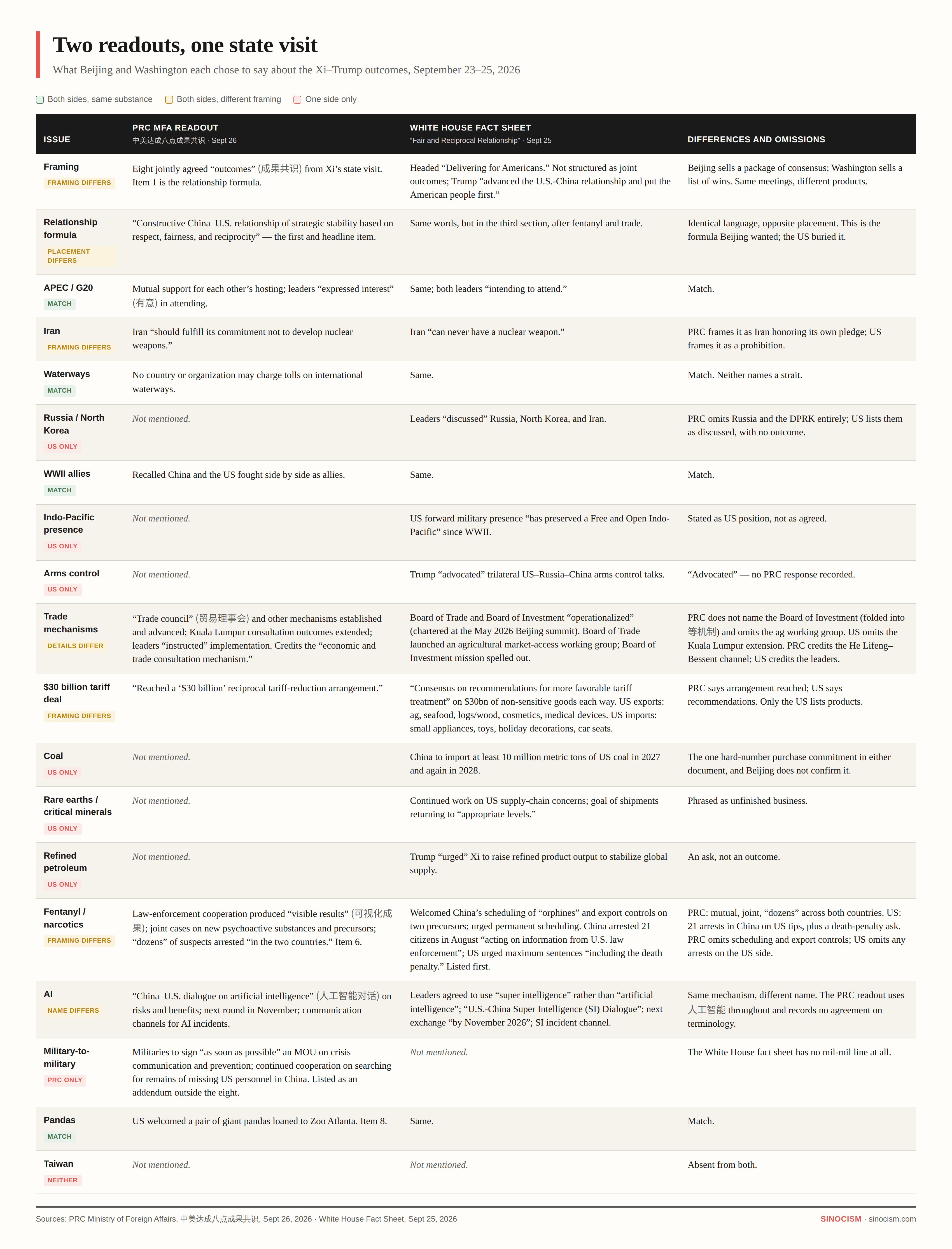
Taiwan was not mentioned in either readout, but according to the readout of Xi’s talks with President Trump, Xi “expressed the hope that the U.S. side would uphold the correct position of opposing ‘Taiwan independence’ and handle the Taiwan question prudently”. That implies that the US “opposes” Taiwan independence, but the official US position is “does not support” and US officials say there has been no change to that policy, no matter how much Xi wishes for that shift.
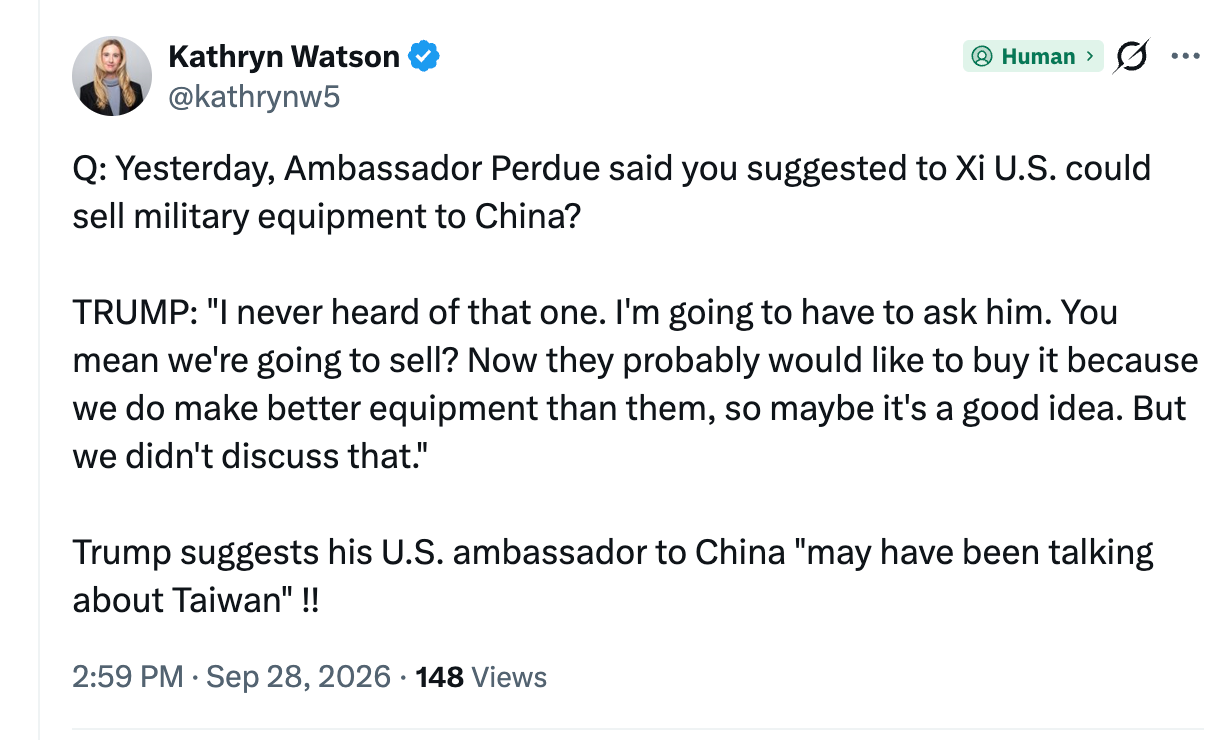
The latest US arms sales package is still on hold, and the US Ambassador to the PRC created a bit of a mess when he said that Trump had offered to sell weapons to Xi. Trump today denied that:
The two leaders will meet again in November in Shenzhen and then in December in Miami, so the relative stability should persist.
But I am sticking with what I wrote in May when Trump was in Beijing:
On the day Trump arrived in Beijing, the Institute of American Studies research group of the MSS think tank China Institutes of Contemporary International Relations (CICIR), issued a report titled “The Great Changes in the World and the Way for China and the US to Coexist”, which I have translated in full here. The abstract says the two countries have “entered a new phase of strategic stalemate 战略相持的新阶段”…
Previous US administrations had resisted entering into these kinds of new frameworks defined by the PRC side, so even with the US conditions of “on the basis of fairness and reciprocity” this is a very significant move by the Trump team. I believe they understand that the Chinese will use this hard won period of tenuous stability to do everything they can to derisk and reduce reliance on the US, as the PRC effectively articulated in the new 15th Five-Year Plan, but it is not clear the US side has the political will or capacity to do the same, especially as the PRC will be using every lever at its disposal to push back on further attempts in the US to derisk and reduce reliance on the PRC.
And I would caution about overconfidence in this period of tenuous calm.