
The entry of the China-US strategic contest into a new phase of strategic stalemate is the second logical premise for our consideration of the correct way for China and the United States to get along. From the historical experience of great-power rivalries, the relations between major powers in a stalemate phase often face severe tests of high winds and rough seas, even of stormy waves; if handled poorly, the relationship faces the major risk of capsizing. How China and the United States coexist in the stalemate phase concerns not only the two countries but the entire world. - China Institutes of Contemporary International Relations
Today’s top items:
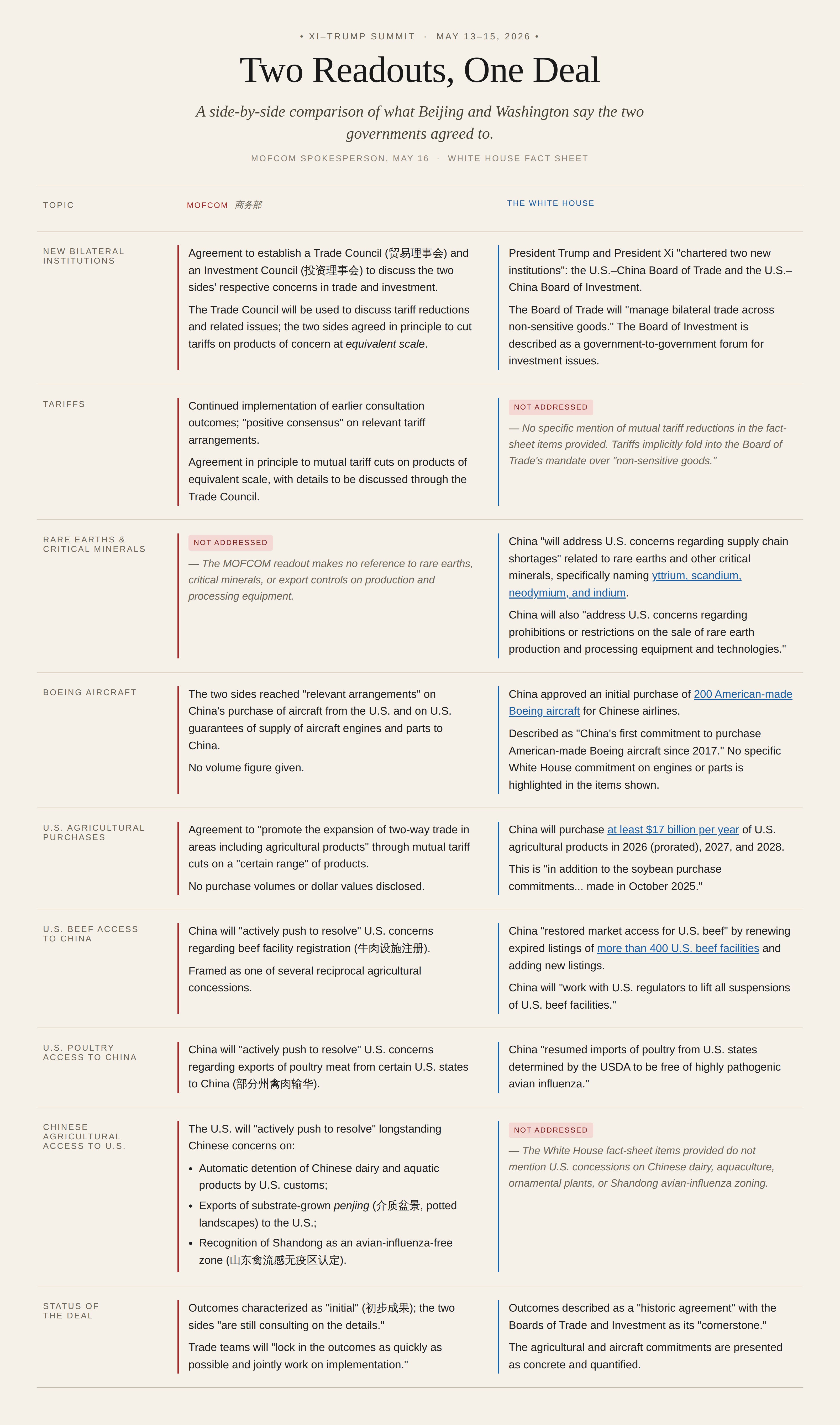
1. Outcomes from Trump’s visit to China - On Saturday the Ministry of Commerce released a statement on initial outcomes from the summit, and on Sunday the White House issued a fact sheet. They are not in complete alignment, but there will be a Board of Trade, to facilitate “managed trade”, and a Board of Investment. I had Claude create this comparison graphic:
The White House fact sheet also stated that:
President Trump and President Xi agreed that the United States and China should build a constructive relationship of strategic stability on the basis of fairness and reciprocity. President Trump will welcome President Xi for a visit to Washington this fall. The two countries will support each other as the respective hosts of the G20 and APEC Summits later this year.
Both leaders agreed Iran cannot have a nuclear weapon, called to reopen the Strait of Hormuz, and agreed that no country or organization can be allowed to charge tolls.
President Trump and President Xi confirmed their shared goal to denuclearize North Korea.
The PRC side did not mention the second and third points.
Agreeing “that the United States and China should build a constructive relationship of strategic stability on the basis of fairness and reciprocity” is a big win for Xi Jinping and the PRC, as this framework is an evolution of Xi’s longstanding attempts to get the US to agree to a new type of major/great-power relationship with the United States. The US side added “on the basis of fairness and reciprocity”, and right now the White House does not see a lot of fairness and reciprocity in the relationship, so this new phase of strategic stalemate may be stabilizing but it is also tenuous.
2. Constructive relationship of strategic stability - I wrote Thursday that so far this looked to be the most important outcome from the meeting, and that conclusion stands. Wang Yi briefed the media Friday on the meetings and discussed the concept in a bit more detail. This has been a concept long in the works, and as I wrote above it is an evolution of the idea of a new type of major/great-power relationship with the United States.
On the day Trump arrived in Beijing, the Institute of American Studies research group of the MSS think tank China Institutes of Contemporary International Relations (CICIR), issued a report titled “The Great Changes in the World and the Way for China and the US to Coexist”, which I have translated in full here. The abstract says the two countries have “entered a new phase of strategic stalemate 战略相持的新阶段”:
The two countries urgently need to explore a correct way of getting along that fits the new realities of the relationship. To this end, the Institute of American Studies of the China Institutes of Contemporary International Relations established a research group to consider, against the backdrop of great changes in the world and the new phase of China-US relations, how to build a constructive China-US relationship of strategic stability framework, and to push the two major powers toward mutual respect, peaceful coexistence, and win-win cooperation.
两国迫切需要探索一条适应中美关系新现实的正确相处之道。为此,中国现代国际关系研究院美国研究所成立课题组,立足世界大变局和中美关系新阶段,思考如何构建中美建设性战略稳定框架,推动中美两个大国迈向相互尊重、和平共处、合作共赢。
Previous US administrations had resisted entering into these kinds of new frameworks defined by the PRC side, so even with the US conditions of “on the basis of fairness and reciprocity” this is a very significant move by the Trump team. I believe they understand that the Chinese will use this hard won period of tenuous stability to do everything they can to derisk and reduce reliance on the US, as the PRC effectively articulated in the new 15th Five Year Plan, but it is not clear the US side has the political will or capacity to do the same, especially as the PRC will be using every lever at their disposal to push back on further attempts in the US to derisk and reduce reliance on the PRC.
As Li Haokai wrote in a Substack post “Stripping Away the Optimistic Rhetoric of the Xi-Trump Summit Reveals China’s Realist Playbook” on the outcomes:
My overarching assessment is that we must strictly distinguish the superficial optics of this summit from the true, underlying nature of the relationship. Within China, very few serious strategists are viewing these developments as positively as they appear. Instead of a genuine relationship “recovery” or a strategic reset, some of the leading Chinese scholars interpret the current dynamic through the lens of hard-nosed realpolitik. Tracking the assessments of prominent figures like Wu Xinbo, Yan Xuetong, and Jin Canrong reveals that we might be witnessing a calculated stalling tactic (缓兵之计) from both sides designed to manage risk as both nations lock into a protracted strategic stalemate (战略相持).
3. Trump’s problematic Taiwan comments - There was concern going into the summit that President Trump might agree to change US policy from “not supporting” Taiwan independence to “opposing” Taiwan independence, and that he would further delay or cancel a planned large arms slle to Taiwan. He was remarkably disciplined in his comments on Taiwan, until his Friday interview for Brett Baier of Fox News. From the transcript:
Donald Trump: they have somebody there now that wants to go independent. Well, it’s a very risky thing. When you go independent, you know, they are going independent because they want to get into a war, and they want to, they figure they have a United States behind them, I’d like to see it stay the way it is.
And I’ll tell you something, I’ll make a little news, I’d like to see everybody making chips over in Taiwan come into America, because to be honest with you, I think it’s the greatest thing you can do, because it’s a heated situation…Bret Baier: Should the people of Taiwan feel more or less secure after your meetings with President Xi?
Donald Trump: Neutral. Neutral. This thing going on for years...
Bret Baier: Has the policy changed at all?...
Donald Trump: No, nothing has changed. I will say this: I’m not looking to have somebody go independent, and you know, we are supposed to travel 9,500 miles to fight a war. I’m not looking for that. I want them to cool down. I want China to cool down.
Bret Baier: But you are waiting on approving billions of dollars of weapons for Taiwan. Is that moving forward?
Donald Trump: That’s, well, I have not approved it yet. We are going to see what happens. I may do it. I may not do it.
Bret Baier: Yes, what’s your hinge point?
Donald Trump: Well, I’m not going to say that. But I may do it, I may not do it. But we are not looking to have wars, and we are, if you kept it the way it is, I think China is going to be OK with that. But we are not looking to have somebody say let’s go independent, because the United States is backing us. You know?
Bret Baier: So, President Xi probably liked that you have not approved the weapons to Taiwan.
Donald Trump: I would say like is maybe too strong a word, because he thinks I could do it with just the signing of my signature, unlike Biden, who couldn’t sign his signature. No, I’m holding that in abeyance, and it depends on China. Depends, it’s a, it’s a very good negotiating chip for us, frankly. It’s a lot of weapons, it’s $12 billion.
So officially the US policy has not changed, but his comments have caused a lot of consternation. So now we have to wait to see if the arms package is approved, either in its full size or broken up into smaller chunks, or just cancelled. And if it is killed, will Trump get something for it from Xi? The DPP should probably increase its DC lobbying budget…