Today’s top items:
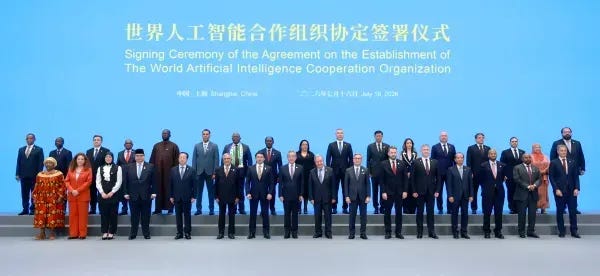
1. World Artificial Intelligence Cooperation Organization - Ahead of the Friday opening of the World Artificial Intelligence Conference (WAIC), Xi hosted a welcome banquet and Wang Yi signed an agreement with representatives from 29 countries for the establishment of the World Artificial Intelligence Cooperation Organization. Andrew and I talked a lot about what to expect at the WAIC in this week’s episode of Sharp China, which you can listen to here.
2. “What China wants to explore is another order” for AI - So says the CCTV account Yuyuan Tantian 玉渊谭天 on the eve of the WAIC, in 中国AI的发展逻辑 The Logic of China’s AI Development, translated here. From the article:
Core technology is held by a few, and other participants can only get products and services while finding it very hard to build up technical capability of their own. In the AI era — closed-source models, paid APIs, restricted compute, locked-down ecosystems — the higher the concentration of technology, the more solid the relations of dependency in the global AI industry become.
核心技术掌握在少数人手中,其他参与者只能获得产品、服务,却很难真正积累自己的技术能力。进入人工智能时代后,模型闭源、接口收费、算力受限、生态锁死,当技术集中度越高,全球AI产业的依附关系就会越稳固。
What China wants to explore is another order: pooling the strength of all humanity and all countries to build an open-source, all-factor AI ecosystem.
而中国想探索的,是另一种秩序——集全人类、各国合力,实现开源的、全要素的AI生态构建。
This is because AI is a wholly different sort of technology and is bound to raise a series of security and ethical questions. Only with global participation and shared effort can a safe and effective path of development be found.
这是因为,人工智能是一项截然不同的技术,势必会引发安全、伦理等一系列问题,唯有全球共同参与、共同努力,才能走出一条安全、有效的发展道路。
At the 2026 World Artificial Intelligence Conference, the open logic of “all-factor sharing” in China’s international AI cooperation will be presented as a clearer, more concrete action framework. The conference may also go further toward answering where the global AI order is headed.
在2026世界人工智能大会上,中国人工智能国际合作“全要素共享”的开放逻辑,将呈现出更清晰、更具体的行动框架。大会也或许会进一步回答全球AI秩序会向何处演进。
3. Kimi’s monster new model - Moonshot is the latest PRC firm showing the way to building open-source AI, with the release today of Kimi K3, which from early reviews is a frontier-class model. Kimi obviously timed the release for the eve of the WAIC, and I will assume they coordinated it with the relevant organs. If it is as good as the initial reviews say it is, this could change lots of assumptions.


4. July 15th issue of Qiushi - I have posted a summary of the 2026 Issue 14 of Qiushi, along with selected full translations, here. The most interesting article may be Raising the Household Consumption Rate by Smoothing Economic Circulation by “special commentator” Xu Qiyuan 徐奇渊, research fellow and deputy director of the Institute of World Economics and Politics at CASS. If Xu is correct, don’t expect any changes to the slow grind towards raising consumption:
Therefore, at the present stage the key to raising China’s household consumption rate lies in promoting the optimization of the demand structure and smooth economic circulation, and in accelerating the formation of a new development model that is led by domestic demand, pulled by consumption, and endogenously growing—not in propping up the indicator through short-term stimulus policies such as “helicopter money” (直升机撒钱), still less in reducing it to a rigid assessment target. Changes in the household consumption rate depend on the relative relationship between the growth rate of household consumption expenditure and the growth rate of GDP. If investment, foreign trade, and the like expand rapidly, making GDP grow faster than household consumption expenditure, the household consumption rate will fall; otherwise it will rise. It is impossible to raise the household consumption rate by suppressing investment and foreign trade activity; the emphasis should be on promoting a higher-level virtuous cycle among investment, foreign trade, and consumption. In addition, household consumption is a slow variable; although short-term consumption subsidies can boost the data, they easily overdraw future potential, and once the policy is withdrawn, growth may fall back, making it hard to drive a fundamental transformation of the development model.
因此,现阶段提升我国居民消费率,关键在于推动需求结构优化和经济循环畅通,加快形成内需主导、消费拉动、内生增长的新发展模式,而不在于通过”直升机撒钱”等短期刺激政策拉抬指标,更不能简化为硬性考核任务。居民消费率的变动,取决于居民消费支出增速和国内生产总值增速的相对关系。若投资、外贸等扩张较快,使国内生产总值增速快于居民消费支出,居民消费率就会下降,反之就会上升。不可能为了提高居民消费率而去抑制投资和外贸活动,重在推动投资、外贸与消费形成更高水平的良性循环。另外,居民消费是慢变量,短期消费补贴虽能拉升数据,却易透支后续潜力,一旦政策退坡,就可能出现增速回落,难以驱动发展模式的根本转型。
5. Australian government gets a new China advisor - Congratulations to Richard McGregor, and to Australian Foreign Minister Penny Wong, on McGregor’s appointment as her new senior advisor.
6. Dealing with the “dog days of summer 三伏天” - We are officially in the “dog days of summer 三伏天”, and this year it is ten days longer than usual. Parts of China are in nasty heat wave, as are we here in DC, along with crazy Canadian smoke pollution that is giving me flashbacks to smoggy Beijing summer days.
The National Health Commission held a press conference held a press conference to offer advice about dealing with the heat. I have translated it here. Some of the suggestions may be useful:
Wang Hongbing, a member of the National Expert Pool for Health Science Popularization and a chief physician at Beijing Hospital of Traditional Chinese Medicine, Capital Medical University, wrote on the Healthy China WeChat account that, as part of the normal calendar cycle, this year’s sanfu period is an “extended” 40 days—10 full days longer than last year—and will run from July 15 through August 23.
国家健康科普专家库成员、首都医科大学附属北京中医医院主任医师汪红兵在“健康中国”微信公众号发文介绍,由于是正常的历法循环,今年的三伏天是40天的“加长版”,比去年多出整整10天,将从7月15日持续到8月23日。
He advised that staying healthy during sanfu requires not only preventing heat illness but also emotional self-care, appropriate exercise and a proper diet; people may also practice the TCM therapy of treating winter ailments in summer. Traditional Chinese medicine holds that the Heart opens into the tongue, corresponds to bitterness among the five flavors, has joy as its associated emotion and sweat as its bodily fluid, and corresponds to summer among the four seasons. Nourishing the Heart is therefore especially important in summer, and people should maintain a happy mood and stable emotions. Suitable summer exercise includes swimming, tai chi, Baduanjin and walking. Avoid the hottest hours with the strongest sunlight, from 11 a.m. to 4 p.m., and reduce exercise intensity appropriately.
他提醒,伏天养生,除了防暑降温,也要注意情志调养、适当运动、饮食得当,同时可进行冬病夏治。中医认为,心开窍于舌,通五味之苦,在志为喜,其在液为汗,应四时之夏,因此,夏季养心非常重要,应该保持心情愉悦、情绪平稳。夏季运动适合的项目包括游泳、太极拳、八段锦、散步等,注意避开气温最高、阳光最强烈的时段(11时至16时),且强度要适当降低。
Tashi is definitely leaning in to the “reduce exercise intensity appropriately” advice: