
Today’s top items:
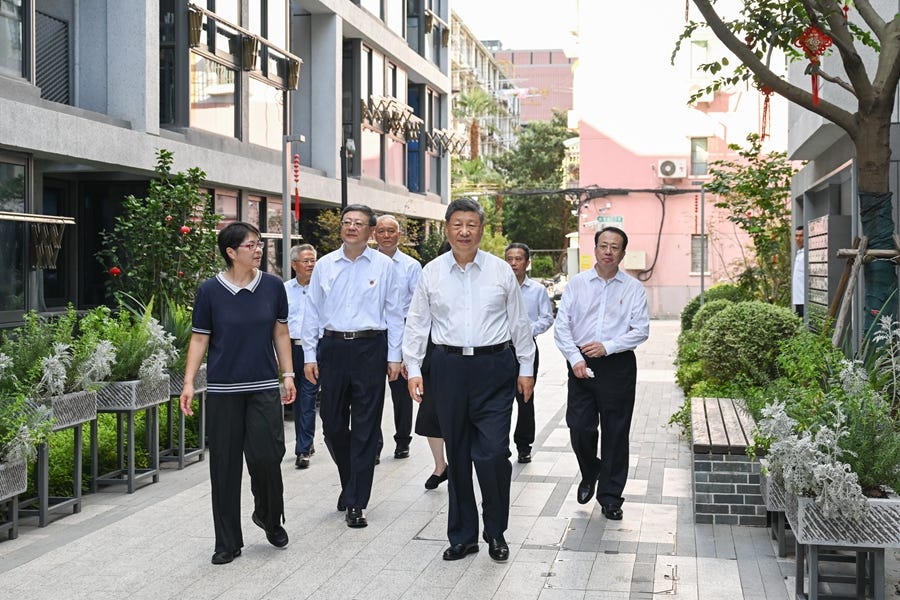
1. Xi inspects Shanghai - As expected, Xi has undertaken an inspection tour of Shanghai ahead of his Friday speech at the World Artificial Intelligence Conference. The key themes from today’s readout:
Xi Jinping stressed during an inspection in Shanghai on the 15th that advancing urban renewal with high quality is an important handhold for urban modernization, that the people’s city concept must be comprehensively put into practice, that one must persist in asking the people what they need, seeking the people’s counsel, and letting the people judge results, that all aspects of urban renewal work must be done deeply, finely, and solidly, and that residents’ sense of gain, happiness, and security must be continually strengthened.
The readout also included comments from Xi about the ongoing flooding in parts of the country:
In the course of the inspection Xi Jinping stressed that this is currently the critical period for flood prevention, and that all localities and all relevant parties must firmly establish bottom-line thinking and worst-case thinking, closely follow rainfall, flood, and typhoon conditions, carry out thorough and meticulous investigation of risks and hidden dangers, do solid work on flood prevention and control and on emergency rescue and disaster relief, and earnestly safeguard the safety of the people’s lives and property.
Will the People’s Leader visit any of the affected regions before returning to Beijing?
2. GDP data - The PRC economy slowed more than expected in Q2. Real GDP growth declined from 5.0% year-on-year in Q1 to 4.3%, below the 4.5% consensus and the lower bound of the government’s 4.5–5.0% full-year target. First-half growth was 4.7%. Sequential Q2 growth of 0.9% was in line with expectations.
AI, high-tech manufacturing, exports and selected modern services are expanding rapidly. Property, private investment, conventional infrastructure and household consumption remain weak. The official Q&A noted that “new growth drivers” contributed more than 40% of economic growth, while officials largely avoided explaining why aggregate investment is contracting.
The GDP deflator turned positive for the first time in 12 quarters.
The data is not great but probably not bad enough for significant new policy measures coming out of the upcoming July Politburo meeting that will discuss the economy. But in his meeting with experts and economists earlier this week, Premier Li, whom I assume already knew today’s data, said “counter-cyclical adjustment must be stepped up; existing policies must be used well and to the full while incremental policies are studied and reserved in advance”.
3. Problems in the US-China trade deal - Bloomberg’s Jenny Leonard reports on the open secret in DC, that the PRC side has not lived up to the Trump-Xi deal but the US is keeping quiet about the problems, especially around rare-earths. From the article:
While there’s plenty of internal grumbling and frustration voiced among Trump officials, those familiar with the situation describe a hush culture where the US government is reluctant to publicly admonish China and risk plunging the countries back into a trade war.
Some officials believe Trump is particularly disinclined toward registering any objection that could endanger his plans to host Xi for a lavish state visit in September. There’s also concern that pushing back could prompt the Chinese leader to escalate retaliation in a way that could rock markets ahead of November’s midterm elections or fully turn off access to critical minerals...
Treasury Secretary Scott Bessent and Jamieson Greer, who leads the trade office, have spent a half-dozen meetings with Chinese representatives over the course of a year attempting to iron out sourcing for the crucial inputs for American firms, only to be rebuffed.
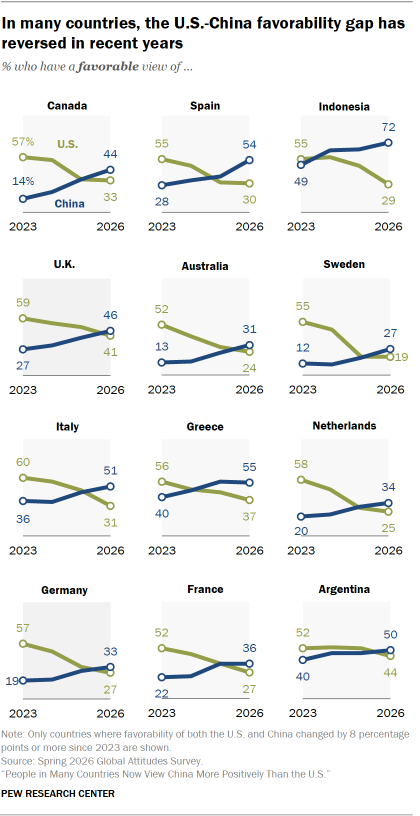
4. Pew Research: China viewed more positively than US in many countries - Pew Research is out with a new survey of respondents in 36 countries that says People in Many Countries Now View China More Positively Than the US:
Views of China have improved in recent years while opinions of the U.S. have worsened, to the point where China is now seen more positively than the U.S. in most of 36 countries surveyed…
China being assessed more positively than the U.S. is a relatively recent shift in most countries surveyed. This reversal in favorability is often driven by shifting views of both superpowers: improving views of China coupled with worsening views of the U.S.
5. Foreign Correspondents Club on reporting challenges - The Foreign Correspondents’ Club of China’s (FCCC) 2025 Media Freedoms Report describes worsening conditions for foreign correspondents and increasing numbers of “sensitive” areas for reporting. Meanwhile, officials, propaganda organs and academics talk about the need for “new” Edgar Snows, as articulated in last week’s report Legacy of Edgar Snow: Contemporary Value and Inspiration to the World from the Xinhua Institute:
Only by approaching China with an objective eye, walking its ground, listening to its people, and seeing it for oneself as Snow did, can one move beyond prejudice and stereotypes, understand the historical inevitability and practical rationality of China’s pursuit of the Chinese path, and view China’s development achievements, opportunities and challenges fairly, it said.
The report said the legacy still inspires the world to build bridges of friendship, promote exchanges and mutual learning and address global challenges with joint efforts.
It called for more “new Snows” to uphold an attitude of openness, inclusiveness, exchange and mutual learning, continue writing new chapters of friendship between China and the rest of the world, illuminate the way forward for the peace and development of humanity, and rally the people of all countries around a new vision of building a better world.
As I wrote in an entry from the January 4, 2021 Sinocism after then MoFA spokesperson Hua Chunying said:
The year 2021 will be of historic significance to China as we will celebrate the CPC’s centenary. In the 1930s and 1940s, when the then Kuomintang government sealed off Yan’an and spared no efforts to “demonize” the CPC, foreign journalists like Americans Edgar Snow, Anna Louise Strong and Agnes Smedley, curious about who and what the CPC is, chose to blend in with the CPC members in Yan’an after going through various difficulties to get there, where they wrote many objective reports as well as works like the famous Red Star over China, giving the world its first glimpse of the CPC and its endeavor in uniting and leading the Chinese people in pursuing national independence and people’s liberation. They were indeed a window for the world to understand the CPC and China. They will always be remembered by the Chinese people as our good and true friends.
The PRC may want only pliant foreign journalists to better “tell China’s story”, but the information environment today is obviously a lot different than it was in the 1930s and 1940s. China is even more important now, across every dimension, so it is quite distressing to see the reversion to a much more constricted information and access. I think that is what Xi Jinping prefers, with the expectation that greater restrictions on foreign access buttress the CCP’s “political security” and allow the Party-State to better pursue its goal of increasing China’s international discourse power, aka “telling China’s story well”. So in some ways we are going back to the future, but now trying to understand a much more complicated country and society with increasingly narrow lenses.
Five years on, the PRC has gotten much more effective at telling its story well, and increasing international discourse power. The Pew poll results are in part a reflection of that.
Thanks for reading.
1. Xi inspects Shanghai
Xi Jinping Inspects Shanghai - Translation
Xinhua, Shanghai, July 15 — General Secretary of the CPC Central Committee, President, and Chairman of the Central Military Commission Xi Jinping stressed during an inspection in Shanghai on the 15th that advancing urban renewal with high quality is an important handhold for urban modernization, that the people’s city concept must be comprehensively put into practice, that one must persist in asking the people what they need, seeking the people’s counsel, and letting the people judge results, that all aspects of urban renewal work must be done deeply, finely, and solidly, and that residents’ sense of gain, happiness, and security must be continually strengthened.
新华社上海7月15日电 中共中央总书记、国家主席、中央军委主席习近平15日在上海考察时强调,高质量推进城市更新是城市现代化建设的重要抓手,要全面践行人民城市理念,坚持问需于民、问计于民、问效于民,做深做细做实城市更新各项工作,不断增强居民群众的获得感、幸福感、安全感。
On the afternoon of the 15th, accompanied by Politburo member and Shanghai Party Secretary Chen Jining and Mayor Gong Zheng, Xi Jinping came to the Shimin Xincun residential district of Bansongyuan Road Subdistrict in Huangpu District for an inspection.
15日下午,习近平在中共中央政治局委员、上海市委书记陈吉宁和市长龚正陪同下,来到位于黄浦区的半淞园路街道市民新村居民区考察调研。
Four buildings in the Shimin Xincun residential district, put up in the 1950s, have had their living conditions markedly improved through reconstruction and renewal, with self-contained kitchens and bathrooms installed and elevators added. Xi Jinping walked into the community comprehensive service point and heard a briefing on Shanghai’s push to upgrade and renovate old housing lacking sanitary facilities, on the historic resolution of the “carrying the chamber pot” problem for residents of the old city districts, and on residential compound renovation, and asked staff on site detailed questions about the situation. Xi Jinping stressed that the Party Center attaches great importance to urban work and has explicitly called for building modern people’s cities that are innovative, livable, beautiful, resilient, civilized, and smart, and that renovating old and dilapidated urban residential compounds is an important link in this. In this work one must firmly establish and put into practice a correct view of performance achievements, think what the masses think and treat as urgent what the masses treat as urgent, formulate and implement effective policies and measures, persevere over the long haul, handle well one by one the matters ordinary people care about, and keep improving the people’s wellbeing. Property management and convenience services in residential compounds must be steadily raised with “embroidery-needle skill,” striving to satisfy the residents...
市民新村居民区4幢上世纪50年代建成的楼房,通过改建更新,设立独立厨卫、加装电梯,居住条件明显改善。习近平走进社区综合服务点,听取上海市推进无卫生设施旧房提升改造、历史性解决老城区居民“拎马桶”问题和小区改造介绍,并向现场工作人员详细询问有关情况。习近平强调,党中央高度重视城市工作,明确提出要建设创新、宜居、美丽、韧性、文明、智慧的现代化人民城市,改造城市老旧小区是重要一环。工作中要牢固树立和践行正确政绩观,想群众之所想,急群众之所急,制定实施有效的政策举措,坚持久久为功,把老百姓关切的事一件一件办好,持续增进民生福祉。要以“绣花功夫”不断提升小区物业管理和便民服务水平,努力让居民群众满意。
Xi Jinping then came to the community Party-mass service station, looked over the supply of fruit and vegetables at a convenience produce stall, and had a cordial exchange in the “citizens’ parlor” with resident representatives, subdistrict cadres, community workers, and others. Xi Jinping pointed out that the community is the basic unit of the urban governance system. The level of community governance must be raised, resources, services, management, and the like must be pushed down to the grassroots front line, and burdens on the grassroots must be continually reduced while empowering them. Party building leadership must be further strengthened, new models must be actively explored for the coordinated operation of residents’ committees, homeowners’ committees, and property service enterprises under the leadership of community Party organizations, complete communities and convenient living circles must be built, and good deeds must be done, practical matters handled, and difficulties resolved for residents with heart and with feeling.
随后,习近平来到社区党群服务站,察看便民菜摊果蔬供应情况,在“市民客厅”同居民代表、街道干部、社区工作者等亲切交流。习近平指出,社区是城市治理体系的基本单元。要提高社区治理水平,推动资源、服务、管理等下沉基层一线,持续为基层减负赋能。要进一步加强党建引领,积极探索社区党组织领导下的居委会、业委会、物业服务企业协调运行新模式,建设完整社区和便民生活圈,用心用情为居民做好事、办实事、解难事。
2. GDP data
In the first half year, under the strong leadership of the Central Committee of the Communist Party of China (CPC) with Comrade Xi Jinping at its core, all regions and departments fully implemented the decisions and arrangements made by the CPC Central Committee and the State Council, adhered to the general principle of pursuing progress while ensuring stability, fully and faithfully applied the new development philosophy on all fronts, moved faster to foster a new pattern of development, made efforts to promote high-quality development and effectively carried out more proactive and vigorous macro policies. As a result, the national economy operated within an appropriate range against pressure. Production and supply grew fast, employment was generally stable, prices increased mildly, foreign trade showed good momentum of growth, new growth drivers witnessed rapid development, and people’s wellbeing was ensured in a strong and effective way. The national economy continued to demonstrate strong resilience.
According to preliminary estimates, the gross domestic product (GDP) in the first half of 2026 reached 69,570.4 billion yuan, up by 4.7 percent year on year at constant prices. By industry, the value added of the primary industry was 3,152.2 billion yuan, up by 3.7 percent year on year; that of the secondary industry was 25,047.3 billion yuan, up by 3.9 percent and that of the tertiary industry was 41,370.9 billion yuan, up by 5.2 percent. By quarter, the GDP for the first quarter increased by 5.0 percent year on year and for the second quarter 4.3 percent. The GDP for the second quarter increased by 0.9 percent quarter on quarter.
Caixin - China’s Growth Misses, but AI and Oil Prices Snap Its 3-Year Deflation Streak
China’s economy grew a weaker-than-expected 4.3% in the second quarter, official data showed Wednesday, but surging AI and energy prices offered a rare bright spot: snapping the country’s three-year deflationary streak.
The real year-on-year growth fell short of the 4.4% median forecast in a Caixin survey, dragged down by sluggish construction activity.
Yet nominal GDP jumped 5.9% year-on-year, outpacing real growth for the first time since the first quarter of 2023. The shift ends 12 consecutive quarters of negative GDP deflator readings — a broad measure of economy-wide prices.
China’s economy grows at one of lowest rates in decades - Financial Times
Retail sales added just 1 per cent in June from a year earlier, while fixed-asset investment was down 5.7 per cent year on year for the first half of the year, compared to 4.1 per cent in the first five months.
Industrial production, one sign of strength, grew 5.3 per cent last month on a year earlier.
Lynn Song, chief greater China economist at ING, said the GDP data showed a “significant deceleration” from the first quarter and pointed to a “sharp weakening in monthly indicators”.
“Though the monthly activity data does not translate directly into the GDP contribution, we have seen fixed-asset investment further crater into negative year-on-year growth [and] retail sales barely in positive territory,” he said.
‘Bad Inflation’ Ends China’s Record Streak of Price Declines - Bloomberg
The so-called GDP deflator, which measures price changes across all domestically produced goods and services, rose 1.6% in the second quarter after three years of contraction. But the turnaround brings little comfort for an economy that slowed in the April-June period to the weakest pace since the last months of 2022.
“The higher price level is cost-push — we can call this ‘bad inflation,’” said Raymond Yeung, chief economist for Greater China at ANZ. Still, he added that positive inflation expectations are better for the economy than remaining stuck in a persistent deflationary trap.
China’s retail sales of goods, services up 2.7% in first half of 2026 | Xinhua
China’s total retail sales of goods and services, a major indicator of the country’s consumption strength, increased by 2.7 percent year on year in the first half of 2026, official data showed Wednesday.
The retail sales of services increased by 5.3 percent in the period from a year ago, and that of goods increased by 1.1 percent, according to data released by the National Bureau of Statistics (NBS).
“As living standards improve, service consumption has increasingly become a key area for unlocking consumption potential,” Mao Shengyong, deputy head of the NBS, told media.
In terms of services consumption, the categories of communication and information services, tourism consulting and leasing services, and cultural, sports and leisure services saw fast growth, the NBS data showed.
Caixin - China’s Industrial Capacity Use Falls to Six-Year Low as Coal, Chemicals Weaken
The utilization rate for industrial enterprises above a designated size dropped to 73%, down 0.6 percentage point from the first quarter and 1 percentage point lower than a year earlier, according to data released Wednesday by the National Bureau of Statistics.
The decline highlights the persistent difficulty of balancing supply and demand in the world’s second-largest economy, as China seeks to rein in excessive industrial competition while shifting toward high-tech growth drivers.
The second-quarter reading was the lowest since the first quarter of 2020, when utilization fell to 67.3% during the initial Covid-19 outbreak. It was also close to levels seen during China’s 2016 supply-side structural reforms. For the first half of 2026, cumulative capacity utilization stood at 73.3%, below the 74.4% average for 2025.
China’s property investment falls 18% in H1 2026 - ECNS
China’s real estate development investment fell 18% year on year to 3.81 trillion yuan ($561 billion) in the first half of 2026 the National Bureau of Statistics said Wednesday. Property sales and developer funding also declined.
Investment in residential projects dropped 17.8% to 2.93 trillion yuan ($431.5 billion). The floor space of newly started projects fell 23.4%, while completed floor space decreased 23.7%.
The floor space of newly built properties sold declined 11.6% to 401.4 million square meters. Sales by value fell 13.6% to 3.79 trillion yuan ($558.1 billion), with residential property sales down 13.7%.
Funds available to real estate developers decreased 20.2% to 4.02 trillion yuan ($592 billion). Domestic loans fell 31.7%, while individual mortgage loans dropped 24.9%.
70-city house prices give off multiple positive signals: more cities with new-home gains in June 70城房价释放多重积极信号!6月新房上涨城市数量继续攀升 Securities Times 证券时报 · 2026-07-15
National Bureau of Statistics data released July 15 show 20 of 70 large and medium cities had month-on-month new-home price gains in June, four more than in May and the most since May 2025. First-tier new-home prices rose 0.1% month on month, a fifth straight gain; second-tier prices went flat after a 0.1% fall; third-tier prices fell 0.3%, narrowing by 0.1 point. Nine cities had second-hand price gains, one fewer than May. Zhang Dawei of Centaline told the paper the bottoming-out trend is unchanged; Yan Yuejin of the E-house Shanghai institute said the new-home price adjustment is largely complete.
3. Problems in the US-China trade deal
China Trade Pact Violations Go Unchallenged by Trump Administration - Bloomberg
Within President Donald Trump’s trade team, two sobering conclusions are emerging: China is cheating on its trade deal. And the US isn’t going to do much about it.
Reopening access to critical minerals and rare earths, crucial for US companies manufacturing a wide range of products including cars and fighter jets, was a central objective of the pact Trump struck with Chinese President Xi Jinping last year in South Korea.
But in meetings and messages described by people who requested anonymity to detail internal discussions, staffers at the White House and Office of the US Trade Representative acknowledge Beijing simply isn’t abiding by the Trump administration’s understanding of the deal...
Wonder if just a coincidence that same day Bloomberg has that story about the Trump team frustration with China not living up to the deal, Navarro is allowed to publish this oped - Peter Navarro: America Can Break China’s Choke Hold on Critical Minerals - WSJ
China uses “starve, not strangle” tactics designed to control the critical-minerals valves without closing them entirely. Its bureaucracy slows licenses, rations access, raises costs and reminds every boardroom that the road to strategic manufacturing runs through Beijing.
In response, the U.S. is mobilizing private capital, engineering talent, entrepreneurial risk-taking and strategic government support.
America’s aim isn’t only to reduce dependence on China. It is also to undercut China’s production advantage by developing cleaner, cheaper and more-flexible technologies that can produce critical minerals at or below China’s prices.
China and the new era of critical minerals diplomacy - Financial Times
Yttrium, however, is “the killer chokepoint”, says one supplier to the semiconductor industry. “We are facing an existential risk . . . As of yet, there is no date where we will have any fully de-risked supply chain.”
The limited supply has caused “panic” in the past few months, says Nick Myers, chief executive of US rare earths start-up Phoenix Tailings. Defence, automotive and semiconductor companies are calling “all the time”, with some warning that they may be forced to halt production by Christmas if they do not source the metal, he says...
“China could shut down the entire semiconductor industry if they wanted to turn off the valve,” says Lita Shon-Roy, a sector expert at analysis group TechInsights...
One executive at a large Japanese user of rare earths says China wants to keep companies in a “neither alive nor dead” state, by supplying them with the minimum needed to avoid a supply chain collapse — which would hit Chinese companies that still rely on materials and components from Japan.
White House weighs releasing controversial intel on China and US elections, sources say | Reuters
Trump may disclose the intelligence, which was collected and analyzed during his first term, in a speech that he is due to deliver on Thursday night, when he is expected to outline information about alleged vulnerabilities in the voting infrastructure that could allow for foreign interference in U.S. elections, the sources said.
Reuters could not determine the details of the intelligence, but sources said it is classified and related to whether China had the intention or ability to disrupt U.S. elections in 2020. The sources, who were granted anonymity to discuss classified material, said the intelligence did not show Beijing had manipulated or changed votes.